Purdue-Built Detector Completes Its Mission at CERN
2026-11-10
Purdue researchers are helping remove the current CMS tracker, analyze its record dataset and build the detector that will replace it
Purdue University built key parts of the 124-million-pixel detector that has tracked particles at the heart of CERN's Compact Muon Solenoid (CMS) experiment since its installation in 2017. Purdue assembled close to 1000 silicon sensor modules in the Physics and Astronomy’s clean room facilities for the forward tracking systems, alongside the University of Nebraska-Lincoln, with final assembly at Fermilab. Now, after nearly a decade of service at the Large Hadron Collider (LHC), Purdue researchers are helping retire the detector and build its newly designed successor.
“Building nearly a thousand silicon detector modules required extraordinary precision and careful quality control, because every module had to perform reliably once installed deep inside CMS,” Matthew Jones, professor of physics and astronomy at Purdue University, said. “Seeing the detector successfully operate for almost a decade and contribute to major scientific discoveries is incredibly rewarding. It shows how the work carried out in Purdue's clean rooms becomes an essential part of exploring fundamental physics.”
“As a postdoc at Fermilab, I led the testing and commissioning of the Phase-1 forward pixel system installed in 2017,” said Mia Liu, assistant professor of physics and astronomy at Purdue University. “It is especially meaningful to see it complete its mission through Runs 2 and 3.”
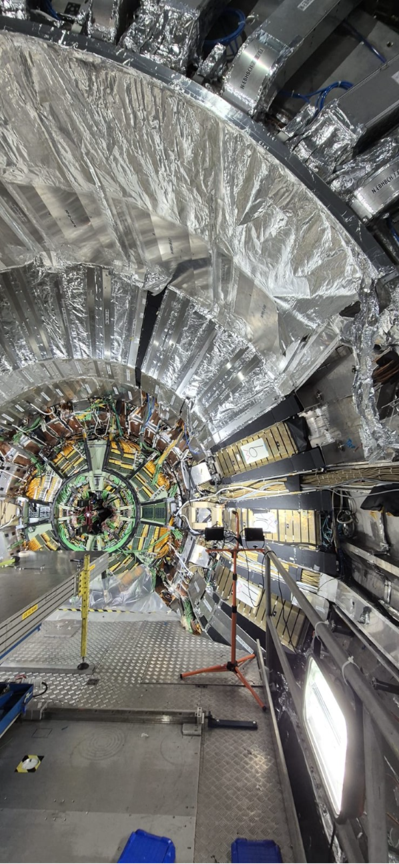
Scientists and engineers recently extracted the pixel detector from CMS near Geneva, Switzerland. The removal marks an early milestone of Long Shutdown 3, or LS3, when CERN's accelerator and experiments are being upgraded for the High-Luminosity LHC (HL-LHC). The HL-LHC operations are set to restart in 2030, aiming to collect approximately 10x more data than collected so far.
Purdue researchers helped construct, operate, and use the tracking system now being removed. They are also helping lead to its decommissioning and building components for its successor.
Removing a Detector Built to Last
Sushrut Karmarkar, a research engineer at Purdue, is a convener of Work Package 2 for the CMS Tracker decommissioning effort. He helps coordinate the removal of services inside the tracking detector, where access is limited, and cables, cooling lines, support structures and detector systems must be disconnected in a carefully controlled sequence.
Decommissioning is not simply construction in reverse. Components have operated for years in a radiation environment, and each step must protect personnel and neighboring detector systems while preserving access for the work that follows.
“Decommissioning the tracker is much more than simply reversing the installation process,” Karmarkar said. “Every step requires careful planning because we're working around sensitive detector components, complex services, and very limited space. Our experience designing and integrating these systems helps us understand how to dismantle them safely and prepare CMS for its next major upgrade.” The work draws on Purdue experience in lightweight composites, precision mechanics, and the integration of detector services. The same expertise now supports the design and construction of the upgraded CMS tracking system.
The Detector Comes Out and the Science Continues
Across its first three running periods, the LHC has delivered more than 500 inverse femtobarns (fb⁻¹) of proton-proton collisions to each of CMS and ATLAS. The resulting datasets will sustain years of physics analyses during LS3, while the detectors are upgraded for the 2030 restart. Giulia Negro, a postdoctoral researcher in the Jung group, serves as CMS Run Coordinator during the completion of data taking and helped oversee operation of the full detector.
“Operating a detector as complex as CMS requires hundreds of people working together to ensure that every subsystem performs reliably and that we collect the highest-quality data possible,” Negro said. “As Run Coordinator, it has been particularly exciting to help lead CMS through the final stages of Run 3. The enormous data set we collected will continue to drive discoveries for years to come, from exploring the quantum nature of top quarks and the Higgs boson’s self-coupling to studying bottom-quark systems in vast samples of top-quark events and searching for new heavy particles beyond the Standard Model at highest scales.”
For Andreas Jung, professor of physics and astronomy at Purdue University, the dataset offers a new opportunity to study the quantum behavior of the top quark, the heaviest known elementary particle. Top quarks decay before they can hadronize, allowing information about their spin to survive in their decay products.
CMS has already observed quantum entanglement between top quarks at the discovery significance of 5.1 standard deviations. The Purdue-led analysis reconstructed quantum correlations between the top quark and top antiquark from their decay products and established entanglement at the highest energies yet studied experimentally. The result was published by the CMS Collaboration in Reports on Progress in Physics in 2024.
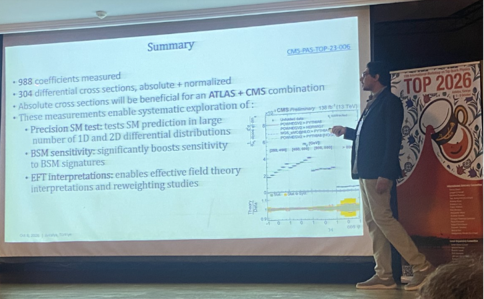
A new CMS study was released in October 2026 and presented by Osama Dawood, a graduate student in the Jung group, for the first time at the major top quark conference: 19th TOP26. The result provides a more comprehensive picture of the quantum spin state of top-quark pairs. Using all of the Run 2 data set CMS measured all 15 independent quantities needed to characterize the pair’s spin state and mapped how those quantities change with the particles’ energy and production angle – allowing for insights in preparation for the even larger Run 3 data set. This vast Run 3 data sample will allow researchers to move beyond establishing that entanglement exists. They can reconstruct finer details of the two-particle quantum state through quantum tomography and examine how it changes across phase space. “The observation of entanglement was an important milestone, but it is the starting point,” Jung said. “The Run 3 dataset gives us the statistical power to reconstruct the top-quark pair's quantum state more completely and to test quantum mechanics in an energy regime that cannot be reproduced anywhere else.”
Recently, Jung’s group has developed a novel approach using quantum steering ellipsoids, geometric shapes that describe what measuring one particle can reveal about the other. The work, submitted to PRX Quantum, provides a framework for interpreting spin measurements and substantially improves the discovery reach for physics beyond the Standard Model. “The geometry turns complex spin information into patterns we can study,” Jack Li (Postdoc in the Jung group) said “Different interactions can distort the ellipsoid in different ways. Understanding those changes gives us another way to look for physics beyond our current theory.”
The same high precision tracking data also allows the Purdue HEP group to study details of the Higgs bosons, electroweak interactions and searches for new particles. The capabilities of the silicon tracking devices are crucial for identifying bottom quarks, reconstructing top-quark decays, measuring Higgs-boson processes, and performing precision electroweak measurements. In other words, the detector hardware deep inside CMS ultimately underpins physics analyses spanning much of Purdue's particle physics program.
Recently, Norbert Neumeister, professor of physics and astronomy at Purdue University, and his group, working with collaborators in Brussels, carried out of the most sensitive searches for new heavy particles that could reveal physics beyond the Standard Model [CMS Physics Analysis Summary]. The researchers searched for hypothetical particles that might decay into pairs of electrons or muons, leaving distinctive signals in the CMS detector. Such particles include heavier versions of the Z boson, known as Z′ bosons, and possible signatures of extra dimensions of space, offering clues to fundamental mysteries such as dark matter and the unification of forces. Among billions of collisions recorded between 2022 and 2025, CMS observed an extraordinary event containing two electrons with a combined mass of 5.2 TeV, the highest-mass dilepton event ever recorded by the experiment. Although no evidence for new particles emerged, the analysis established some of the world's strongest constraints on physics beyond the Standard Model, excluding hypothetical Z′ bosons lighter than 5.55 TeV in one benchmark model. “Every time we push to higher energies, we explore territory where new particles could be hiding,” Neumeister said. “Even when we find no new particle, we learn something important: we narrow down the possibilities for what physics beyond the Standard Model can look like.” The results demonstrate how the unprecedented Run 3 dataset extends the discovery reach of CMS and opens new opportunities for even more sensitive searches at the High-Luminosity LHC.
In the next decade, the High-Luminosity LHC will deliver far larger datasets, allowing physicists to search even more precisely for extremely rare signals that may still be hiding beyond today’s reach.
Building the fully upgraded CMS Tracker
The Purdue high energy physic group is already building parts of the detector that will replace the present tracker. The High-Luminosity LHC will produce many more simultaneous collisions and expose detectors to higher radiation levels, requiring a completely re-designed new tracking system.
The Purdue Silicon Detector Laboratory is assembling and testing silicon sensor modules for the Tracker Forward Pixel (TFPX) detector, a key component of the new CMS inner tracking system. These modules will help reconstruct particle trajectories close to the collision point, enabling precise measurements in the much denser collision environment and higher radiation levels expected at the upgraded LHC. In parallel, lead research engineer Ben Denos and Purdue's detector-mechanics team led by Jung design, manufacture and validate lightweight carbon-fiber structures for the new pixel detector and its services.
The structures must be stiff, dimensionally precise, and exceptionally light. Material inside a tracking detector can deflect particles and reduce the precision of the measurement. Purdue designs move through simulation, prototyping, composite manufacturing, and precision metrology before shipment to CERN.
“These are not components you can simply order from a manufacturer,” Denos, who serves as lead engineer on these projects, said. “We develop the designs, manufacturing processes, and quality controls needed to produce structures that are exceptionally lightweight, mechanically stable, and precise. Seeing those technologies move from prototypes in our laboratory to components of the upgraded CMS detector is particularly rewarding.”
For Jung, the transition shows the full cycle of experimental particle physics at Purdue. “We helped build and operate this detector, and we used its measurements to make discoveries,” he said. “Now our team is helping remove it while building critical structures for what comes next. Detector construction and scientific measurement are parts of the same program.”
The tracker leaving CMS may have recorded its final collision, but its data will continue to fuel scientific discoveries throughout the shutdown and beyond. When the High-Luminosity LHC begins operation in 2030, a new generation of Purdue-built detector technology will again sit close to the collision point, ready to capture an unprecedented number of proton-proton collisions. Across Runs 4 and 5, extending into the early 2040s, CMS expects to collect roughly ten times more data than before, opening new opportunities to explore fundamental physics with unprecedented precision. Alongside building and upgrading detector components, Purdue researchers are preparing the advanced computing, software, and analysis methods needed to process these enormous datasets and turn them into the discoveries of tomorrow.
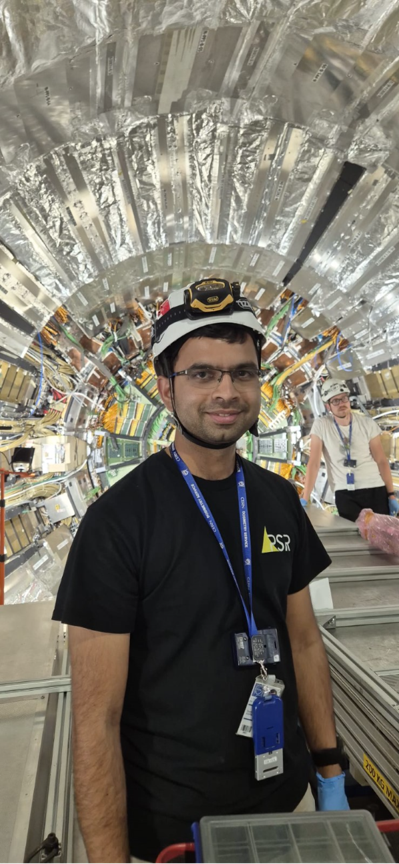
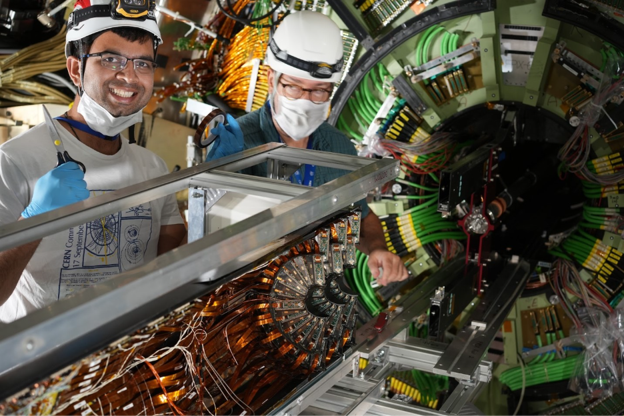
Karmarkar preparing to extract the Silicon Pixel detector system of CMS.
About the Department of Physics and Astronomy at Purdue University
Purdue’s Department of Physics and Astronomy has a rich and long history dating back to 1904. Our faculty and students are exploring nature at all length scales, from the subatomic to the macroscopic and everything in between. With an excellent and diverse community of faculty, postdocs and students who are pushing new scientific frontiers, we offer a dynamic learning environment, an inclusive research community and an engaging network of scholars.
Physics and Astronomy is one of the seven departments within the Purdue University College of Science. World-class research is performed in astrophysics, atomic and molecular optics, accelerator mass spectrometry, biophysics, condensed matter physics, quantum information science, and particle and nuclear physics. Our state-of-the-art facilities are in the Physics Building, but our researchers also engage in interdisciplinary work at Discovery Park District at Purdue, particularly the Birck Nanotechnology Center and the Bindley Bioscience Center. We also participate in global research including at the Large Hadron Collider at CERN, many national laboratories (such as Argonne National Laboratory, Brookhaven National Laboratory, Fermilab, Oak Ridge National Laboratory, the Stanford Linear Accelerator, etc.), the James Webb Space Telescope, and several observatories around the world.
Contributors:
Andreas Jung, professor of physics and astronomy at Purdue University
Norbert Neumeister, professor of physics and astronomy at Purdue University
Composite Manufacturing & Simulation Center (CMSC)
Photos provided by Andreas Jung