Purdue theorists show why quantum "colliders" can fool scientists and how to fix it
2026-04-10
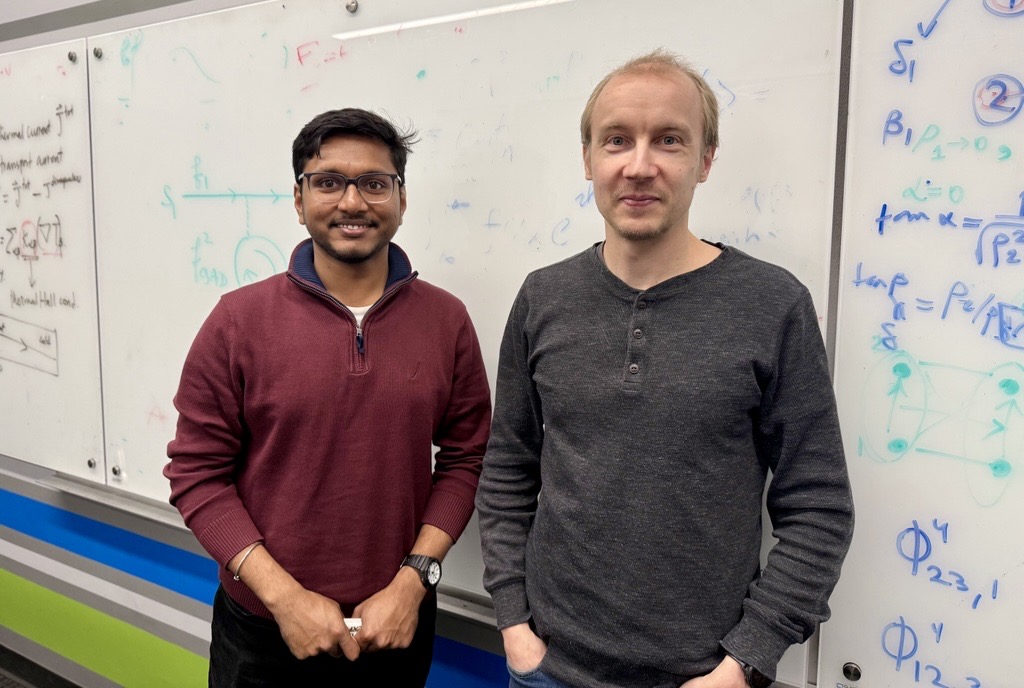
Sai Satyam Samal and Jukka I. Väyrynen. (Photo credit/David Siple)
In the quantum world, smashing two identical particles together is one of the cleanest ways to reveal what kind of particles they really are. But a new theoretical study shows that a key experimental tool used for these tests can quietly introduce "false positives," making fermions appear to behave like bosons. The researchers also outline a practical way to separate real quantum-statistics signals from misleading interference.
The work, led by Sai Satyam Samal, a graduate student in Purdue University's Department of Physics and Astronomy, and Jukka I. Väyrynen, assistant professor of physics and astronomy, was published in Physical Review Letters as “Quantum statistics and self-interference in extended colliders.”
Particles fall into families with fundamentally different rules. In everyday three-dimensional space, most quantum particles are either bosons, which can pile into the same quantum state, or fermions, which cannot.
As Samal explains, “Our world is (3+1)-dimensional (three spatial dimensions and one time dimension) and is made up of particles that can be categorized as bosons or fermions. A characteristic property of bosons is that a given quantum state can be occupied by multiple bosons. In contrast, a single quantum state cannot be occupied by more than one fermion; this property of fermions is known as Pauli's exclusion principle.”
Those rules show up in how particles respond when you swap them. “As a result, exchanging two bosons spatially (by swapping their locations) does not modify their wave function,” says Samal. “However, the wave function for a pair of fermions gains an extra negative sign. This fundamental and characteristic property of any quantum particle is known as exchange statistics.”
But in ultra-thin, effectively two-dimensional systems, quantum physics allows something more exotic, anyons. These particles can pick up a “fractional” phase when exchanged, and they are a centerpiece of modern research into the fractional quantum Hall effect and future quantum computing concepts.
To probe a particle's exchange statistics, experimentalists often use mesoscopic “colliders” built from quantum point contacts in quantum Hall edge states. Those setups were frequently treated as ideal pointlike objects in theory.
The Purdue-led study tackles a practical reality: “When it comes to experiment, the colliders are rarely pointlike objects and can support a resonant level or multiple tunneling points,” Samal explains.
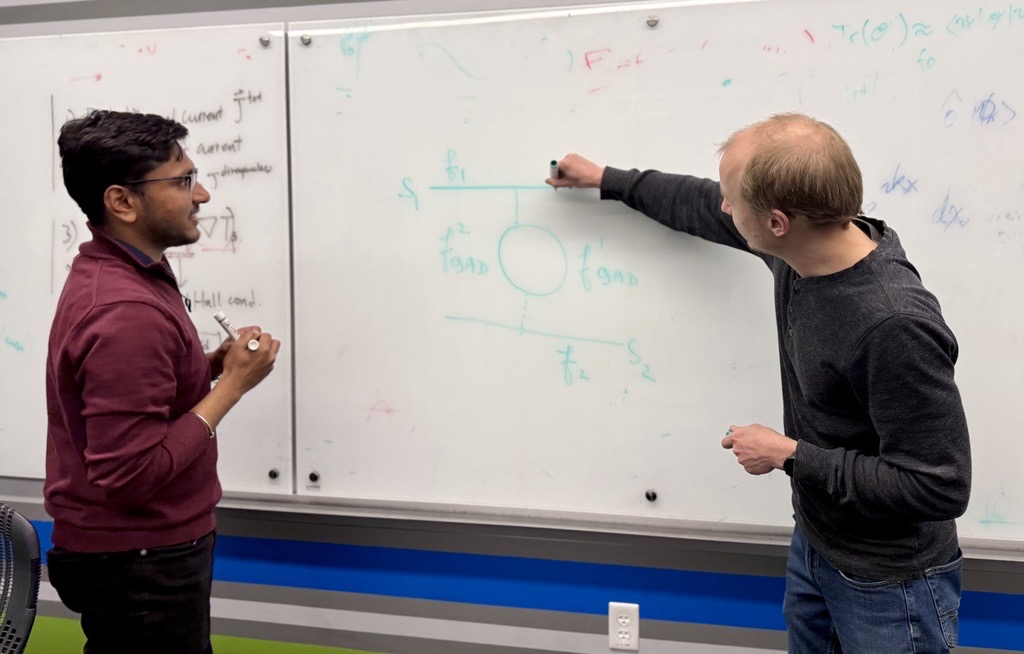
Sai (graduate student) and Prof. Jukka (Assistant Professor) discussing the physics of “extended” mesoscopic collider with incoming particles, in the Department of Physics and Astronomy at Purdue University. (Photo credit/David Siple)
That geometry matters because an extended collider allows many possible paths. A single particle can effectively interfere with itself, like light through a multi-slit experiment, and that can distort what scientists think they are measuring.
“Our work generalizes the mesoscopic collider setup by incorporating microscopic details of the collider and going beyond the idealized assumption of a point-like collider,” says Samal. “We introduce a paradigmatic model for an extended collider and study the scattering of bosons and fermions in this extended mesoscopic collider setup. We find that extracting exchange statistics in a non-point-like collider is not straightforward. Complications arise due to single-particle self-interference, which can sometimes produce misleading signatures of exchange statistics.”
In particular, the team shows how self-interference can create “apparent bunching” of fermions, a boson-like behavior that is not actually telling the truth about the particles' statistics.
The key contribution is a strategy for extracting the “true” statistics even when the collider is extended. As described in the team's abstract, the work identifies “an experimentally accessible current correlator, which reveals the true mutual statistics of fermions.”
Samal frames the motivation clearly, “This is an important step in understanding quantum statistics because, when studying anyons, we must ensure that we are not misled by false statistical signatures that can arise due to the non-point-like geometry of the mesoscopic collider. We must be 100% sure that the exchange statistics information we obtain is not distorted by any such self-interference contributions.”
At Purdue, the work was carried out by Samal and Väyrynen. “The project idea was conceived by Prof. Jukka I. Väyrynen and collaborators Prof. Yuval Gefen from the Weizmann Institute of Science in Israel and Prof. Smitha Vishveshwara from University of Illinois at Urbana-Champaign, and the calculations were carried out by Sai Satyam Samal. Through numerous discussions between Sai, Prof. Jukka and collaborators, the physical insights were extracted from mathematical derivations and equations. Prof. Yuval and Prof. Smitha also visited us here at Purdue which were very fruitful for our research work.”
Outside collaborators also helped steer the direction of the project through discussions and ideas.
Samal's broader research aims at building theory that experimentalists can actually use to probe the most subtle features of quantum Hall systems.
“My research area is understanding topological phases of matter. More specifically I am interested in probing topological order in quantum hall setups by theoretically proposing real and experimentally accessible platform for detecting the braiding statistics of particles in the system,” said Samal.
And while the work is motivated by potential quantum-information applications, the authors emphasize that this particular advance is a foundation-building step.
“Our work addresses a critical gap in quantum statistical detection by moving beyond the idealized point-like collider paradigm. Through analysis of single-particle self-interference effects on cross-current correlation functions, we propose a dual-benchmark scheme that effectively discriminates genuine quantum statistical signals from spurious self-interference contributions. Notably, the proposed methodology-particularly the irreducible correlation function approach and dual-benchmark strategy- offers a general framework for addressing multi-path interference effects that plague both topological and quantum statistical measurements,” says Samal.
About the Department of Physics and Astronomy at Purdue University
Purdue's Department of Physics and Astronomy has a rich and long history dating back to 1904. Our faculty and students are exploring nature at all length scales, from the subatomic to the macroscopic and everything in between. With an excellent and diverse community of faculty, postdocs and students who are pushing new scientific frontiers, we offer a dynamic learning environment, an inclusive research community and an engaging network of scholars.
Physics and Astronomy is one of the seven departments within the Purdue University College of Science. World-class research is performed in astrophysics, atomic and molecular optics, accelerator mass spectrometry, biophysics, condensed matter physics, quantum information science, and particle and nuclear physics. Our state-of-the-art facilities are in the Physics Building, but our researchers also engage in interdisciplinary work at Discovery Park District at Purdue, particularly the Birck Nanotechnology Center and the Bindley Bioscience Center. We also participate in global research including at the Large Hadron Collider at CERN, many national laboratories (such as Argonne National Laboratory, Brookhaven National Laboratory, Fermilab, Oak Ridge National Laboratory, the Stanford Linear Accelerator, etc.), the James Webb Space Telescope, and several observatories around the world.
Written by: David Siple, communications specialist, Purdue University Department of Physics and Astronomy
Contributors: Sai Samal, graduate student in physics and astronomy, Purdue University
Jukka I. Väyrynen, assistant professor of physics and astronomy, Purdue University