Purdue team explains the 'cosmic dandelion' left by a medieval supernova
2026-04-29
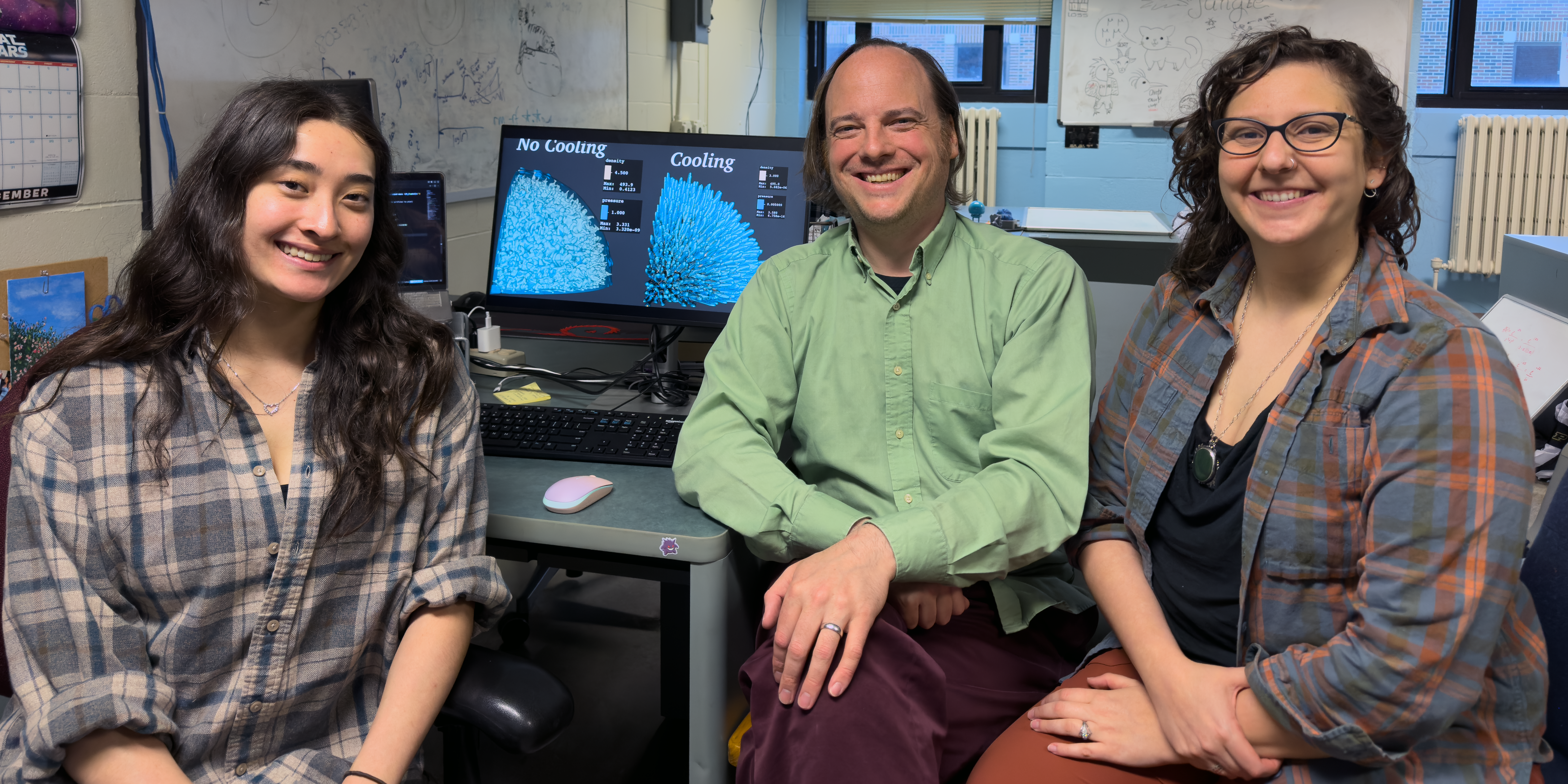
From left to right: Graduate student researcher Miranda Pikus, Professor Paul Duffell, Professor Abigail Polin. (Picture provided by/Paul Duffell)
More than 800 years after a bright "guest star" appeared in the sky, Purdue researchers say they may be closer to explaining one of its strangest leftovers. In a new study, the team modeled the unusual shape of Pa 30, a supernova remnant thought to be tied to the stellar explosion recorded in 1181. Instead of looking like a rough shell or a messy cloud of debris, Pa 30 appears as a nearly perfect burst of thin spikes radiating outward, a shape that has puzzled astronomers because it does not resemble any other known supernova remnant.
The work was led by Miranda Pikus, a graduate student in Purdue University's Department of Physics and Astronomy, with Paul Duffell, assistant professor of physics and astronomy, Abigail Polin, assistant professor of physics and astronomy, and Soham Mandal, a postdoctoral researcher at the University of Virginia and former Purdue graduate student. The paper was recently published in The Astrophysical Journal.
Pikus carried out the calculations, ran the code, developed diagnostics, interpreted the output and wrote the paper. Duffell supervised the project and developed an earlier version of the idea in two dimensions. Polin helped connect the theory to observations, and Mandal wrote the hydrodynamics code used for much of the work.
For astronomers, Pa 30 has become a captivating object because it seems to connect modern astrophysics with medieval skywatching. "The discovery of the Pa 30 nebula is very neat!" Pikus said. "In fact, supernovae are often referred to as 'visiting' or 'guest' stars in ancient texts since they appeared and vanished in the sky on timescales short enough for people observing just with their eyes and no telescopes."
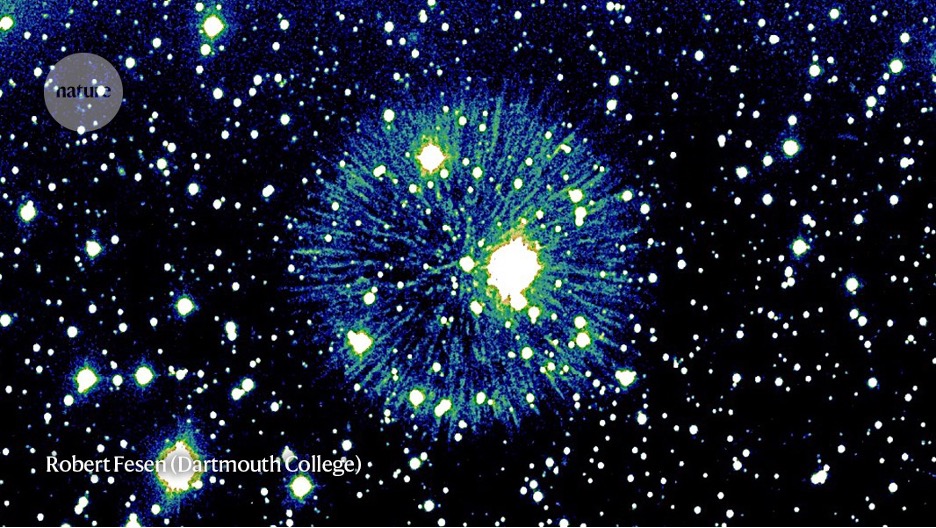
Researchers imaged Pa 30’s fireworks display using an optical filter that is sensitive to sulfur. (Photo Credit/Robert Fesen)
Over time, Pa 30 emerged as a stronger candidate for the remnant of that long-ago event, and follow-up observations revealed just how unusual it really is. Pikus said, "It had a structure that has never been seen before in any other known supernova remnant."
That structure is the heart of the mystery. Pa 30 is filled with long, narrow filaments that point radially away from the center, giving it the look of a dandelion, fireworks display or, as Pikus put it, a "spiky" ball. Duffell said, "When we look at this supernova today, the remnant exhibits a really strange shape, consisting of a sort of 'spiky' structure. Some people say it looks like a dandelion, others say it looks like a fireworks display. Either way, it doesn't look like anything astronomers have seen before."
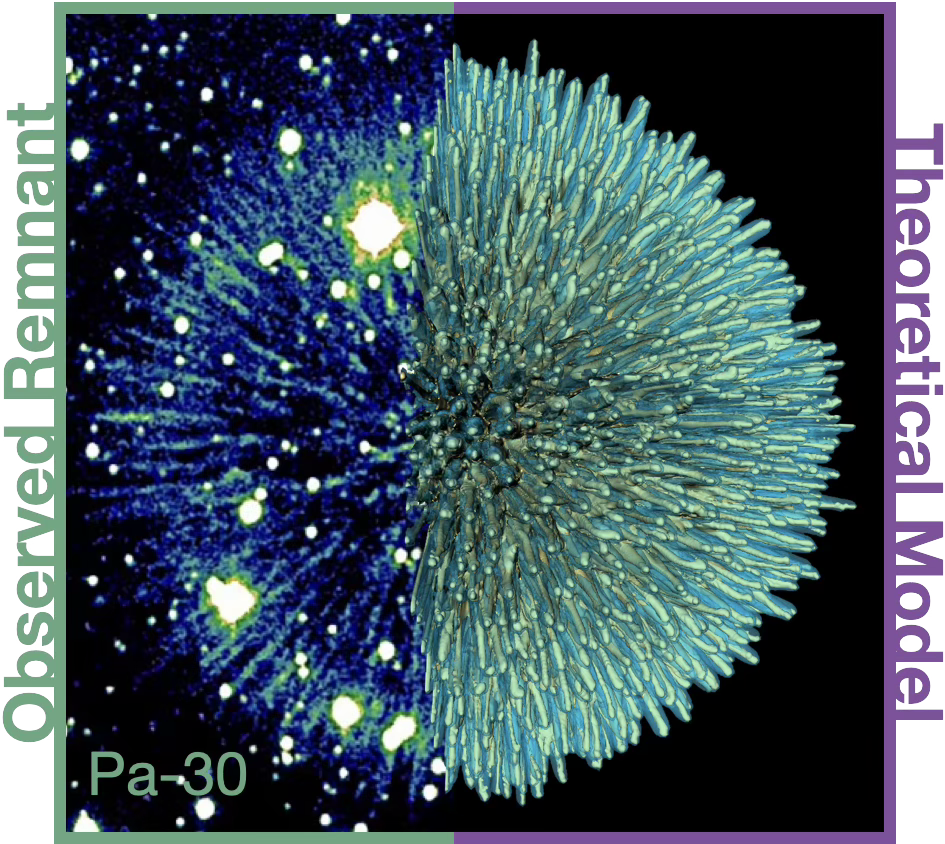
High-resolution image of Pa 30 on the left. Miranda’s 3D computer model representation of Pa 30 on the right. (Picture provided by/Paul Duffell)
To figure out why, the Purdue team treated Pa 30 not just as an astronomical object, but as a fluid dynamics problem. When the material blasted outward by a supernova slams into surrounding gas, instabilities form at the boundary between them. One instability can stretch matter into fingerlike protrusions, while another usually shreds and overturns those fingers, turning the whole structure into a more chaotic, turbulent mess.
In the new models, the researchers found that strong cooling changes that outcome. When enough thermal energy is radiated away quickly, the spikes stay narrow and ordered instead of being mixed away. In the paper, the team showed that once cooling becomes strong enough, the remnant begins producing the same kind of long, radial filaments seen in Pa 30, with material in those filaments still moving at about 95% to 100% of its free-expansion speed.
"Our group was trying to explain the unusual spiky shape of the supernova by looking at it as a fundamental fluid dynamics problem," Duffell said. "Sometimes the interface between two fluids can be unstable, which can cause one of the fluids to try to mix into the other fluid."
Pikus described the idea in more everyday terms: "Honestly, the same instability that happens when you pour cold creamer into your coffee and it makes these twisty and long tendrils as it gets mixed in (just on much, much larger scales)."
The project depended on high-resolution, three-dimensional simulations that followed the remnant as it expanded and collided with gas around it. Rather than manually placing spikes into the model, the team let the physics generate the structure on its own. "Miranda didn't tell the computer where to put the spikes or how many to put in, or how long they should be," Duffell said. "They were generated naturally by the fluid dynamics of the supernova colliding with the surrounding gas."
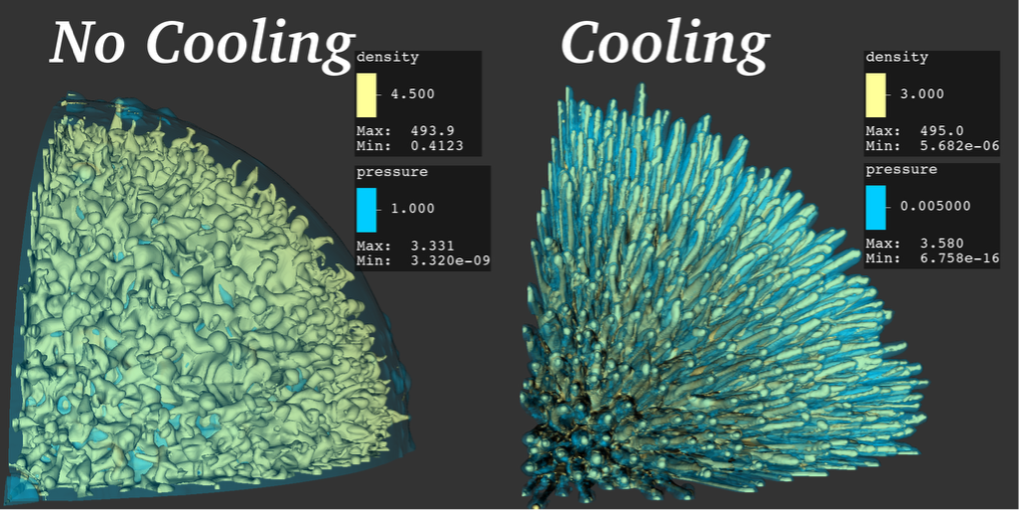
Three-dimensional visualization of the remnant structure for no cooling implemented and for our most rapid cooling with β = 800. Both models are at t = 0.1 tSedov. The yellow-colored iso-surface is a choice of density intended to target the shape of the ejecta, in units of ρCSM. Furthermore, the transparent blue-colored iso-surface represents the pressure near the forward shock displayed in units of P0. (Figure provided by/Miranda Pikus)
In the paper, the researchers describe this with a single cooling parameter that lets them test how quickly a remnant loses heat. Their best match for Pa 30 came in the rapid-cooling regime, where the modeled remnant naturally developed the same kind of elongated, highly ordered spikes and a strongly corrugated shock front.
That does not mean every question has been answered. In some ways, the researchers say, they have simply turned a large mystery into a smaller one. "We were able to reduce a major mystery ('why it looks like a dandelion') to a more minor mystery ('why is it cooling so fast')," Pikus said. "We still do not know what is creating this structure in Pa 30, but we have begun to narrow down possibilities." The study also makes predictions that future observations could test, helping astronomers determine whether rapid cooling is truly the main sculptor of the remnant's shape.
Duffell said his group uses fluid dynamics and powerful supercomputing at Purdue’s Rosen Center for Advanced Computing, which houses some of the best supercomputers in the world to tackle some of the biggest questions in astrophysics. "We run these codes on big supercomputers to perform simulations at very high resolution to learn and understand how these astrophysical systems behave," Duffell said.
For Duffell, that broader purpose matters as much as the technical details. "Really, when it comes down to it, the only true purpose of astrophysics is so that humanity can better understand how the universe works," he said. "We turn big philosophical questions into physics problems that we can actually solve on a computer." And for Pikus, Pa 30 still has one more lesson to offer: because it is so close to Earth in galactic terms, she said, "This suggests that events like Pa 30 are more common than we think."
About the Department of Physics and Astronomy at Purdue University
Purdue's Department of Physics and Astronomy has a rich and long history dating back to 1904. Our faculty and students are exploring nature at all length scales, from the subatomic to the macroscopic and everything in between. With an excellent and diverse community of faculty, postdocs and students who are pushing new scientific frontiers, we offer a dynamic learning environment, an inclusive research community and an engaging network of scholars.
Physics and Astronomy is one of the seven departments within the Purdue University College of Science. World-class research is performed in astrophysics, atomic and molecular optics, accelerator mass spectrometry, biophysics, condensed matter physics, quantum information science, and particle and nuclear physics. Our state-of-the-art facilities are in the Physics Building, but our researchers also engage in interdisciplinary work at Discovery Park District at Purdue, particularly the Birck Nanotechnology Center and the Bindley Bioscience Center. We also participate in global research including at the Large Hadron Collider at CERN, many national laboratories (such as Argonne National Laboratory, Brookhaven National Laboratory, Fermilab, Oak Ridge National Laboratory, the Stanford Linear Accelerator, etc.), the James Webb Space Telescope, and several observatories around the world.
About the Rosen Center for Advanced Computing
The Rosen Center for Advanced Computing operates the centrally-maintained research computing resources at Purdue University, providing access to leading-edge computational and data storage systems as well as expertise and support to Purdue faculty, staff, and student researchers. The center also operates the Anvil supercomputer, an NSF-funded national HPC resource that provides advanced computing capabilities to researchers nationwide through the NSF’s ACCESS and NAIRR Pilot programs.
Written by: David Siple, communications specialist, Purdue University Department of Physics and Astronomy