Purdue study confirms stable anyon behavior at the edge of quantum matter
2026-04-30
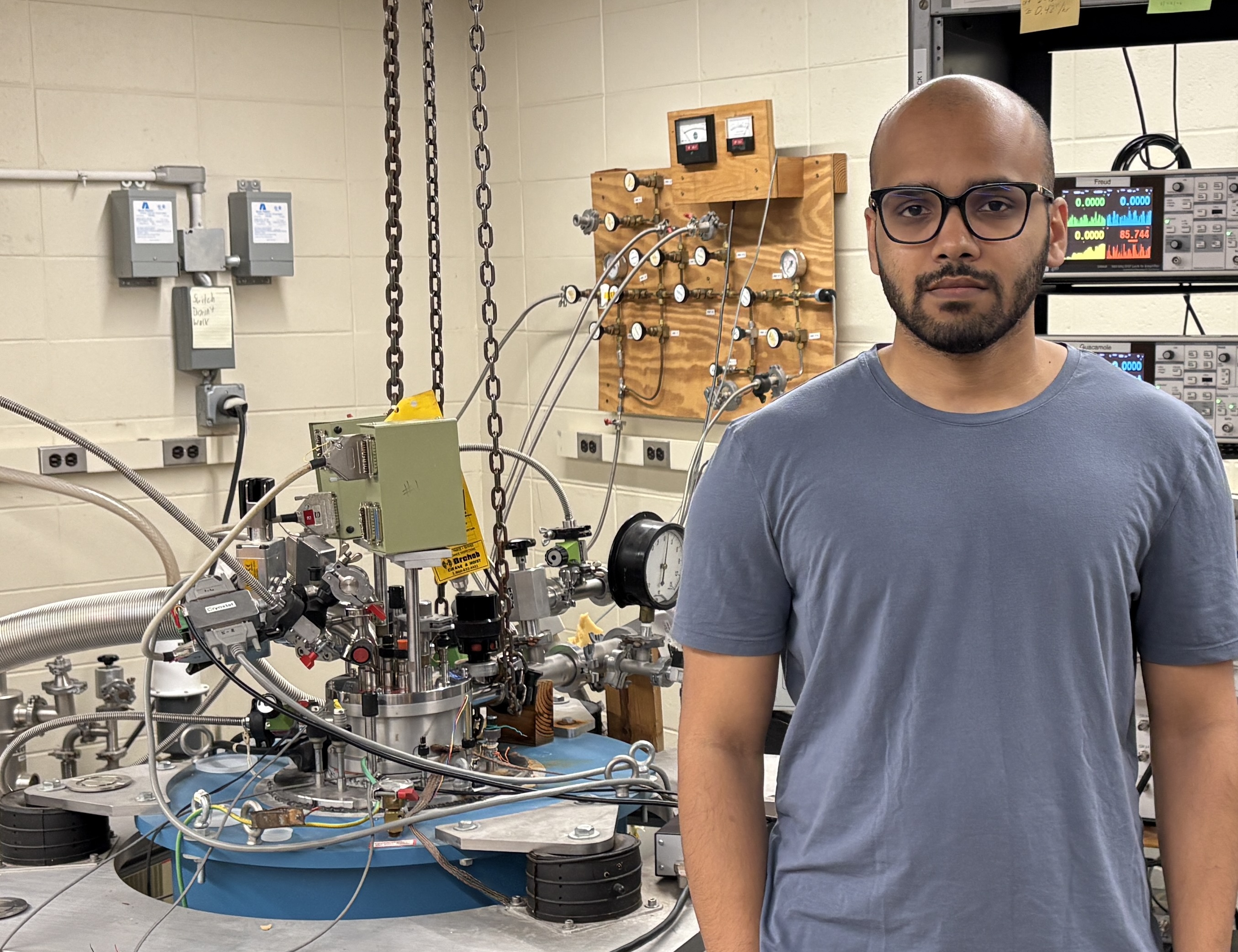
Adithya Suresh in front of the experimental station. (Photo provided by/ Adithya Suresh)
Researchers at Purdue University have shown that an unusual kind of quantum behavior stays remarkably stable even when experimental conditions change, giving physicists stronger evidence for a longstanding theory of how exotic quantum states behave at the edge of matter.
In a paper published in Physical Review Letters, the team reports that a key signature of anyon tunneling remains locked to its predicted value in the ν = 1/3 fractional quantum Hall state, even as transmission changes and weak disorder is introduced. The result gives scientists a more reliable way to identify topological order, the protected quantum organization underlying these states.
The research was carried out by a Purdue team that included PhD students Adithya Suresh and Ramon Guerrero, postdoctoral researchers Tanmay Maiti and Shuang Liang, and professors Claudio Chamon and Michael Manfra, with Geoffrey Gardner of Microsoft Quantum also contributing to the work. Suresh, Guerrero and Manfra designed the experiments; Liang and Manfra designed the heterostructure; Liang and Gardner conducted molecular beam epitaxy; Suresh performed the measurements; Chamon carried out the theoretical calculations; and the group analyzed the data together and wrote the paper collaboratively.
At the center of the study are anyons, unusual quasiparticles that appear only under very specific conditions. "Anyons are particles that can only exist in two-dimensional systems," said Adithya Suresh, who is the first author. "They carry fractional charge, fractional statistics and have exotic tunneling properties."
In this case, the team studied a two-dimensional gas of electrons in a gallium arsenide and aluminum gallium arsenide semiconductor structure placed in a strong magnetic field and cooled to extremely low temperatures, where the fractional quantum Hall effect can emerge.
In simple terms, quantum tunneling allows a particle to pass through an energy barrier that classical physics would normally forbid. The Purdue researchers focused on how anyons tunnel between edge modes, or narrow pathways that form along the boundary of the quantum Hall state.
To do that, they used a quantum point contact, a tiny constriction that brings those edge modes close enough together to interact. By measuring the tunneling conductance, the team found that the scaling exponent, essentially a mathematical fingerprint of the tunneling behavior, stayed pinned at 1/3 throughout the incompressible region of the n= 1/3 plateau and only changed when the bulk state became compressible.
This experiment is significant in the study of topological matter because for years experimental investigations of this topic did not always agree cleanly with theory. This paper addresses that problem by using an AlGaAs/GaAs heterostructure with sharp edge confinement, which the researchers say is crucial for observing the expected universal behavior. The study also showed that weak disorder in the device did not significantly alter the scaling exponent, strengthening the case that the observed tunneling behavior is
genuinely robust topological property rather than a fragile laboratory artifact.
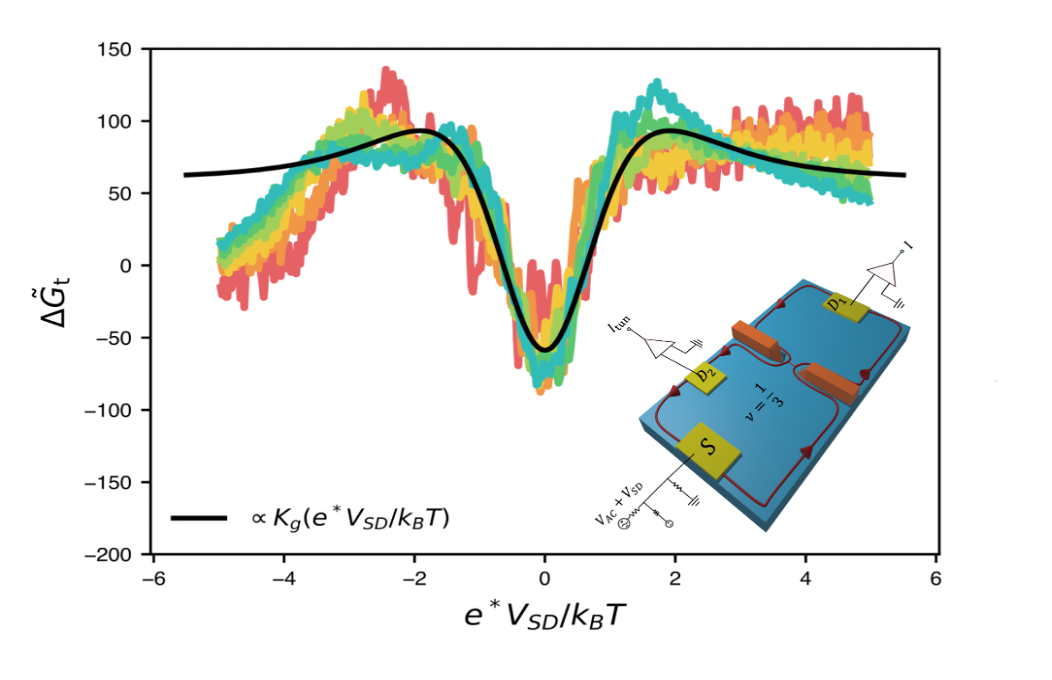
This figure shows the rescaled difference between the measured tunneling conductance and the lowest-order theoretical prediction. The collapse of the curves onto a single trend indicates that the deviations are captured by a universal next-order correction, strengthening evidence for robust anyon tunneling at n = 1/3. (Figure provided by/ Adithya Suresh)
"Our work demonstrates that the tunneling properties measured can be robustly described by chiral Luttinger liquid theory," said Suresh. That theory is the mathematical framework physicists use to describe how these edge states move and interact. The new measurements provide strong experimental backing for that framework and show that what happens at the edge of the system is intimately related to the topological order inside the bulk state.
The work highlights Purdue's full-stack quantum research support, from materials growth to nanofabrication, low-temperature measurements, and theory. "The Manfra Group at Purdue University is uniquely positioned to study anyons in the fractional quantum Hall effect," said Suresh. "Our group designs and grows the semiconductor heterostructure by molecular beam epitaxy. We make use of the cleanroom at the Birck Nanotechnology Center to fabricate the devices. Finally, we perform the measurements in the Physics building in one of our dilution refrigerators that operate at ultra-low temperatures." Professor Claudio Chamon performed the critical calculations necessary to compare experimental data with the predictions of chiral Luttinger liquid theory.
While the research is fundamental, it gives scientists a stronger experimental route for characterizing topological order in quantum Hall systems and for testing the exotic particles that continue to draw attention across quantum science and technology. The robustness suggests that edge tunneling experiments, when paired with sharp confinement and Fabry-Pérot interferometry, can serve as a powerful tool for probing the quantum order of the bulk state.
This research is sponsored by the U.S. Department of Energy Office of Science, Office of Basic Energy Sciences, under award No. DE-SC0020138 for the experimental work and No. DE-FG02-06ER46316 for theory.
About the Department of Physics and Astronomy at Purdue University
Purdue's Department of Physics and Astronomy has a rich and long history dating back to 1904. Our faculty and students are exploring nature at all length scales, from the subatomic to the macroscopic and everything in between. With an excellent and diverse community of faculty, postdocs and students who are pushing new scientific frontiers, we offer a dynamic learning environment, an inclusive research community and an engaging network of scholars.
Physics and Astronomy is one of the seven departments within the Purdue University College of Science. World-class research is performed in astrophysics, atomic and molecular optics, accelerator mass spectrometry, biophysics, condensed matter physics, quantum information science, and particle and nuclear physics. Our state-of-the-art facilities are in the Physics Building, but our researchers also engage in interdisciplinary work at Discovery Park District at Purdue, particularly the Birck Nanotechnology Center and the Bindley Bioscience Center. We also participate in global research including at the Large Hadron Collider at CERN, many national laboratories (such as Argonne National Laboratory, Brookhaven National Laboratory, Fermilab, Oak Ridge National Laboratory, the Stanford Linear Accelerator, etc.), the James Webb Space Telescope, and several observatories around the world.
Written by: David Siple, communications specialist, Purdue University Department of Physics and Astronomy