Purdue researchers find a clearer way to measure quantum entanglement
2026-09-29
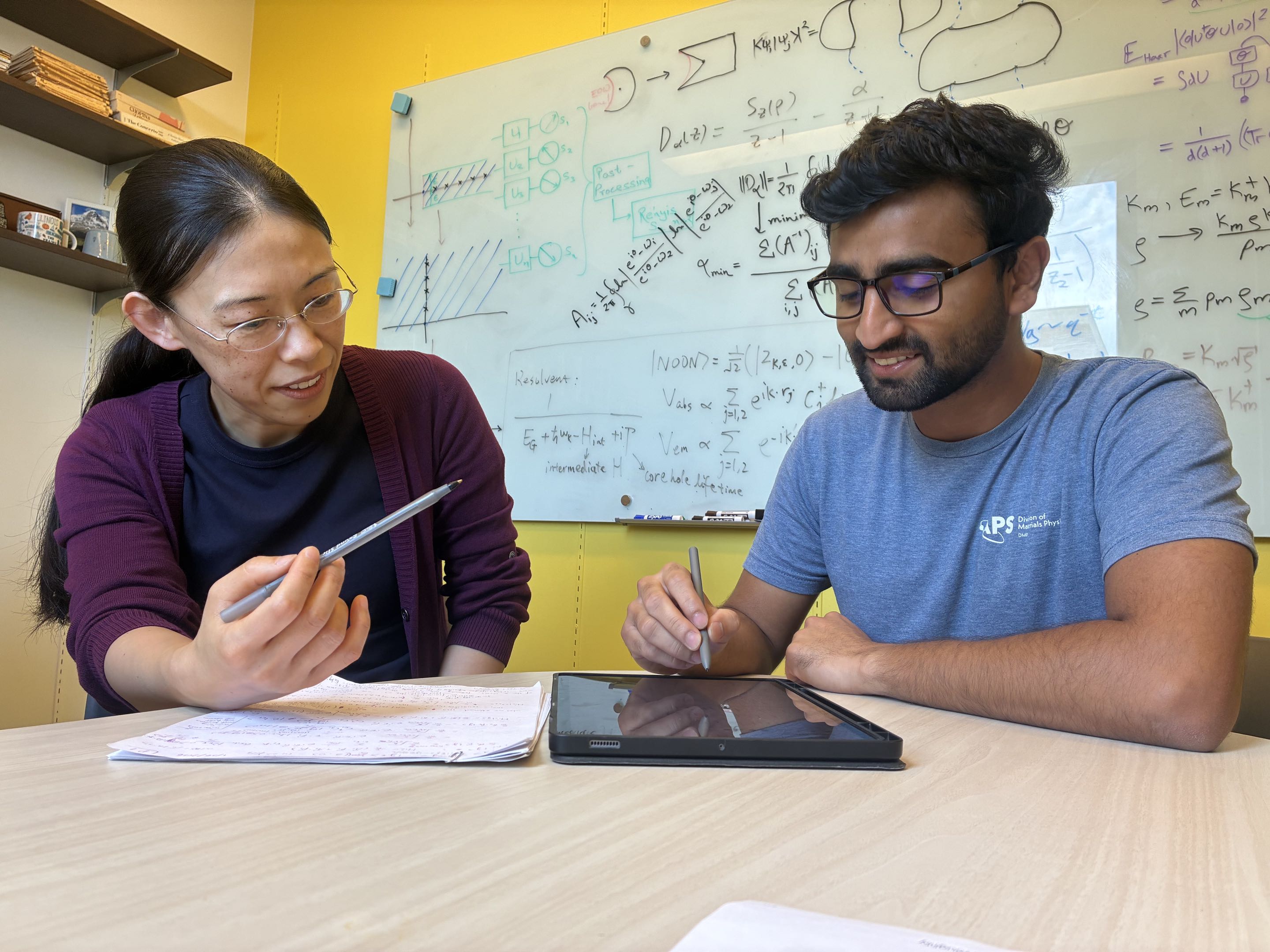
Purdue University Assistant Professor of Physics and Astronomy Laimei Nie, left, works with physics and astronomy graduate student Ayush Raj. (Photo Credit/Eric Schultz)
New approach could help scientists better characterize quantum devices and understand whether they are exhibiting useful quantum behavior
Quantum computers and simulators can produce enormous amounts of information, but extracting exactly what scientists want to know from a limited set of measurements is not always straightforward.
Purdue University physicists have developed a new method that can recover an important measure of quantum entanglement even when researchers have only a limited collection of noisy experimental data. The approach could give scientists a more practical way to characterize quantum devices and better understand the complicated many-particle systems at their core.
The research, led by Laimei Nie, assistant professor of physics and astronomy at Purdue, was recently published in Physical Review Letters. Purdue physics and astronomy graduate student Ayush Raj also played a leading role in the work. The study was conducted with Akash Vijay, Jonah Kudler-Flam, Benoît Vermersch and Andreas Elben.
Entanglement is one of the defining features of quantum mechanics. In an entangled system, particles cannot always be described independently of one another, even when scientists examine only part of the system. Understanding how much entanglement exists can reveal important information about how a quantum system behaves.
Measuring it directly, however, becomes extremely difficult as quantum systems grow more complex. "We found a new way to reliably estimate the amount of entanglement in quantum devices even when experiments provide only limited, noisy data," Nie said. "Entanglement is a key feature that separates the quantum world from the classical one, but it is notoriously hard to measure in many-particle systems."
Researchers can already obtain several indirect measures of entanglement through techniques known as randomized measurements. But one quantity physicists often want is the von Neumann entropy, a fundamental measure of how much entanglement exists within a quantum system. Randomized measurements generally do not provide that quantity directly.
Instead, scientists may only receive a handful of measured Rényi entropies, each carrying some degree of experimental uncertainty. Nie compares the problem of estimating von Neumann entropy from Rényi entropies to trying to determine the shape of a curve from only a few blurry points. "Many different curves might appear to fit those points, especially when the measurements contain noise, so a simple extrapolation can give an unreliable answer," Nie said. "Our method uses additional mathematical information about how the curve is allowed to behave, together with the uncertainty in each data point, to rule out implausible possibilities and identify a trustworthy estimate."
The researchers' approach, called stabilized analytic continuation, uses known mathematical constraints and incorporates uncertainty in the experimental measurements rather than simply fitting a curve through the available data.
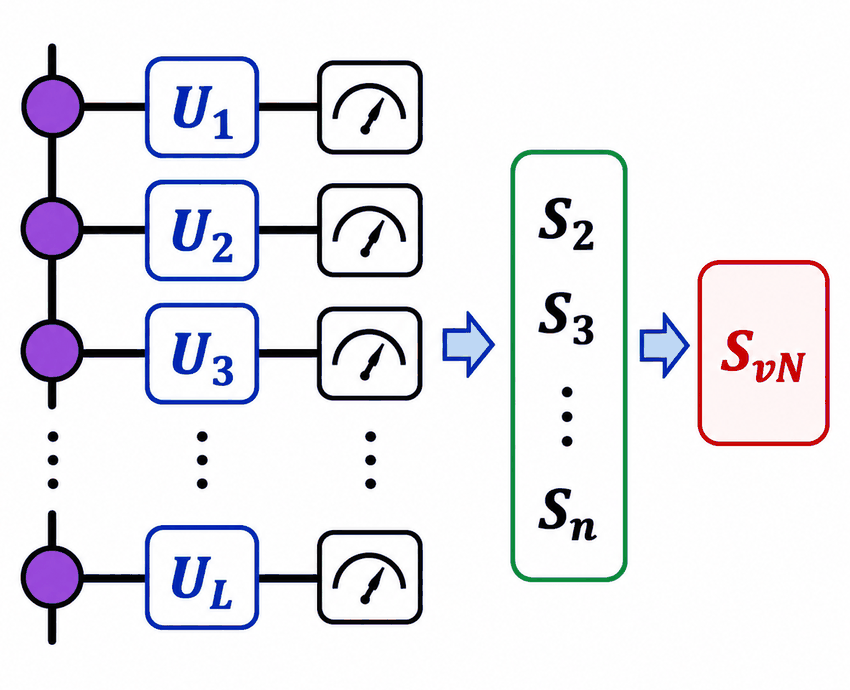
Using a novel analytic continuation method, researchers convert randomized-measurement data into robust estimates of von Neumann entanglement entropy on quantum devices. (Figure provided by/ Laimei Nie)
The team first tested the method using controlled numerical simulations. Raj conducted extensive tests using synthetic data and then helped apply the approach to experimental data from a real quantum simulator. Those tests were designed to determine whether the technique remained accurate when realistic noise was introduced.
The researchers then applied the method to previously collected data from a trapped-ion quantum simulator. That system contained 10 calcium ions, allowing the team to demonstrate the approach on measurements produced by an actual quantum experiment rather than relying only on idealized calculations. The study found that SAC produced stable estimates of von Neumann entropy while alternative extrapolation approaches were substantially more sensitive to noise.
Reliability is important for researchers working on quantum hardware development. "In the near term, our method could help researchers extract more useful and reliable information from existing quantum experiments without requiring a fundamentally new measurement protocol," Nie said. "In particular, it provides a practical way to estimate entanglement from limited, noisy measurements, which could improve how quantum devices are characterized."
The method may eventually extend well beyond this particular measurement. In their paper, the researchers note that the same mathematical framework could be adapted to other nonlinear, difficult-to-measure quantum diagnostics. They also suggest that similar analytic-continuation problems arise across other areas of physics.
Nie's broader research uses ideas from quantum information science to understand many-particle quantum systems, including quantum materials and synthetic quantum matter. She is particularly interested in how measurements of entanglement can reveal phenomena such as quantum chaos and thermalization and, ultimately, contribute to the development of quantum technologies.
The work also shows Purdue's growing quantum research community. Nie is a member of the Purdue Quantum Science and Engineering Institute, where her research focuses on quantum informatics and quantum materials.
"The Department of Physics and Astronomy at Purdue has a highly collaborative environment, with many faculty members working across different areas of quantum science," Nie said. "These interactions have been especially valuable for our research."
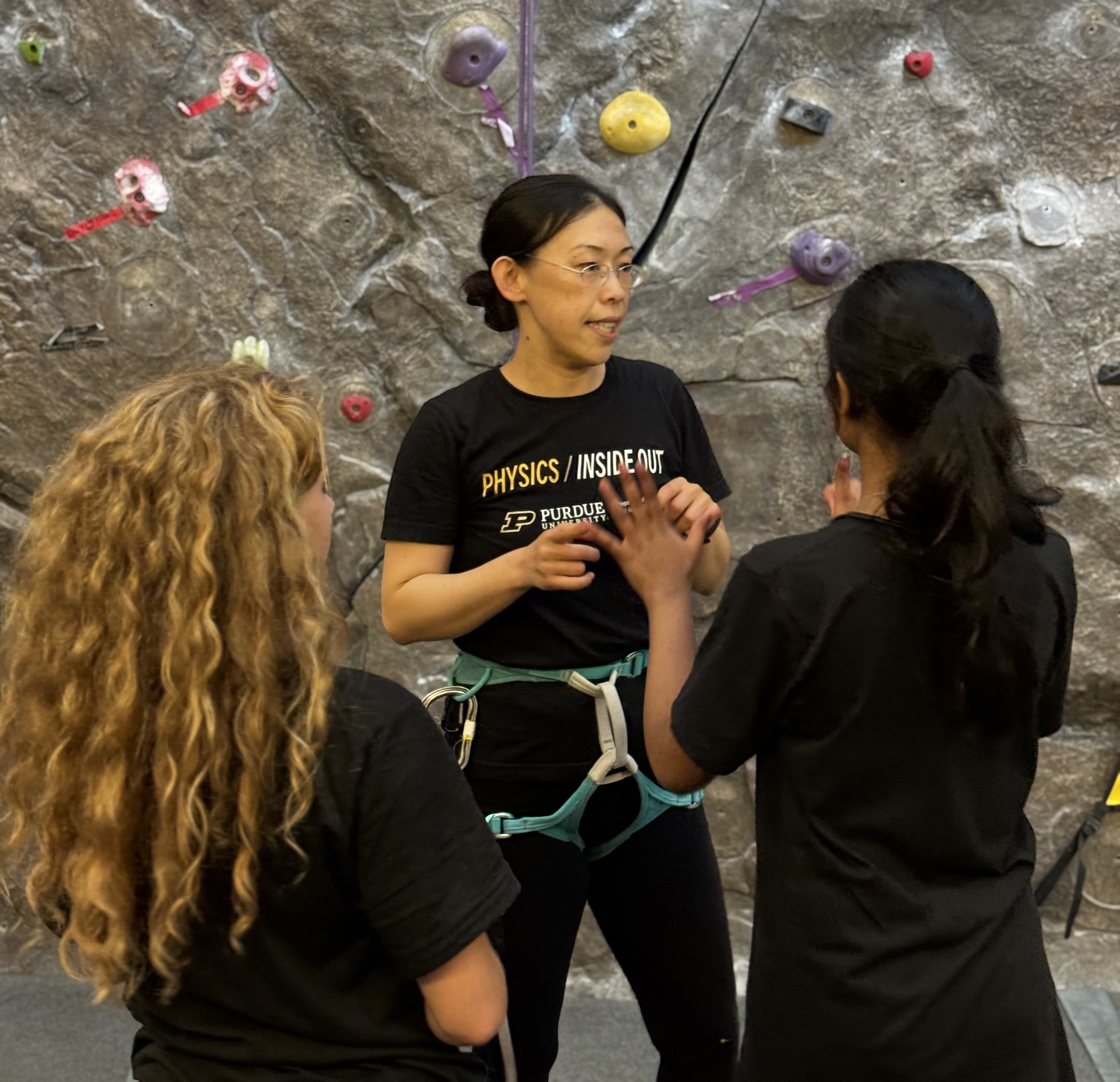

Purdue Assistant Professor of Physics and Astronomy Laimei Nie speaks with students during a Purdue Physics Inside Out outreach activity. In addition to her research, Nie is active in science outreach and education. (Photo credit/David Siple)
Conversations with experimental researchers helped the group better understand the limitations encountered on current quantum platforms, while theoretical physicists at Purdue provided feedback as the project developed. The team also used Purdue's high-performance computing resources through the Rosen Center for Advanced Computing for portions of its numerical calculations.
About the Department of Physics and Astronomy at Purdue University
Purdue's Department of Physics and Astronomy has a rich and long history dating back to 1904. Our faculty and students are exploring nature at all length scales, from the subatomic to the macroscopic and everything in between. With an excellent and diverse community of faculty, postdocs and students who are pushing new scientific frontiers, we offer a dynamic learning environment, an inclusive research community and an engaging network of scholars.
Physics and Astronomy is one of the seven departments within the Purdue University College of Science. World-class research is performed in astrophysics, atomic and molecular optics, accelerator mass spectrometry, biophysics, condensed matter physics, quantum information science, and particle and nuclear physics. Our state-of-the-art facilities are in the Physics Building, but our researchers also engage in interdisciplinary work at Discovery Park District at Purdue, particularly the Birck Nanotechnology Center and the Bindley Bioscience Center. We also participate in global research including at the Large Hadron Collider at CERN, many national laboratories (such as Argonne National Laboratory, Brookhaven National Laboratory, Fermilab, Oak Ridge National Laboratory, the Stanford Linear Accelerator, etc.), the James Webb Space Telescope, and several observatories around the world.
About the Rosen Center for Advanced Computing
The Rosen Center for Advanced Computing operates the centrally-maintained research computing resources at Purdue University, providing access to leading-edge computational and data storage systems as well as expertise and support to Purdue faculty, staff, and student researchers. The center also operates the Anvil supercomputer, an NSF-funded national HPC resource that provides advanced computing capabilities to researchers nationwide through the NSF’s ACCESS and NAIRR Pilot programs.
Written by: David Siple, communications specialist, Purdue University Department of Physics and Astronomy