Purdue physicists watch quantum matter lose and regain its coherence
2026-09-25
Experiments with ultracold atoms reveal how collective quantum order can survive beneath seemingly chaotic behavior
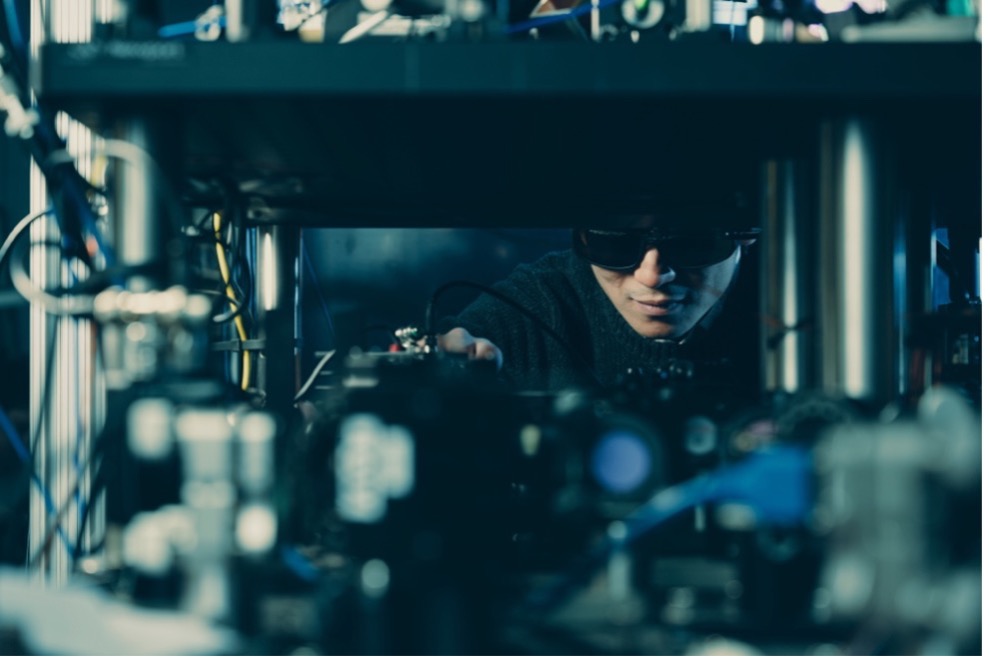
A collection of about 10,000 atoms, chilled to within billionths of a degree of absolute zero, has given Purdue University researchers a new look at what happens when order in a quantum system appears to fall apart, and how that order can return.
By confining ultracold atoms inside a narrow, laser-made channel and suddenly changing how the atoms interact, researchers watched waves ripple through the quantum gas, develop shockwave-like structures and gradually lose their long-range coherence. Then, when the interaction between the atoms was changed again, that coherence unexpectedly re-emerged.
The work, led by researchers in Purdue University's Department of Physics and Astronomy, was published in Nature Communications as "Direct observation of long-range many-body coherence in quasi-one-dimensional attractive Bose gases." The study provides an experimental look at how many interacting quantum particles behave far from equilibrium, an area that remains difficult to understand theoretically.
Chen-Lung Hung, professor of physics and astronomy at Purdue, conceived the experiment with Hikaru Tamura, who conducted the work as a Purdue postdoctoral researcher and is now a research assistant professor at the Institute for Molecular Science in Japan. Tamura designed and performed the experiment and analyzed the data. Purdue doctoral students Sambit Banerjee and Rongjie Li also participated in the experimental work.
"We studied a bizarre quantum wave-like behavior in merely 10,000 atoms, which were cooled to less than 10 billionth of a degree above absolute zero," Hung said. "We used lasers to confine these atoms to move along a narrow 'trench,' and suddenly made them attracted to each other."
At temperatures that low, atoms no longer behave simply as individual particles. They can act collectively as matter waves. Hung compares the experiment to watching water move through a narrow canal.
When the researchers suddenly changed the interactions between the atoms from repulsive to attractive, waves began moving inward from the edges of the atomic gas. The behavior resembles what physicists call a dam-break flow, producing dispersive shock waves that interact with small fluctuations already present in the gas. Under some conditions, sharp peaks can emerge that resemble Peregrine solitons, wave structures related mathematically to the rogue waves studied in oceanography.
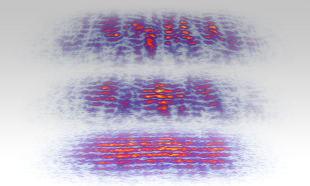
The team was especially interested in phase coherence. A measure of how well the atoms remain collectively organized as a quantum wave.
The researchers created two neighboring, quasi-one-dimensional atomic gases and allowed their matter waves to interfere. The resulting interference patterns let the team track how phase coherence changed as the system evolved. The experiment showed that coherence did not simply disappear steadily as the attractive gas became unstable. Instead, it changed in a more complicated way as shock waves competed with instability arising from density fluctuations.
Then came one of the study's most surprising findings. "Many-body phase coherence is fragile," Hung said. "When coherence fades away, it typically means the order between ultracold atoms is lost, for example, due to heating. When we observed that long-range phase coherence can be recovered when the interaction was changed back, it means that phase coherence wasn't really lost in the matter wave."
When the researchers changed the atoms back to repulsive interactions, phase jumps that had formed throughout the gas evolved into wave-like excitations known as phonons. Comparing experimental observations with simulations helped the team understand how that process allowed long-range order to reappear in the quasi-one-dimensional system.
The result offers a way of studying a broader question in quantum physics: When an organized system becomes disordered, how much of its original order has actually vanished? Hung said the findings could extend beyond ultracold atomic gases. Similar nonlinear wave behavior appears in plasma physics, nonlinear optics and even fiber-optic communications, while the observed rephasing could offer new insight into phase transitions and the emergence of long-range order in quantum many-body systems.
The experiments were made possible by specialized equipment and experimental capabilities developed in Hung's laboratory at Purdue over several years. Hung is a faculty member specialized in atomic, molecular, and optical physics in the Department of Physics and Astronomy. He is also affiliated with the Purdue Quantum Science and Engineering Institute and serves as a courtesy professor of Electrical and Computer Engineering.
Hung's laboratory uses laser-cooled atoms to investigate fundamental questions in many-body quantum physics and to simulate quantum phenomena that can be difficult to access through other experiments. The group also studies atoms interacting with nanophotonic waveguides, work with potential applications in quantum optics and quantum networks.
For Hung, the experiment shows that what looks like disorder may still contain information about the organized quantum state that came before it. "Perhaps the most surprising behavior was that even after a long time when the phase coherence gradually fades away, the order between atoms wasn't truly lost and we found a way to recover it," Hung said.
The Purdue funding portion of the research was supported in part by the National Science Foundation, Grant PHY-2409591; the W.M. Keck Foundation; the Department of Energy QuantISED program through the Fermilab Quantum Consortium; and the Air Force Office of Scientific Research, Grant FA9550-22-1-0327. Collaborators received additional support from the National Science Foundation, Simons Foundation and Army Research Office.
About the Department of Physics and Astronomy at Purdue University
Purdue's Department of Physics and Astronomy has a rich and long history dating back to 1904. Our faculty and students are exploring nature at all length scales, from the subatomic to the macroscopic and everything in between. With an excellent and diverse community of faculty, postdocs and students who are pushing new scientific frontiers, we offer a dynamic learning environment, an inclusive research community and an engaging network of scholars.
Physics and Astronomy is one of the seven departments within the Purdue University College of Science. World-class research is performed in astrophysics, atomic and molecular optics, accelerator mass spectrometry, biophysics, condensed matter physics, quantum information science, and particle and nuclear physics. Our state-of-the-art facilities are in the Physics Building, but our researchers also engage in interdisciplinary work across Purdue and at national and international research facilities.
Written by: David Siple, communications specialist, Purdue University Department of Physics and Astronomy
Contributors: Chen-Lung Hung, professor of physics and astronomy, Purdue University Department of Physics and Astronomy