Purdue physicists develop new tool to study exotic quantum behavior tied to future technologies
2026-02-20
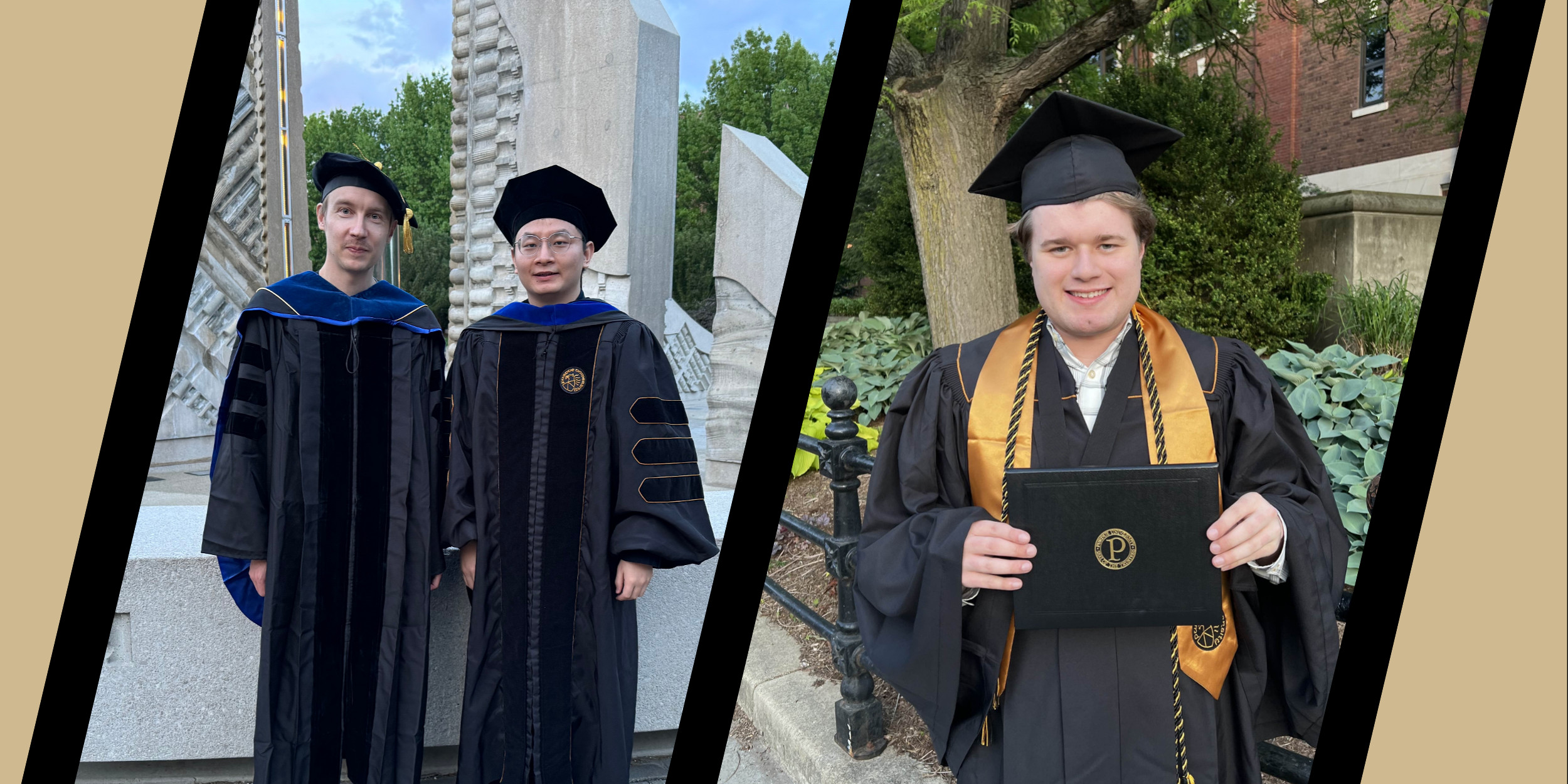
From left to right: Jukka Väyrynen, Guangjie Li, and Jordan Gaines. (Photos provided by/Jukka Väyrynen and Jordan Gaines)
When electrons interact, they can behave in ways that go beyond everyday experience intuition. Instead of acting as independent particles, they can move collectively, giving rise to surprising phenomena such as magnetism or superconductivity. Understanding how these collective behaviors emerge remains one of the most difficult problems in modern physics.
A new study led by Purdue University researchers tackles that challenge by introducing a powerful computational method to study a deceptively simple but deeply complex theoretical framework known as the multichannel Kondo model. The findings offer new insight into exotic quantum behavior that could one day inform quantum technologies.
“Interacting electrons can give rise to collective emergent behavior, such as magnetism or superconductivity,” said Jukka Väyrynen, assistant professor of physics and astronomy at Purdue University. “These behaviors are, in general, difficult to predict and the ‘many-body problem’ is one of the biggest open questions in physics.”
The work was published in Physical Review Letters and includes contributions from current and former Purdue students working across different stages of their careers.
The Kondo model, named after Japanese physicist Jun Kondo, is one of the most widely used theoretical tools for studying interacting electrons. It describes how electrons behave when they encounter a single magnetic impurity, such as an atom embedded in a metal.
“The Kondo model is one of the simplest theoretical models of interacting electrons,” Väyrynen said. “The model describes electrons that interact with a single magnetic impurity, but not with each other.”
Despite its simplicity, the model produces collective behavior that is difficult to calculate and predict. The Purdue team focused on an extension known as the multichannel Kondo model, in which several types of electrons compete to interact with the same impurity.
“A seemingly simple extension of the model is its ‘multichannel’ version, where now multiple ‘species’ or ‘flavors’ of electrons interact with the impurity, resulting in a competition to screen it,” Väyrynen said. That competition leads to unusual physics, including behavior that cannot be explained using standard theories of matter.
“This ‘multichannel Kondo model’ exhibits properties that hint at the existence of so-called anyonic excitations,” Väyrynen said. “These are emergent particles that behave in highly unusual ways.”
Anyons are neither fermions nor bosons, the two particle types familiar from everyday physics. Instead, they follow different quantum rules that make them of particular interest for researchers exploring fault-tolerant quantum computing.
“Purdue is at the forefront of both theoretical and experimental research into anyons,” Väyrynen said. “They might be used in future quantum computing technologies.”
While physicists have studied the multichannel Kondo model for decades, simulating it accurately has remained a major challenge. Existing numerical techniques worked for models with one or two channels, but extending them to more channels proved difficult.
“Our recent paper provides a new numerical technique to numerically simulate the multichannel Kondo problem,” Väyrynen said. “Previously, the same technique had been used for the two-channel version, but it was unclear how to generalize it to more channels.”
The research team overcame that obstacle by introducing a new concept known as an “image impurity,” a mathematical construct that allows the model to scale to additional channels.
“We introduced a new concept of an ‘image impurity’ that generalizes the method to any number of channels, and we demonstrated it for 3 and 4,” Väyrynen said. “The image impurity is somewhat similar to the concept of an image charge in electromagnetism.”
The project relied heavily on the work of Dr. Guangjie Li, now a postdoctoral researcher at the University of Utah, who completed much of the foundational analysis while he was a graduate student at Purdue under Väyrynen.
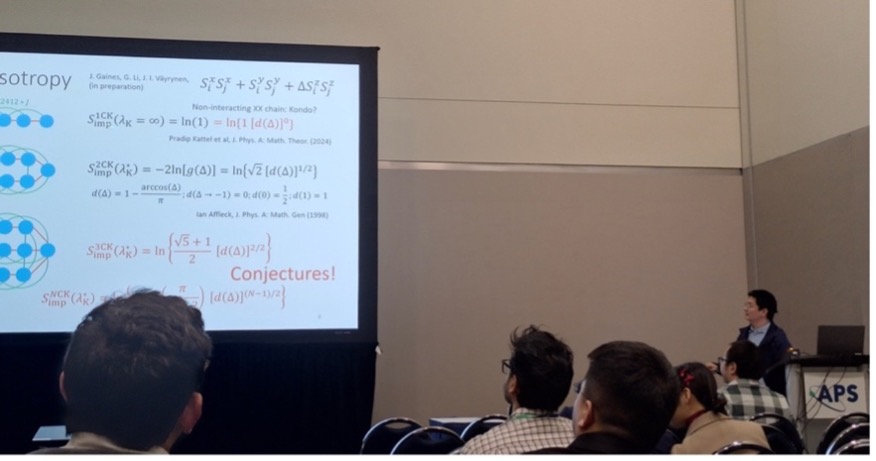
Dr. Guangjie Li is presenting preliminary results of this research at the 2025 March Meeting in Anaheim, California. (Photo provided by/Guangjie Li)
“In the spring of 2024, when I was at Purdue, I worked out the spin-chain three-channel Kondo model under Prof. Väyrynen’s supervision and through many helpful discussions,” Li said. “Later, I also studied the scaling behavior of the impurity spin-spin correlation functions and the impurity entropy.”
Jordan Gaines, now a doctoral student at the University of Maryland, College Park, began the project as an undergraduate researcher in Väyrynen’s group. He played a central role in developing the computational tools used in the study.
“I wrote the majority of the computer simulation code to study the multi-channel Kondo spin chain and collected most of the data used for our paper,” Gaines said. “The discussion and analysis of our final results was a collaborative effort.”
High-performance computing resources at Purdue were essential to completing the simulations, particularly during the early stages of the project. “At the early stages of the work, when Jordan was still at Purdue, we used high-performance computing resources from the Rosen Center (RCAC) at Purdue,” Väyrynen said.
“The Purdue computer cluster (specifically the Bell cluster) was essential to running many of our more performance-intensive simulations,” Gaines said.
The research also benefited from Purdue's broader collaborative environment, which supports undergraduate, graduate and faculty research across physics and quantum science. The team hopes the new method will enable physicists to explore previously inaccessible aspects of quantum matter and further clarify the connection between multichannel Kondo systems and anyons.
“We hope that this new method will enable theoretical physicists to study the properties of anyons in multichannel Kondo systems,” Väyrynen said. To encourage continued discovery, the researchers have made their simulation codes publicly available through Purdue's PURR data repository.
About the Department of Physics and Astronomy at Purdue University
Purdue's Department of Physics and Astronomy has a rich and long history dating back to 1904. Our faculty and students are exploring nature at all length scales, from the subatomic to the macroscopic and everything in between. With an excellent and diverse community of faculty, postdocs and students who are pushing new scientific frontiers, we offer a dynamic learning environment, an inclusive research community and an engaging network of scholars.
Physics and Astronomy is one of the seven departments within the Purdue University College of Science. World-class research is performed in astrophysics, atomic and molecular optics, accelerator mass spectrometry, biophysics, condensed matter physics, quantum information science, and particle and nuclear physics. Our state-of-the-art facilities are in the Physics Building, but our researchers also engage in interdisciplinary work at Discovery Park District at Purdue, particularly the Birck Nanotechnology Center and the Bindley Bioscience Center. We also participate in global research including at the Large Hadron Collider at CERN, many national laboratories (such as Argonne National Laboratory, Brookhaven National Laboratory, Fermilab, Oak Ridge National Laboratory, the Stanford Linear Accelerator, etc.), the James Webb Space Telescope, and several observatories around the world.
Contributors: Jukka Väyrynen, assistant professor of physics and astronomy at Purdue
Jordan Gaines, current physics PhD student at the University of Maryland, College Park; former undergraduate researcher in Prof. Vayrynen’s group at Purdue.
Guangjie Li, a postdoc at the University of Utah; former graduate student in Prof. Jukka Vayrynen’s group at Purdue
Written by: David Siple, communications specialist, Purdue University Department of Physics and Astronomy