Purdue physicist Mia Liu helps advance AI-powered chip design through DOE Genesis Mission
2026-10-16
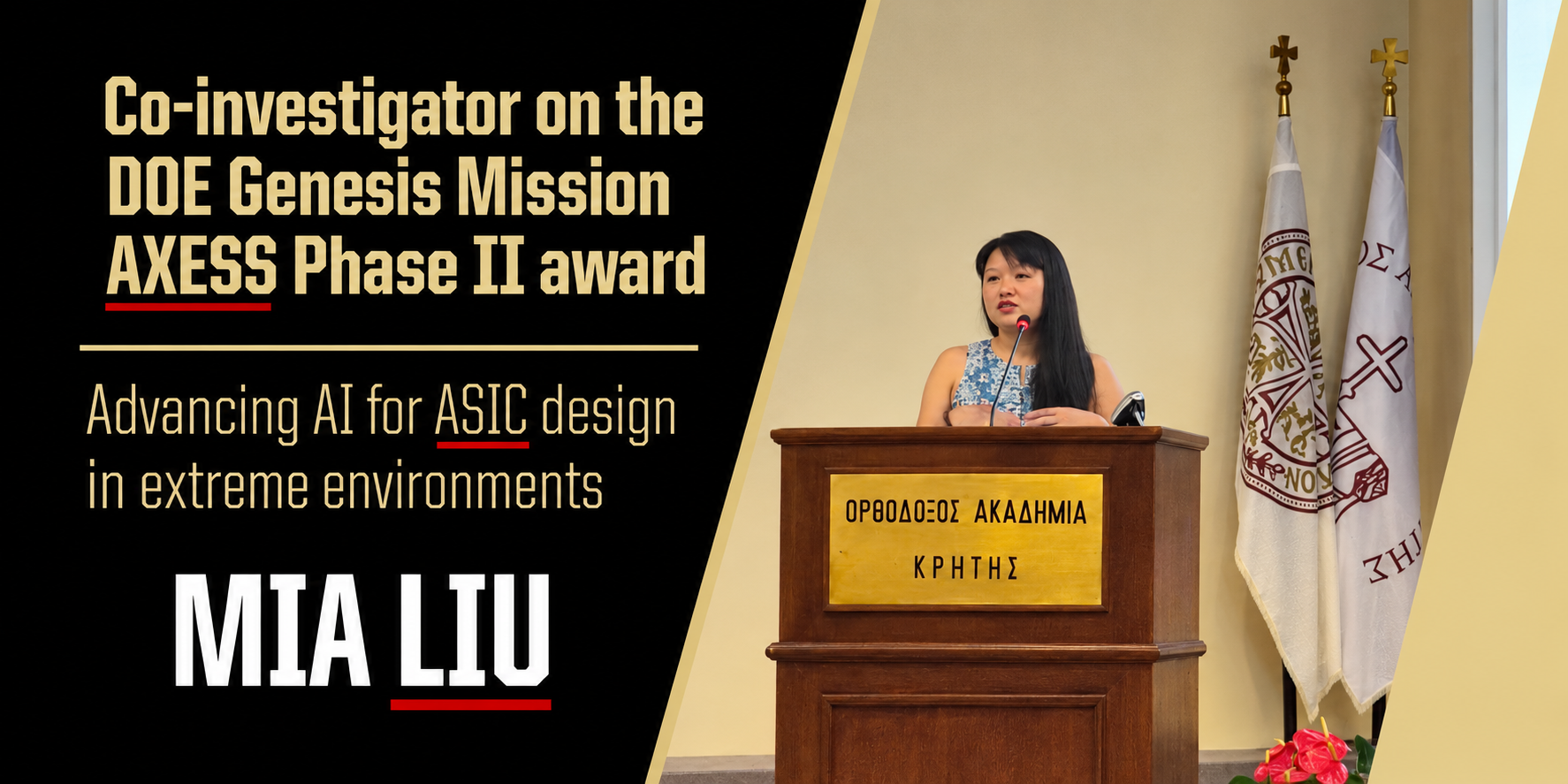
Mia Liu is presenting the surrogate model work at a Sixth MODE Workshop on Differentiable Programming for Experiment in Kolymbari, Crete, Greece. (Photo provided by/Mia Liu)
Purdue University physicist Mia Liu is helping develop artificial intelligence tools that could revolutionize how scientists design specialized computer chips used in particle physics experiments and quantum technologies.
Liu, a professor in Purdue's Department of Physics and Astronomy, is a co-investigator on Accelerating eXtreme Environment Specs-to-Silicon (AXESS), a project led by Fermi National Accelerator Laboratory (Fermilab) and selected for a Phase II award through the U.S. Department of Energy's Genesis Mission.
Working alongside doctoral student Arghya Ranjan Das, Liu is advancing research that uses AI to improve the design and efficiency of application-specific integrated circuits (ASICs). These specialized chips are essential for scientific instruments operating in extreme environments, including intense radiation and temperatures approaching absolute zero.
One area of this research is SmartPixel. This explores how small neural networks could process information directly within particle detectors. Ultimately helping scientists identify valuable collision data without overwhelming storage and transmission systems.
"SmartPixel opens a path to using detailed pixel information when deciding which collisions to record," Liu said. "That could help experiments preserve events valuable for discovery and enable finer, more precise detectors without a corresponding increase in the data they need to transmit."
Das has also led research developing AI models that can predict chip performance in milliseconds, potentially replacing design evaluations that traditionally take hours.
The AXESS project creates opportunities to apply these advances to new scientific instruments, including electronics used in quantum computing.
"The AXESS Phase II award gives us an opportunity to build on these studies and advance ASIC design for extreme environments," Liu said. "We want to shorten the path from a scientific measurement goal to the electronics needed to achieve it, including cryogenic chips that could support qubit readout."
Purdue University's Elmore Family School of Electrical and Computer Engineering (ECE) is also contributing to the AXESS collaboration. Learn more about the university's broader involvement in the ECE research team's feature. The project is supported by the U.S. Department of Energy's Genesis Mission.
About the Department of Physics and Astronomy at Purdue University
Purdue's Department of Physics and Astronomy has a rich and long history dating back to 1904. Our faculty and students are exploring nature at all length scales, from the subatomic to the macroscopic and everything in between. With an excellent and diverse community of faculty, postdocs and students who are pushing new scientific frontiers, we offer a dynamic learning environment, an inclusive research community and an engaging network of scholars.
Physics and Astronomy is one of the seven departments within the Purdue University College of Science. World-class research is performed in astrophysics, atomic and molecular optics, accelerator mass spectrometry, biophysics, condensed matter physics, quantum information science, and particle and nuclear physics. Our state-of-the-art facilities are in the Physics Building, but our researchers also engage in interdisciplinary work at Discovery Park District at Purdue, particularly the Birck Nanotechnology Center and the Bindley Bioscience Center. We also participate in global research including at the Large Hadron Collider at CERN, many national laboratories (such as Argonne National Laboratory, Brookhaven National Laboratory, Fermilab, Oak Ridge National Laboratory, the Stanford Linear Accelerator, etc.), the James Webb Space Telescope, and several observatories around the world.
Written by: David Siple, communications specialist, Purdue University Department of Physics and Astronomy