Purdue physicist earns NSF CAREER award to explore collective quantum behavior
2026-01-14
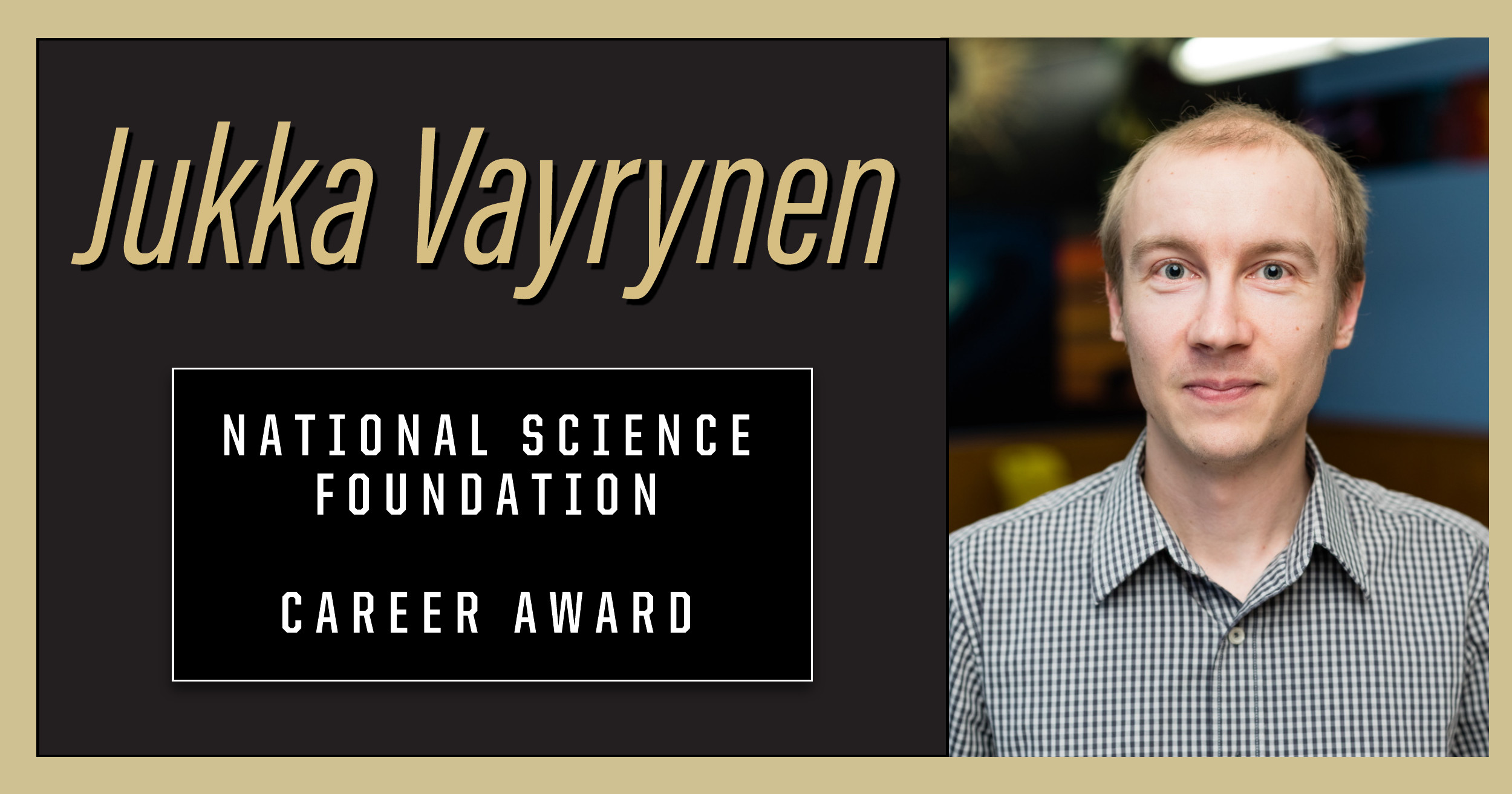
The National Science Foundation (NSF) has awarded Jukka Vayrynen, assistant professor of physics and astronomy at Purdue University, the NSF CAREER award. Vayrynen’s project, CAREER: Topological quantum devices as a window into strongly correlated matter, received a five-year grant from NSF, one of the nation’s most prestigious recognitions for faculty whose research and education efforts show exceptional promise.
The award will support theoretical work probing how electrons interact in quantum devices built from topological materials, a class of systems with unusual, quantum-governed properties that could one day underpin advanced technologies.
“I’m glad that NSF, advised by the community of my peers, is recognizing the fundamental theoretical research into topological quantum devices as important,” Vayrynen said. “The five-year duration of the award is longer than many typical grants, allowing me time to think deeply about the questions in the field.”
When electrical systems are cooled to just a few degrees above absolute zero, far colder than outer space, quantum effects dominate how electrical current flows. At those temperatures, tiny devices on the scale of a micrometer can exhibit behaviors that defy classical intuition. In topological materials, electron motion is expected to be insensitive to minute imperfections, giving researchers a unique laboratory for exploring collective phenomena.
“The Department of Physics and Astronomy at Purdue is at the forefront of this research frontier, which is also how my theoretical research fits into our department,” he said.
One of the intriguing questions Vayrynen hopes to tackle under the CAREER award centers on exotic quantum excitations called anyons. These quasi-particles emerge in certain topological materials and have also been observed in experiments at Purdue and elsewhere. Additionally, anyons have been theoretically predicted to emerge in certain quantum devices, but the connection between anyons in simple theoretical systems and those in real topological materials remains unclear. The answer to this question could play a role in future quantum technologies.
“For example, it has been shown theoretically that simple quantum devices that can be described by theoretical models called quantum impurity models can host fractionalized ‘anyonic’ excitations,” Vayrynen said. “It is unclear how these anyons are related to the ones that can be found in topological quantum materials, and this is a question I hope to be able to answer in the next five years.”
The award also supports student involvement. Funding will allow Vayrynen to hire a graduate student to work on the project, continuing a tradition of student-driven research in the group. Undergraduate students, particularly those with strong numerical and quantum mechanics skills, also will have opportunities to contribute to the work.
“All of our important past results on this field have been carried out by Purdue graduate students,” he said. “I want to also mention that the research provides opportunities for outstanding Purdue undergraduate students, especially those who are numerically-oriented and who know quantum mechanics. In the past, I’ve had good experiences even working with undergraduates majoring in computer science.”
The department's leadership praised the award as a recognition of both research quality and educational promise. “We are extremely proud of Jukka Vayrynen’s NSF CAREER award, which highlights the quality of the faculty we have recruited and the excellence they bring to our program,” said Gabor Csathy, professor and head of the Department of Physics and Astronomy. “This achievement strengthens our condensed matter group and reflects the high standards we uphold in the Department of Physics and Astronomy. The honor also underscores Professor Vayrynen’s exceptional potential as both a researcher and an educator, while reinforcing our commitment to advancing innovative, high-impact science that benefits the Purdue community and beyond.”
Vayrynen joined Purdue in August 2020 and is also affiliated with the Purdue Quantum Science and Engineering Institute (PQSEI). His work not only advances fundamental understanding of quantum materials but also lays the groundwork for future experimental tests and potential technological innovations rooted in quantum physics.
About the Department of Physics and Astronomy at Purdue University
Purdue's Department of Physics and Astronomy has a rich and long history dating back to 1904. Our faculty and students are exploring nature at all length scales, from the subatomic to the macroscopic and everything in between. With an excellent and diverse community of faculty, postdocs and students who are pushing new scientific frontiers, we offer a dynamic learning environment, an inclusive research community and an engaging network of scholars.
Physics and Astronomy is one of the seven departments within the Purdue University College of Science. World-class research is performed in astrophysics, atomic and molecular optics, accelerator mass spectrometry, biophysics, condensed matter physics, quantum information science, and particle and nuclear physics. Our state-of-the-art facilities are in the Physics Building, but our researchers also engage in interdisciplinary work at Discovery Park District at Purdue, particularly the Birck Nanotechnology Center and the Bindley Bioscience Center. We also participate in global research including at the Large Hadron Collider at CERN, many national laboratories (such as Argonne National Laboratory, Brookhaven National Laboratory, Fermilab, Oak Ridge National Laboratory, the Stanford Linear Accelerator, etc.), the James Webb Space Telescope, and several observatories around the world.
Contributors: Jukka Vayrynen, assistant professor of physics and astronomy at Purdue
Gabor Csathy, professor and head of the Department of Physics and Astronomy at Purdue
Written by: David Siple, communications specialist, Department of Physics and Astronomy at Purdue