Purdue physicist earns Air Force Young Investigator award for quantum optics research
2026-03-16
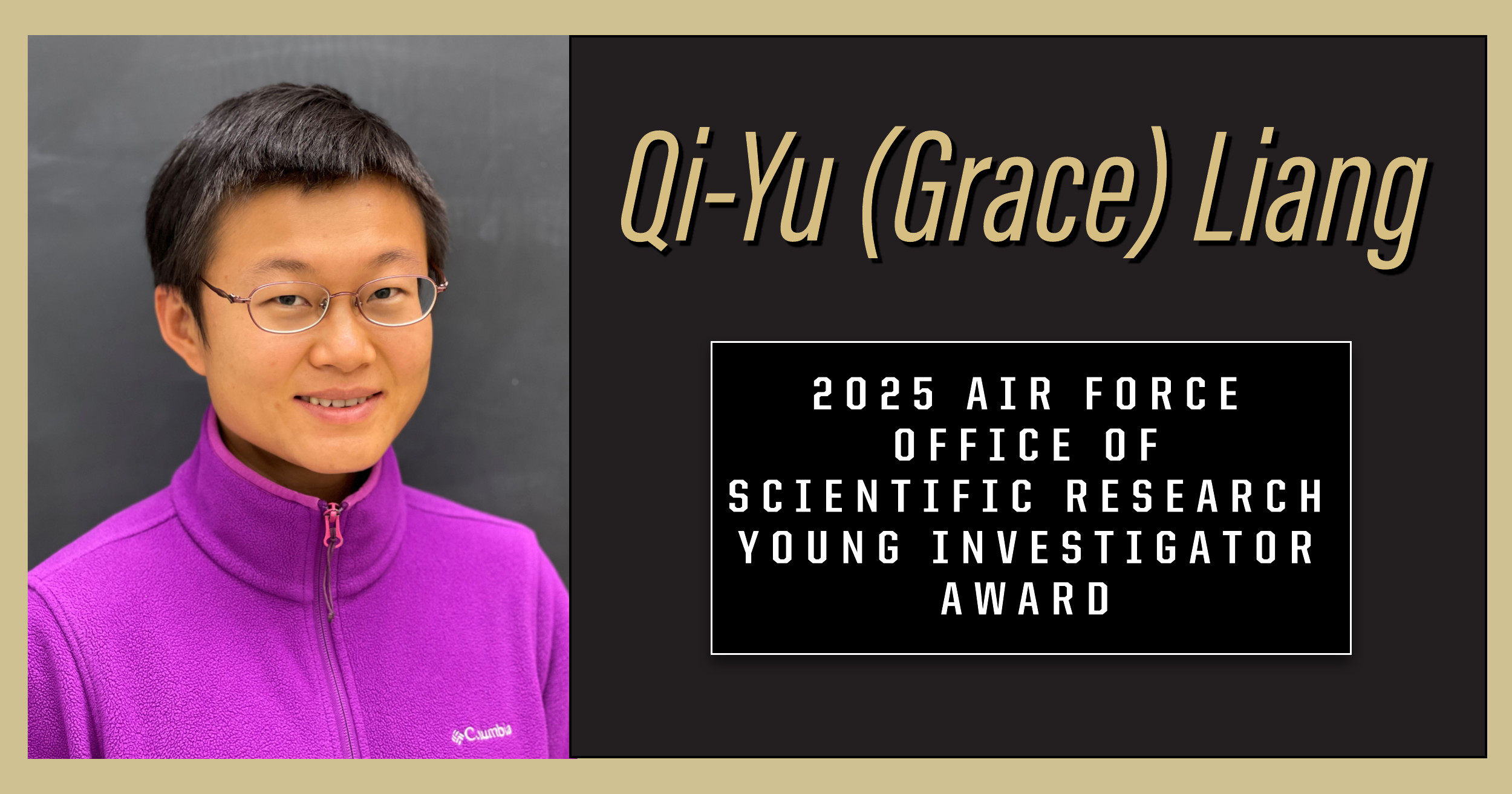
Qi-Yu “Grace” Liang, assistant professor of physics and astronomy at Purdue University, has received the 2025 Young Investigator Program award from the Air Force Office of Scientific Research for research that could expand how scientists observe and control quantum systems. According to the congratulatory notice sent to Liang, her proposal, “Quantum Optics with Rydberg Antiblockade,” was selected from more than 150 proposals.
The Air Force Young Investigator Program supports early-career scientists and engineers who show exceptional promise in basic research. The program is designed to foster creative research, support early-career development and connect investigators with Air Force and Space Force science and engineering challenges. Public program materials describe awards of up to $150,000 per year for three years, for a total of $450,000.
Liang's project focuses on Rydberg atoms, a powerful platform for building and studying quantum systems because they can be made to interact strongly with one another and with external fields. Her team aims to optically detect an underexplored interaction regime known as Rydberg antiblockade, which could give researchers a new way to probe strongly interacting quantum matter.
“We aim to optically detect an underexplored regime of interaction, known as Rydberg antiblockade,” Liang said. “Successful optical detection would establish a new measurement modality for strongly interacting Rydberg systems.”
She said that the breakthrough could help researchers move beyond static measurements and toward real-time observation of quantum behavior.
“With this funding, we hope to make it possible to ‘watch a movie’ of individual atoms as they interact,” Liang said. “We aim to provide a new probing method for addressing numerous perplexing phenomena. We expect to open new applications of Rydberg antiblockade in quantum optics, quantum simulation, quantum computing and quantum sensing.”
The work will be carried out using Liang's laser-cooled atomic ensemble system at Purdue. She said the research builds on ongoing efforts in her lab and in related theory work exploring how Rydberg antiblockade can be used in quantum information processing and sensing.
In broader terms, Liang's field is working to harness the unusual behavior of quantum systems for new technologies. Rydberg atoms are especially promising because they offer strong, tunable interactions in otherwise weakly interacting neutral-atom systems. Those properties have already helped establish atom arrays as a leading platform for quantum information processing and quantum simulation, while also opening new possibilities in quantum optics and sensing.
Liang said one of the most exciting frontiers is quantum sensing, where researchers are trying to make exquisitely sensitive measurements while better understanding the interactions that can also limit performance.
“This funding allows us to pursue research questions that are fundamentally intriguing from a physics perspective while also holding exciting possibilities for quantum technologies,” Liang said. “In my view, quantum sensing represents the most promising near-term pathway toward achieving practical quantum advantage.”
Liang is affiliated with the Purdue Quantum Science and Engineering Institute. She said support from Purdue has been critical in making the work possible. "Thanks to the institutional and departmental support, the students were able to construct the apparatus and carry out the proposed research. I feel lucky to work with such highly motivated students," Liang said.
Looking ahead, Liang said the long-term goal is to better understand and control Rydberg interactions so they can be used to improve quantum technologies and enable entirely new ones. “Understanding and ultimately controlling these interaction effects is therefore critical,” Liang said. “This work represents a first step toward the long-term goal of harnessing Rydberg interactions to enable new types of sensors, improve and mitigate limitations in existing sensing platforms, and expand the capabilities of quantum information processing.”
About the Department of Physics and Astronomy at Purdue University
Purdue's Department of Physics and Astronomy has a rich and long history dating back to 1904. Our faculty and students are exploring nature at all length scales, from the subatomic to the macroscopic and everything in between. With an excellent and diverse community of faculty, postdocs and students who are pushing new scientific frontiers, we offer a dynamic learning environment, an inclusive research community and an engaging network of scholars.
Physics and Astronomy is one of the seven departments within the Purdue University College of Science. World-class research is performed in astrophysics, atomic and molecular optics, accelerator mass spectrometry, biophysics, condensed matter physics, quantum information science, and particle and nuclear physics. Our state-of-the-art facilities are in the Physics Building, but our researchers also engage in interdisciplinary work at Discovery Park District at Purdue, particularly the Birck Nanotechnology Center and the Bindley Bioscience Center. We also participate in global research including at the Large Hadron Collider at CERN, many national laboratories (such as Argonne National Laboratory, Brookhaven National Laboratory, Fermilab, Oak Ridge National Laboratory, the Stanford Linear Accelerator, etc.), the James Webb Space Telescope, and several observatories around the world.
Written by: David Siple, communications specialist, Purdue University Department of Physics and Astronomy
Contributor: Qiyu (Grace) Liang, assistant professor, Purdue University Department of Physics and Astronomy