Purdue-led team watches a “frictionless” quantum fluid freeze into a solid-like state
2026-03-06
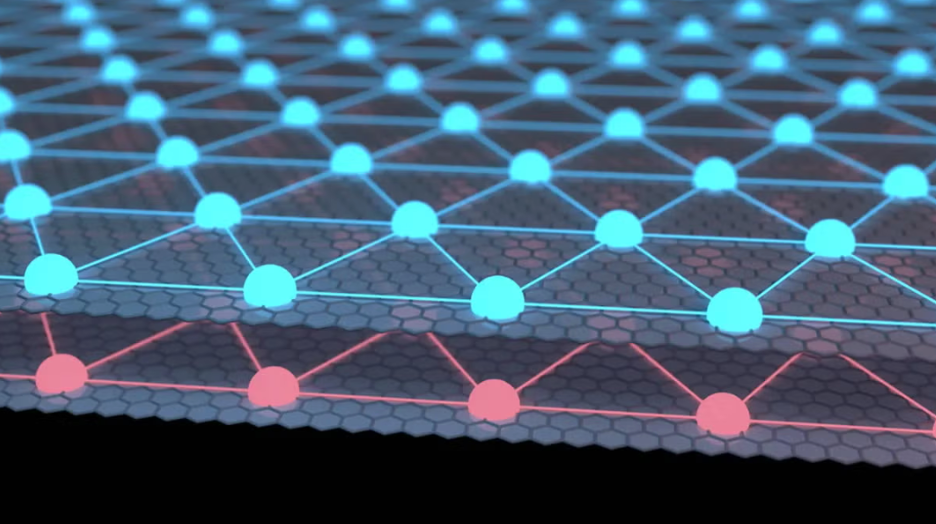
Bilayer excitons spontaneously self-assemble into a solid phase. Credit: Cory Dean/Columbia University.
Superfluids are the showoffs of the quantum world: Once they start moving, they are expected to keep flowing without resistance. But a team of physicists that includes Purdue University has now observed something stranger, an exciton superfluid that can freeze into an ordered, solid-like phase.
The discovery, led by Yihang Zeng, assistant professor of physics and astronomy at Purdue University, is reported in Nature in the paper “Observation of a superfluid-to-insulator transition of bilayer excitons.”
At the center of the work are excitons, bound pairs formed when negatively charged electrons link up with positively charged “holes.” Under the right conditions, excitons act like bosons and can form a collective quantum state that behaves as a superfluid.
“Electrons and holes carry opposite charge and bind with each other, forming excitons. These excitons (bosons) carry different quantum mechanical properties as their constituent particles (fermions) and can form a superfluid phase – a fluid that flows without resistance. We demonstrate in our work that by tuning experimental knobs such as the average spacing between these excitons and how much they are confined, we are able to switch an exciton from a superfluid to an ordered crystal phase, like a solid. Interestingly, this solid is not like a normal solid—it melts into a superfluid and hints towards a long-sought-after supersolid phase,” Zeng said.
In everyday life, we understand how a fluid turns into a solid when water freezes into ice. In quantum materials, phase changes can be even more surprising because the “rules” depend on collective behavior, including coherence, the synchronized wave-like motion of particles.
Zeng uses a simple analogy to help explain what the team saw. “Just as an ordinary fluid like water can freeze into a normal solid like ice, a quantum fluid can also freeze—but in a much more intriguing way. Quantum fluids possess unique properties, such as phase coherence, meaning their particles move in a coordinated, wave-like manner. A well-known example is a superfluid, which can flow without resistance because of this coherence. In our work, we report evidence that such a superfluid can freeze into an enigmatic supersolid state—a rare phase of matter that simultaneously behaves like a solid while retaining superfluid-like quantum coherence. This long-predicted quantum phase has remained elusive in real materials, and our results provide new insight into its emergence,” he said.
In the Nature study, the researchers worked with graphene double layers separated by an ultrathin insulating spacer. By adjusting conditions, the team mapped where the system shows signatures of coherent, dissipationless exciton flow and where that behavior disappears into an insulating phase, a key marker of a superfluid-to-insulator transition. The insulating state is one reason the result is attracting attention when it suggests an ordered phase, possibly related to a “supersolid,” a rare state that blends solid-like structure with superfluid-like coherence.
At Purdue, Zeng led the project and is the main contributor of the experiment (fabricated the devices used for this experiment and conducted most of the low-temperature measurements). He also wrote the manuscript together with Jia Li and Cory Dean.
The collaboration included researchers at Brown University, Columbia University and scientists in Japan who provided raw materials. “There’s a team at Brown University consisting of graduate student Ron Q. Nguyen, former graduate student Naiyuan J. Zhang, and Associate Professor Jia Leo Li, who recently moved to UT Austin. There’s another team at Columbia consisting of graduate student Dihao Sun, Professor James Hone, and Professor Cory Dean. Dihao Sun contributed to part of the experiment and is the co-leading author of this work. Jia Leo Li and Cory Dean developed the idea of this project and provided support for this project.” Zeng said.
Zeng joined Purdue's growing effort in quantum science and engineering in the spring of 2025 and is affiliated with the Purdue Quantum Science and Engineering Institute (PQSEI). He also points to the momentum in the field on campus. “Studying of 2d quantum phases is flourishing at Purdue,” he said.
Zeng’s broader research program focuses on understanding and controlling the quantum behaviors that emerge in ultrathin materials.
“The Zeng lab at Purdue is focused on studying and manipulating quantum properties of two-dimensional materials. Our research aims to discover new physics phenomena and address long-standing questions in physics. Taking one step further, harnessing these quantum properties can drive technological breakthroughs,” Zeng said.
About the Department of Physics and Astronomy at Purdue University
Purdue's Department of Physics and Astronomy has a rich and long history dating back to 1904. Our faculty and students are exploring nature at all length scales, from the subatomic to the macroscopic and everything in between. With an excellent and diverse community of faculty, postdocs and students who are pushing new scientific frontiers, we offer a dynamic learning environment, an inclusive research community and an engaging network of scholars.
Physics and Astronomy is one of the seven departments within the Purdue University College of Science. World-class research is performed in astrophysics, atomic and molecular optics, accelerator mass spectrometry, biophysics, condensed matter physics, quantum information science, and particle and nuclear physics. Our state-of-the-art facilities are in the Physics Building, but our researchers also engage in interdisciplinary work at Discovery Park District at Purdue, particularly the Birck Nanotechnology Center and the Bindley Bioscience Center. We also participate in global research including at the Large Hadron Collider at CERN, many national laboratories (such as Argonne National Laboratory, Brookhaven National Laboratory, Fermilab, Oak Ridge National Laboratory, the Stanford Linear Accelerator, etc.), the James Webb Space Telescope, and several observatories around the world.
Written by: David Siple, communications specialist, Purdue University Department of Physics and Astronomy
Contributor: Yihang Zeng, assistant professor of physics and astronomy, Purdue University