Purdue astronomers uncover massive structures in the young universe
2026-09-08
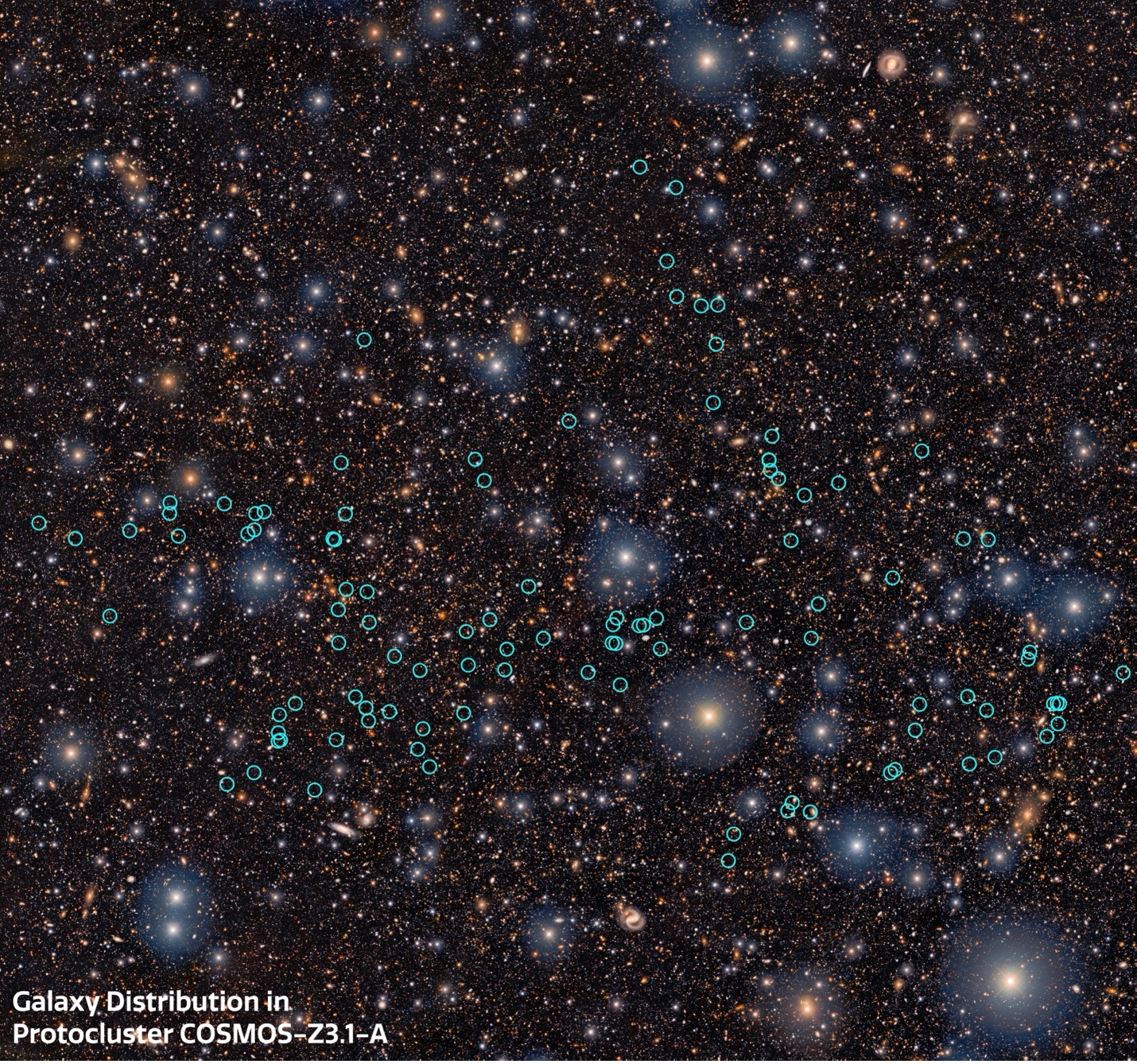
Image above - Captured within this image is the newly discovered galaxy proto-supercluster named COSMOS-z3.1-A. A proto-supercluster is a loose collection of galaxies that will one day coalesce into a stable ‘cluster-of-clusters’ of galaxies. COSMOS-z3.1-A has a mass 5000 times that of the Milky Way and is located around 11 billion light-years away, making it the most distant such structure ever found.(Photo credit/CTIO/NOIRLab/DOE/NSF/AURA
Image Processing: T.A. Rector (University of Alaska Anchorage/NSF NOIRLab), M. Zamani & D. de Martin (NSF NOIRLab)
More than 11 billion years ago, some of the largest structures in today's universe were still being built. Purdue University researchers have now created detailed three-dimensional maps of several of these young cosmic structures, including an extraordinarily rare proto-supercluster with about 5,000 times the mass of the Milky Way.
The research is helping astronomers understand how galaxy clusters, the most massive structures in the universe held together by gravity, grew from scattered groups of galaxies into the enormous systems seen today.
The work was led by Vandana Ramakrishnan, who earned her doctorate in physics from Purdue in May 2026. Ashley Ortiz, who worked on the project as a Purdue undergraduate, is the study's second author. Kyoung-Soo Lee, professor of physics and astronomy in Purdue University's College of Science, supervised the Purdue research.
Their study, "ODIN: Characterizing the Three-dimensional Structure of Two Protocluster Complexes at z = 3.1," has been accepted for publication in The Astrophysical Journal.
The researchers studied distant ancestors of galaxy clusters known as protoclusters. Because their light takes billions of years to reach Earth, observing them allows astronomers to look back in time and study how large structures developed when the universe was much younger.
The challenge is figuring out what those structures actually look like. A normal image of the sky is essentially flat, showing where galaxies appear in two dimensions. By combining those images with measurements that help determine a galaxy's distance, the Purdue-led team was able to add a third dimension and reconstruct the structures in 3D.
"For me, the most interesting part was being able to actually visualize these structures in 3D. When you look at a normal image of the sky, it can be difficult to tell how galaxies are related to one another because everything is projected onto two dimensions. Once we include the redshift information and add the third dimension, you can start to see galaxies grouping together and even filamentary features connecting overdense regions," Ortiz said.
The observations came primarily from the One-hundred-deg² DECam Imaging in Narrowbands survey, or ODIN, which searches large areas of the sky for young galaxies that can help reveal where matter was gathering in the early universe. Additional observations allowed the researchers to determine the galaxies' positions more precisely and reconstruct two structures known as COSMOS-z3.1-A and COSMOS-z3.1-C.
Instead of smooth, rounded clusters, the maps revealed irregular structures made up of several dense concentrations of galaxies. That is what astronomers expect to see if the universe grew in a "bottom-up" fashion, with smaller structures forming first and gradually merging into larger ones.
This animation shows a 3D model of the newly discovered galaxy proto-supercluster named COSMOS-z3.1-A. A proto-supercluster is a loose collection of galaxies that will one day coalesce into a stable ‘cluster-of-clusters’ of galaxies. COSMOS-z3.1-A has a mass 5000 times that of the Milky Way and is located around 11 billion light-years away, making it the most distant such structure ever found. (Video Credit: CTIO/NOIRLab/DOE/NSF/AURA/DSS2/NSF–DOE Vera C. Rubin Observatory Acknowledgment: The original version of this 3D model was created by A. Ortiz (Purdue) Image Processing: T.A. Rector (University of Alaska Anchorage/NSF NOIRLab), M. Zamani & D. de Martin (NSF NOIRLab) Motion Graphics: R. Proctor)
"It is likely that the clumpy substructure we see in our 3D maps is evidence of this bottom-up growth," Ramakrishnan said. COSMOS-z3.1-A stood out in particular. This structure is not simply a protocluster. Researchers identified it as a proto-supercluster, the early ancestor of a system made up of multiple galaxy clusters. Ramakrishnan said such structures are exceptionally rare, with fewer than one expected for every 10,000 galaxy clusters.
Its scale is difficult to imagine. "I think the distance and sheer scale of the structures we are studying is really extraordinary. These are structures containing hundreds to thousands of galaxies; the proto-supercluster has a mass 5000 times that of the Milky Way! It brings home the vastness of the cosmos in a way that I believe no science other than astronomy does," Ramakrishnan said.
Ortiz played a major role in creating and testing the 3D reconstructions while she was an undergraduate at Purdue. Her work included determining how reliably the method could recover structures using simulated galaxy distributions.
Her background in both physics and computer science also helped her work with the large datasets and visualization tools required for the project. As part of a computer science course, she created an interactive website that allows users to explore the reconstructed protoclusters in three dimensions.
Ortiz also led a follow-up study. “The work I did on the 3D reconstructions naturally led into the follow-up paper,” Ortiz said. That work expands the analysis to six additional protoclusters, giving researchers a larger sample for studying how galaxies behave in some of the densest environments in the early universe. Together, the two studies provide detailed information about eight protoclusters and give astronomers a new way to watch the universe's largest structures grow.
The U.S. National Science Foundation supported the research under grants AST-2206705 and AST-2408359, and the Ross-Lynn Purdue Research Foundations also contributed. The work also incorporates observations and support from NSF NOIRLab, DESI and collaborating institutions around the world." More details are found in the NOIRLab press release text here.
About the Department of Physics and Astronomy at Purdue University
Purdue University's Department of Physics and Astronomy has a rich and long history dating back to 1904. Faculty and students explore nature at all length scales, from the subatomic to the macroscopic and everything in between. With an excellent and diverse community of faculty, postdoctoral researchers and students pushing new scientific frontiers, the department offers a dynamic learning environment, an inclusive research community and an engaging network of scholars.
Physics and Astronomy is one of seven departments within Purdue University's College of Science. World-class research is performed in astrophysics, atomic and molecular optics, accelerator mass spectrometry, biophysics, condensed matter physics, quantum information science, and particle and nuclear physics.
Written by: David Siple, communications specialist, Purdue University Department of Physics and Astronomy