Matthew Eiles joins Purdue Physics and Astronomy faculty
2026-01-20
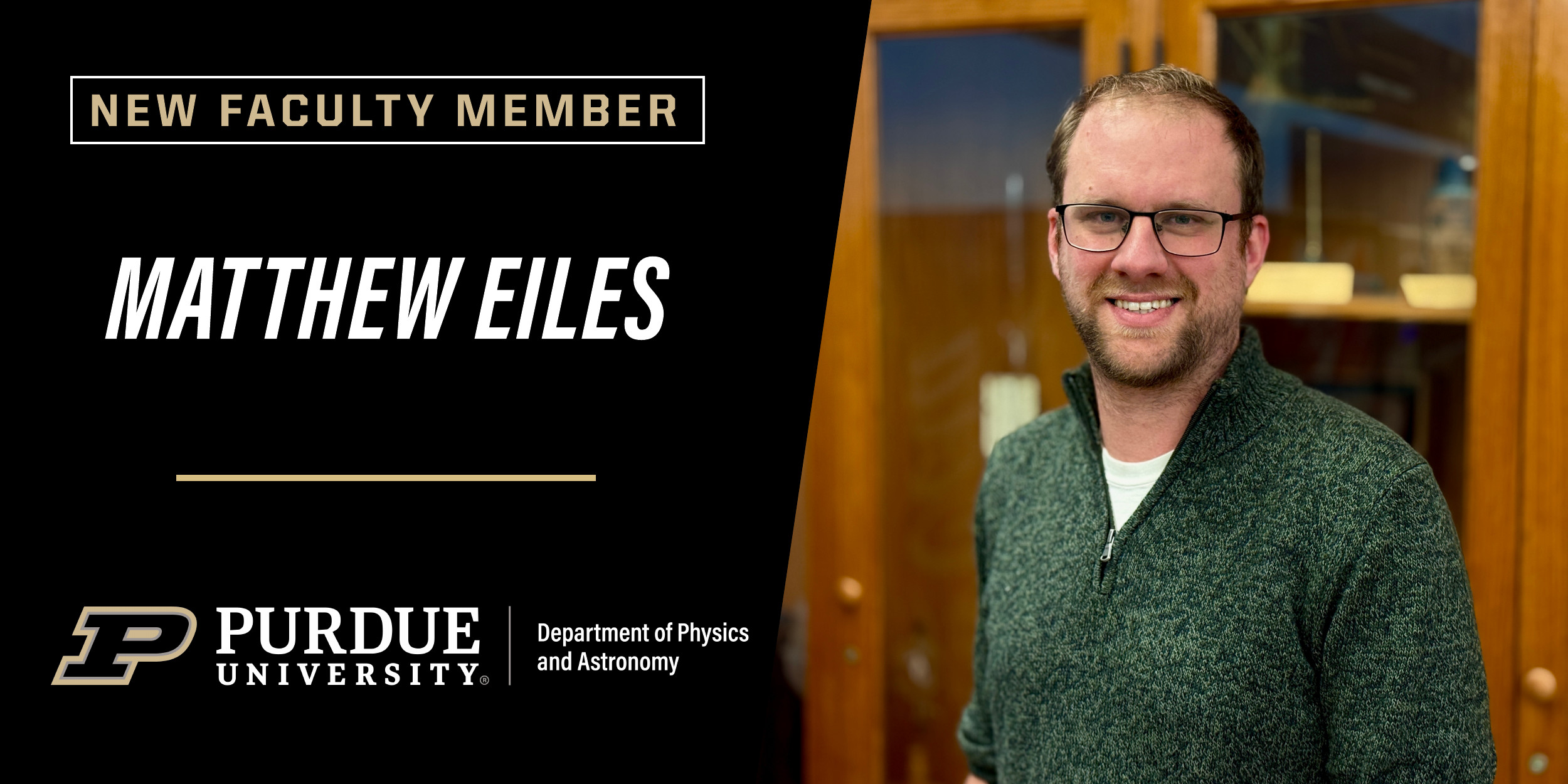
Matthew Eiles has joined the Department of Physics and Astronomy as an assistant professor. He studies atoms in extreme states and the unusual molecules they can form. Using theory and computation, his work aims to better understand how matter behaves at its most fundamental level, while also opening new ways of thinking about interactions that appear across physics.
Eiles comes to Purdue with a strong appreciation for teaching, collaboration and mentorship. Key values that first inspired him to pursue physics and continue to drive his career today. This new chapter brings him back to a campus that played a big role in his academic journey and one he says now feels like home.
Much of Eiles’s inspiration traces back to influential teachers who helped shape his interests early on. “I think my main inspiration came from several teachers,” he said. “My dad, who also has a PhD in physics and first impressed on me the importance of math and science. I learned calculus from two fantastic community college professors who really taught me how fascinating and enjoyable math can be.”
Eiles’s research focuses on theoretical atomic and molecular physics, where he uses quantum physics to better understand how matter behaves at the smallest scales. He is particularly interested in systems that push atoms into extreme states, allowing their unusual properties to reveal new ways of thinking about fundamental physical processes. By exploring how these systems interact, his work offers insight into the underlying rules that govern the microscopic world and how seemingly complex behavior can emerge from simple principles.
His work has been published in leading peer-reviewed journals, including Physical Review Letters, and often involves close collaboration with experimental physicists. These partnerships allow theoretical ideas to be tested and refined, strengthening the connection between theory and observation.
As an undergraduate, Eiles began to see how those interests naturally led to physics. “I also learned from my undergrad advisor that what I enjoyed the most about math was really most accessible by studying physics,” he said. That realization helped clarify his path and set him on a course toward an academic career.
Today, Eiles states that his greatest excitement in physics remains the continuous chance to learn and collaborate with others. “I remain passionate about physics because it keeps giving me new puzzles to solve and opportunities to learn and collaborate with other people,” he said. “A physics career gives so many great chances to discuss new ideas with other researchers and learn from their creativity and knowledge, and also to mentor and advise students.”
While his appointment is research-focused, Eiles places high value on the classroom experience. He is especially motivated by helping students work through difficult ideas and discover connections across topics. He mentions that physics can sometimes feel abstract, but that challenge is part of what makes teaching rewarding. “One thing I love about physics is that there are so many interconnected parts, and some trick or technique you learn in one area can be useful in explaining some other concept,” he said.
Those moments of realization are central to his teaching philosophy. “These connections give the little ‘aha’ moments that really help make hard ideas stick,” Eiles said. “I like to bring some humor and energy to the classroom – a few jokes and some excitement go a surprisingly long way when trying to make complex concepts accessible.”
Eiles earned his bachelor’s degrees in physics and math from Hope College in Holland, Michigan, before completing his PhD at Purdue. He then spent seven years at the Max Planck Institute for Complex Physics in Dresden, Germany, where he worked as a postdoctoral fellow and later became a research group leader in 2021.
After years abroad, returning to Purdue holds special meaning. “In just the last decade, Purdue has become one of the top universities in the US for my field of physics, atomic, molecular, and optical physics,” he said. “The quantity and quality of faculty here is really remarkable. I am really excited for the opportunities for collaboration, inspiration, and growth that the Purdue faculty’s strength in this area provide.”
Originally from the West Coast, Eiles grew up in the Bay Area of California and later in the suburbs of Portland, Oregon. Over time, however, the Midwest has come to feel familiar. Experiences at Hope College and Purdue introduced him to small-town communities that he now finds welcoming and grounding.
His family has been excited about his return to the U.S. and his new role at Purdue. “They are excited about it!” Eiles said. “They know that I have wanted to become a professor for a long time, so they are happy to see that finally come true.” After many years overseas, being closer to family has been an added benefit of the move.
As he settles into his role at Purdue, Eiles looks forward to building relationships with students and colleagues alike. Whether in the classroom or through mentorship, his goal is to help others see physics not as an obstacle, but as an invitation to think deeply, ask questions and enjoy the process of discovery.
Be sure to check out Matthew’s Google Scholar page.
Click here to be directed to Matthew's faculty profile page.
About the Department of Physics and Astronomy at Purdue University
Purdue's Department of Physics and Astronomy has a rich and long history dating back to 1904. Our faculty and students are exploring nature at all length scales, from the subatomic to the macroscopic and everything in between. With an excellent and diverse community of faculty, postdocs and students who are pushing new scientific frontiers, we offer a dynamic learning environment, an inclusive research community and an engaging network of scholars.
Physics and Astronomy is one of the seven departments within the Purdue University College of Science. World-class research is performed in astrophysics, atomic and molecular optics, accelerator mass spectrometry, biophysics, condensed matter physics, quantum information science, and particle and nuclear physics. Our state-of-the-art facilities are in the Physics Building, but our researchers also engage in interdisciplinary work at Discovery Park District at Purdue, particularly the Birck Nanotechnology Center and the Bindley Bioscience Center. We also participate in global research including at the Large Hadron Collider at CERN, many national laboratories (such as Argonne National Laboratory, Brookhaven National Laboratory, Fermilab, Oak Ridge National Laboratory, the Stanford Linear Accelerator, etc.), the James Webb Space Telescope, and several observatories around the world.
Written by: David Siple, communications specialist, Purdue University Department of Physics and Astronomy