Antimatter under a sharper lens: Purdue physicist helps ALPHA Collaboration test one of nature's biggest questions
2026-08-10
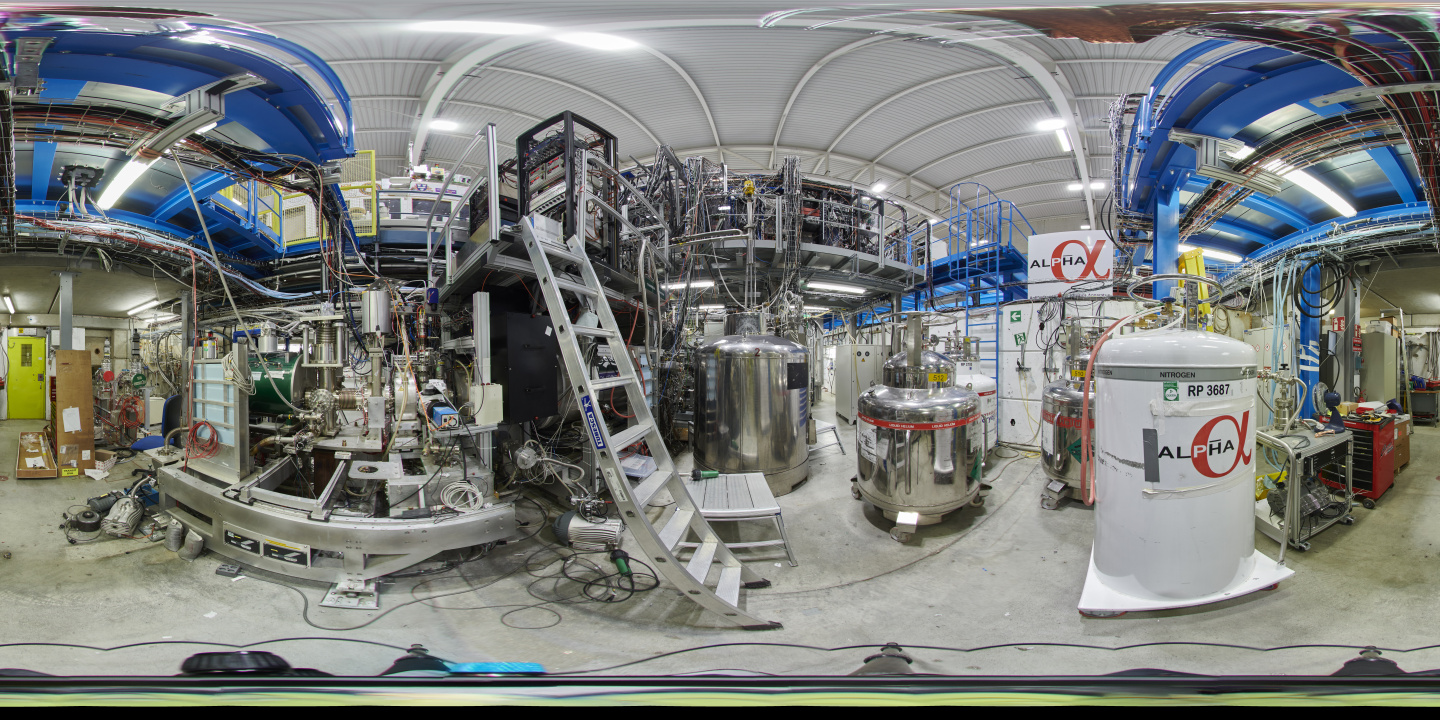
A panoramic view of the ALPHA experiment at CERN’s Antimatter Factory. The complex apparatus allows researchers to produce, trap and study antihydrogen atoms, helping scientists compare antimatter with ordinary hydrogen and test fundamental symmetries of nature. (Photo credit/CERN/ALPHA Collaboration)
Matter makes up nearly everything we see, touch and study. Antimatter, its mirror-like counterpart, is far harder to find and even harder to hold long enough to measure. Yet according to the basic theories that describe the universe, matter and antimatter should behave in exactly the same way, aside from opposite electric charges.
That is the puzzle motivating new research from the international ALPHA Collaboration at CERN. In a paper published in Nature, the collaboration reported a measurement of antihydrogen that is 100 times more precise than previous measurements. This offers a sharper test of whether hydrogen and antihydrogen follow the same rules.
Francis Robicheaux, professor of physics and astronomy at Purdue University, is a member of the ALPHA Collaboration and contributed simulations that helped the team interpret what was happening inside the experiment.
"The idea behind the collaboration is that the basic theories describing how everything works demand that the hydrogen atom and its antimatter counterpart should have exactly the same properties," Robicheaux said. "The ALPHA collaboration measures properties of antimatter hydrogen and compares to what is known about hydrogen.”
Hydrogen is the simplest atom, made of one proton and one electron. Antihydrogen is its antimatter counterpart, made of one antiproton and one positron, the antimatter version of the electron. Because hydrogen has been measured with extraordinary precision for more than a century, antihydrogen offers one of the cleanest ways to look for tiny differences between matter and antimatter.
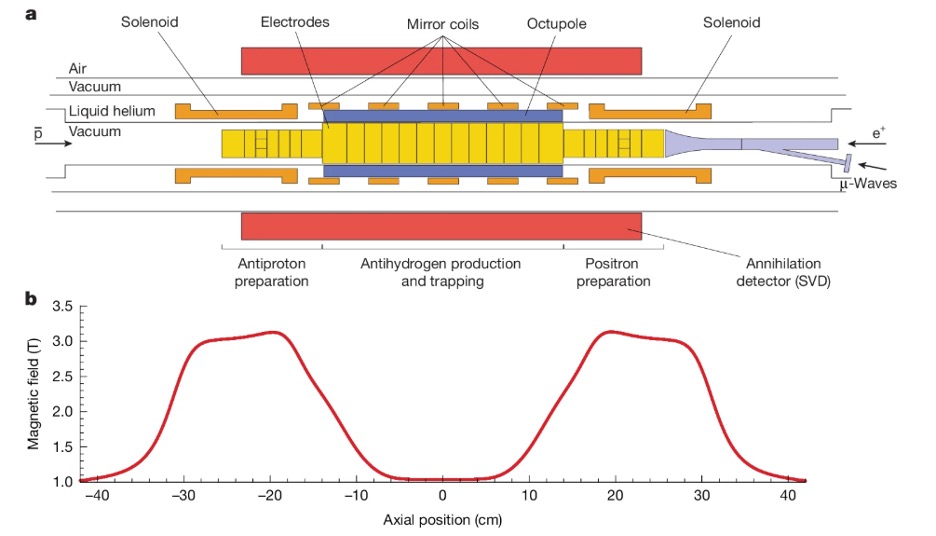
Diagram of the ALPHA-2 antihydrogen experiment showing antiproton and positron preparation areas, the antihydrogen production and trapping region, magnets, electrodes, an annihilation detector and a magnetic field profile. (Image courtesy of the ALPHA Collaboration/Nature.)
The new Nature paper focuses on a feature called ground-state hyperfine splitting. In basic terms, it is a tiny energy difference inside the lowest energy state of antihydrogen, caused by the magnetic interaction between the antiproton and the positron. If the most fundamental symmetries of nature hold true, that energy difference should match the same feature in regular hydrogen.
The ALPHA Collaboration's new result found the antihydrogen measurement to be consistent with expectations for hydrogen, but with far greater precision than before. Instead of closing the question, the measurement gives scientists a stronger tool for continuing to continue testing it.
"Our current theories demand that matter and antimatter are exactly (mathematically) the same but somehow the universe is almost 100% matter," Robicheaux said. "No one knows why."
That imbalance is one of the deepest mysteries in physics. The Big Bang should have produced matter and antimatter in nearly equal amounts. When matter and antimatter meet, they annihilate. If the early universe made both equally, scientists would expect little to no matter to be left behind. Instead, stars, planets, galaxies and people exist.
ALPHA is designed to probe that mystery by making, trapping and studying antihydrogen atoms. That work is extraordinarily difficult because antihydrogen disappears when it touches ordinary matter. Researchers must use carefully shaped magnetic fields to hold the anti-atoms in a vacuum, keeping them away from the walls of the apparatus long enough to measure them.
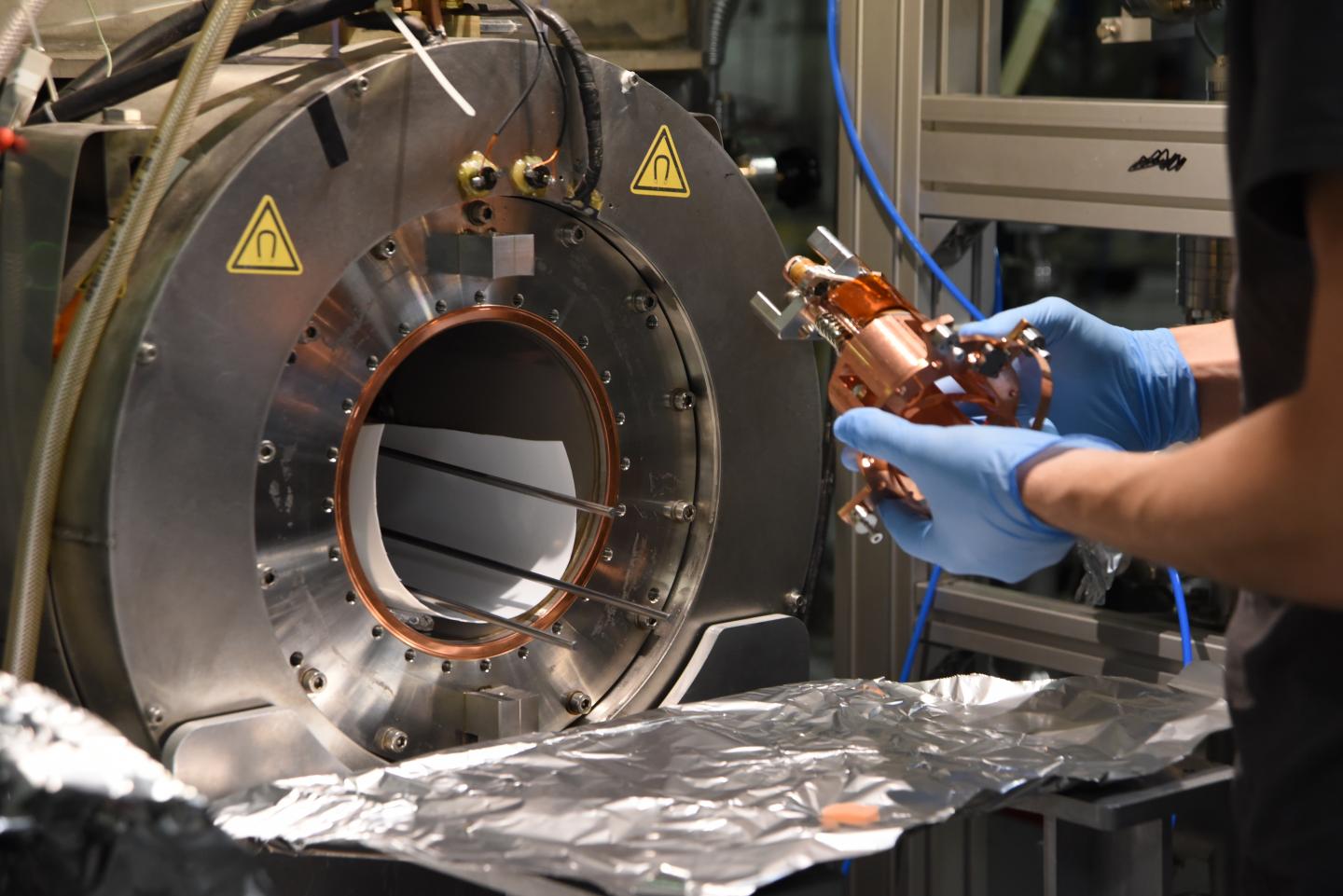
A member of CERN’s ALPHA experiment handles a precision component near the opening of the experimental apparatus. The equipment is used to produce, trap and study antihydrogen atoms under tightly controlled conditions. (Photo credit/CERN/ALPHA Collaboration)
Those simulations Robicheaux conducted helped connect the measurements made at CERN to the actual motion and behavior of antihydrogen atoms inside the trap. In this experiment, the collaboration used microwave spectroscopy to study how antihydrogen responded under tightly controlled conditions. The simulations helped the team understand how the trapped anti-atoms interacted with the microwave fields and how those interactions shaped the signals seen in the experiment.
At Purdue, Robicheaux's broader research focuses on theoretical atomic physics. About half of his work involves simulations for ALPHA, helping improve measurements of antihydrogen atoms. The other half involves simulations of very cold atoms interacting with light, work that helps scientists understand basic quantum processes with implications for quantum information science. Robicheaux is also part of the Purdue Quantum Science and Engineering Institute.
The research is basic physics, meaning it is not aimed at an immediate product or industrial application. Instead, it asks whether the universe behaves the way scientists think it does at the most fundamental level.
But basic physics has a long history of reshaping what people later believe is possible. The study of atoms, light, magnetism and quantum behavior helped build the foundation for technologies that now shape daily life. In the case of antihydrogen, the immediate goal is more fundamental: to keep testing whether matter and antimatter are truly mirror images, or whether a tiny difference may help explain why the universe is filled with matter at all.
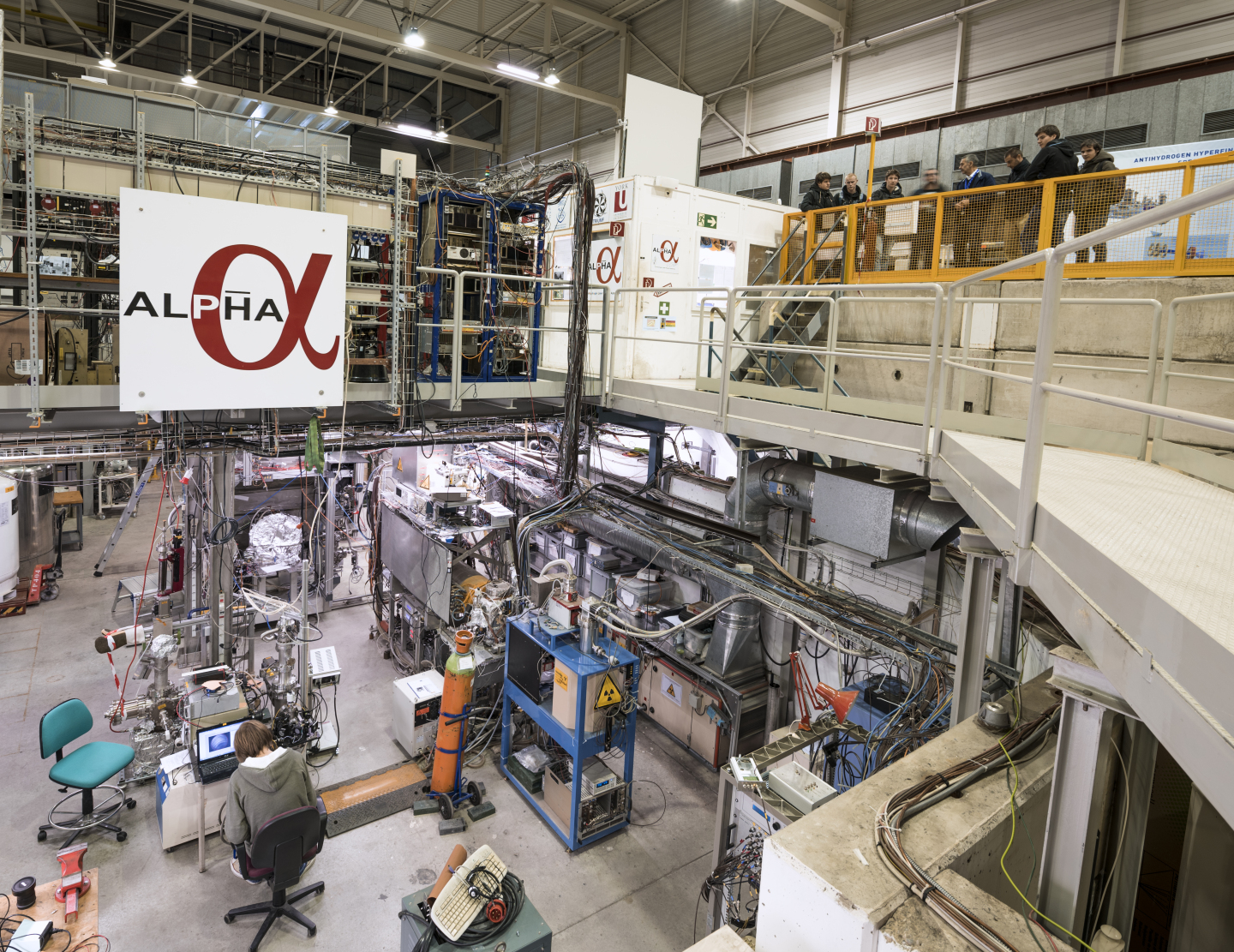
Visitors gather near the ALPHA control room above the experiment at CERN’s Antimatter Factory. (Photo credit/CERN/ALPHA Collaboration)
The work also shows how Purdue researchers contribute to major international collaborations. While the experiment is based at CERN, Robicheaux's role is rooted in computation, modeling and interpretation, the kind of theoretical work that helps experimental teams understand what their instruments are revealing.
The paper, "Four ppm measurement of the antihydrogen ground-state hyperfine splitting," was published in Nature. All authors are members of the ALPHA Collaboration at CERN.
This work was supported by the National Science Foundation under Grant No. 2409162-PHY.
About the Department of Physics and Astronomy at Purdue University
Purdue's Department of Physics and Astronomy has a rich and long history dating back to 1904. Our faculty and students are exploring nature at all length scales, from the subatomic to the macroscopic and everything in between. With an excellent and diverse community of faculty, postdocs and students who are pushing new scientific frontiers, we offer a dynamic learning environment, an inclusive research community and an engaging network of scholars.
Physics and Astronomy is one of the seven departments within the Purdue University College of Science. World-class research is performed in astrophysics, atomic and molecular optics, accelerator mass spectrometry, biophysics, condensed matter physics, quantum information science, and particle and nuclear physics. Our state-of-the-art facilities are in the Physics Building, but our researchers also engage in interdisciplinary work at Discovery Park District at Purdue, particularly the Birck Nanotechnology Center and the Bindley Bioscience Center. We also participate in global research including at the Large Hadron Collider at CERN, many national laboratories (such as Argonne National Laboratory, Brookhaven National Laboratory, Fermilab, Oak Ridge National Laboratory, the Stanford Linear Accelerator, etc.), the James Webb Space Telescope, and several observatories around the world.
Written by: David Siple, communications specialist, Purdue University Department of Physics and Astronomy