A single unexplained event offers a new clue in the search for dark matter
2026-09-09
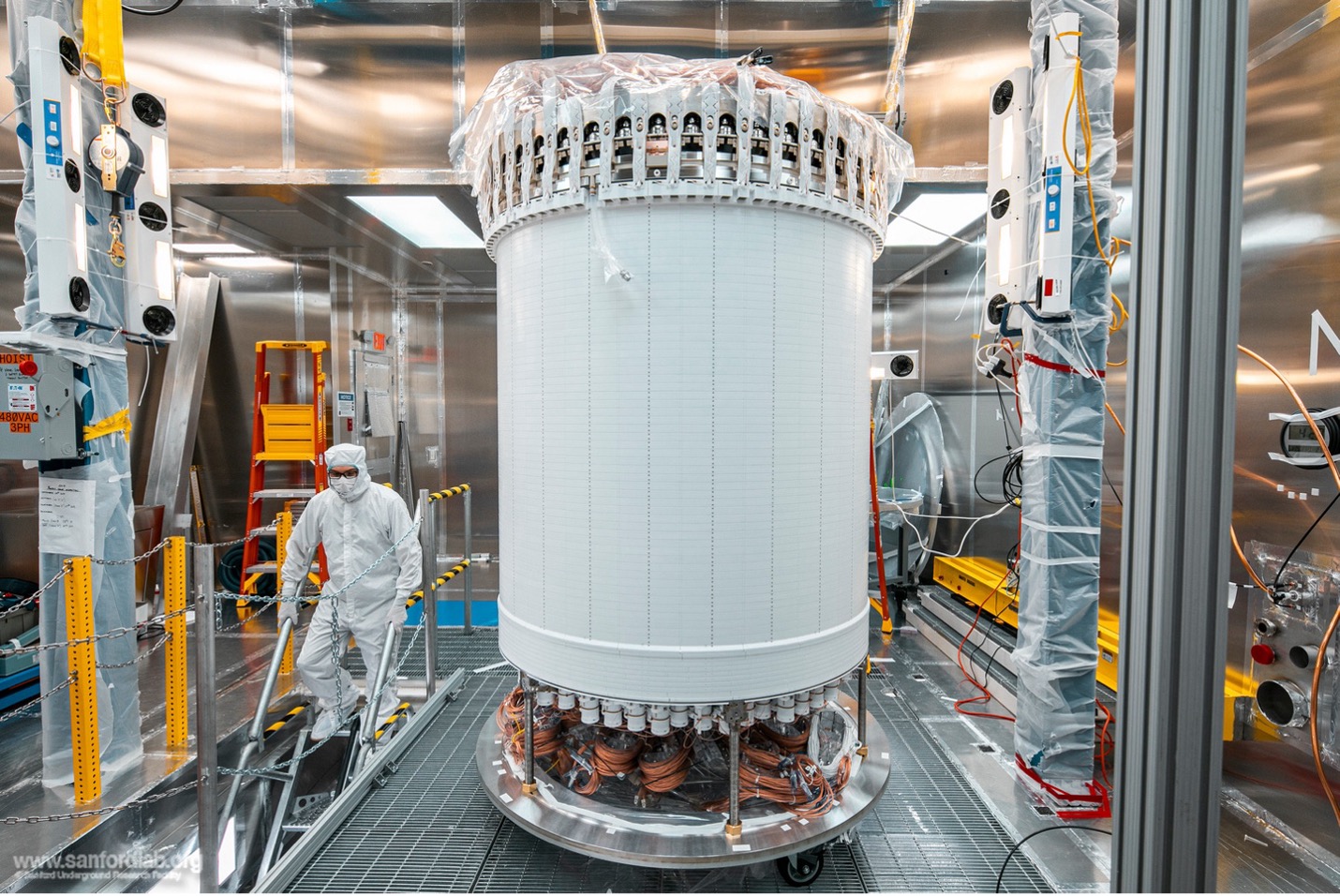
The LUX-ZEPLIN main detector in a surface lab before installation underground. (Photo credit/Matthew Kapust/Sanford Underground Research Facility)
Deep underground in South Dakota, scientists searching for dark matter have found something they cannot easily explain. Purdue physicist Shilo Xia helped coordinate simulations behind the latest results from the LUX-ZEPLIN experiment
A new analysis from the LUX-ZEPLIN, or LZ, experiment identified a single-particle interaction that does not fit the known background events researchers expect to see inside a detector. The event could have been produced by a weakly interacting massive particle, or WIMP, one of the leading candidates for dark matter.
It’s far too soon to call it a discovery. For researchers who have spent decades searching for direct evidence of dark matter, the event is worth watching closely. The LZ collaboration describes it as its most compelling hint of dark matter to date.
Qing "Shilo" Xia, assistant professor of physics and astronomy at Purdue University, is a member of the international LZ collaboration and contributed directly to the work behind the new analysis. “We observed a single particle interaction in the detector that shows tension with our background model,” Xia said. “While this single interaction has low statistical significance and can't be claimed as a discovery, it is an intriguing event that is consistent with a possible dark matter interaction. As LZ and other experiments collect more data, we will be able to determine whether this is a genuine signal or simply a background fluctuation.”
Dark matter is thought to make up roughly 85% of the matter in the universe, yet scientists have never directly detected it. Unlike ordinary matter, dark matter does not emit or reflect light. Scientists instead know it is there because of the gravitational effects it has on galaxies and other structures throughout the universe. LZ was built to search for evidence of those elusive particles.
The experiment operates nearly a mile underground at the Sanford Underground Research Facility in South Dakota. At its center is a detector containing 10 metric tons of ultrapure liquid xenon. If a dark matter particle collides with a xenon atom, it could produce tiny flashes of light and electrons that the detector can record. The rock above the experiment, along with additional shielding and sophisticated analysis tools, helps researchers separate possible dark matter interactions from ordinary particles and other sources of background noise.
That ability to understand the background is central to the latest result, and it is also where Xia contributed to the collaboration. While the analysis was underway, Xia served as LZ Simulation Coordinator from 2023 to 2025. In that role, she was responsible for maintaining the collaboration’s simulation infrastructure and coordinating the first round of high-statistics background simulations of detector materials for this analysis.
Those simulations help scientists understand the kinds of interactions ordinary particles and radioactive materials can produce inside LZ. The better researchers understand those expected events, the more confidently they can identify something that does not belong.
For the new study, the collaboration examined 220 live days of data collected between March 2023 and April 2024. Researchers expanded their search beyond the simplest types of WIMP interactions to look for a broader range of possible interactions that could deposit more energy in the detector.
One event stood out when researchers spent months examining possible sources that might explain it as an ordinary background interaction. So far, none provides a convincing explanation.
If the event was produced by dark matter, researchers estimate the WIMP responsible would likely have a mass of at least 200 GeV/c², more than 200 times the mass of a proton. It could also point toward a type of interaction between dark matter and ordinary matter that goes beyond the simplest WIMP models scientists commonly search for. Statistically, however, scientists need much more evidence.
The result has a significance of 2.6 sigma, meaning there is roughly a 0.5% chance that known background processes could account for the event. Particle physicists generally require a result to reach 5 sigma before claiming a discovery. That makes additional data especially important.
“Direct detection experiments have not yet found convincing evidence for dark matter,” Xia said. “This result provides a first notable hint of a possible dark matter signal in a liquid xenon detector and offers an exciting benchmark for both LZ and the broader dark matter search community.”
LZ is expected to continue operating through the end of 2027, with a goal of collecting 1,000 live days of data. More observations should help researchers determine whether the unusual event was a statistical fluctuation, an unexpected background interaction or something far more significant.
“I am particularly excited to see how this potential hint of dark matter evolves as we collect more data — whether it develops into a discovery or fades as a statistical fluctuation,” Xia said.
The LZ collaboration includes about 250 scientists and engineers from 39 institutions. The experiment is supported by the U.S. Department of Energy and research organizations and institutions in the United Kingdom, Portugal, Switzerland, Australia and South Korea. The scientific paper is on arXiv and Physical Review Letters.
About the Department of Physics and Astronomy at Purdue University
Purdue's Department of Physics and Astronomy has a rich and long history dating back to 1904. Our faculty and students are exploring nature at all length scales, from the subatomic to the macroscopic and everything in between. With an excellent and diverse community of faculty, postdocs and students who are pushing new scientific frontiers, we offer a dynamic learning environment, an inclusive research community and an engaging network of scholars.
Physics and Astronomy is one of the seven departments within the Purdue University College of Science. World-class research is performed in astrophysics, atomic and molecular optics, accelerator mass spectrometry, biophysics, condensed matter physics, quantum information science, and particle and nuclear physics. Our state-of-the-art facilities are in the Physics Building, but our researchers also engage in interdisciplinary work at Discovery Park District at Purdue, particularly the Birck Nanotechnology Center and the Bindley Bioscience Center. We also participate in global research including at the Large Hadron Collider at CERN, many national laboratories (such as Argonne National Laboratory, Brookhaven National Laboratory, Fermilab, Oak Ridge National Laboratory, the Stanford Linear Accelerator, etc.), the James Webb Space Telescope, and several observatories around the world.
Written by: David Siple, communications specialist, Purdue University Department of Physics and Astronomy