Purdue Physics and Astronomy welcomes new faculty
Purdue University is excited to welcome four new faculty members to the Physics and Astronomy Department, bringing fresh expertise and perspectives to the university’s vibrant academic community. These new additions will contribute to advancing research, fostering innovation, and enhancing the educational experience for students in the department.
Claudio Chamon, Fall 2025
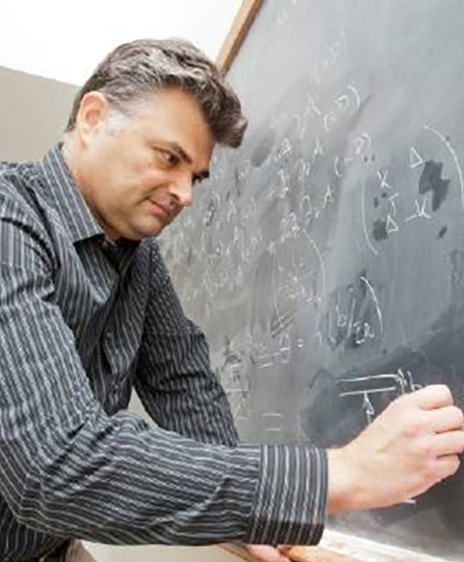 Prof. Claudio Chamon is an expert in electron fractionalization and topology. His research has revealed the existence of fractionally charged topological excitations in systems where time-reversal symmetry is respected. His research has been cited over 13,000 times and over 5,000 times since 2019.
“I study how particles behave when they interact in large groups and the unique forms of quantum matter that result from these interactions,” said Chamon. “Some special systems behave as if their building blocks carry only a fraction of an electron's charge. The unusual properties of these fractionalized building blocks — called fractional quasiparticles — could be useful for processing quantum information and creating stable qubits for quantum computers. My work has focused on how to understand and build quantum states containing these fractional quasiparticles.”
The talent-based Moveable Dream Hires program is piloted by the Deans and Provost to attract high-performing, top-caliber faculty to Purdue even when the topic-based openings in a given year do not match the moveable talent. It complements typical topic-based faculty searches across the University and enables the recruitment of faculty who may not be actively on the job market. These recruits are tenure-track or tenured faculty.
Chamon received his bachelor's, master's, and doctorate degrees from the Massachusetts Institute of Technology, finishing in 1996. He was awarded an NSF Early CAREER Award in 1999 and was elected a Fellow of the American Physical Society in 2008. His research focuses on strongly correlated quantum matter and the out-of-equilibrium dynamics of classical and quantum systems.
His research winds through the ever-growing field of electron fractionalization, from quantum Hall states that are sustained at large magnetic fields, to a novel type of quantum Hall fluid that he and co-workers theoretically predicted and that were recently observed experimentally to exist at zero magnetic field. He also proposed fractionalization in graphene-like structures.
“My current research focuses on leveraging symmetry principles to design superconducting circuits capable of realizing these quantum states, creating blueprints tailored to specific target certain states. At Purdue, I will ramp up this effort, which bridges both quantum science and quantum engineering.”
Read his full write-up: Purdue Science welcomes new physics faculty Claudio Chamon
Tyler Ellison, Fall 2025

Tyler Ellison has joined Purdue University’s Department of Physics and Astronomy as an assistant professor. His research focuses on developing new quantum error-correcting codes that could make quantum computing more reliable and efficient.
To make quantum computing feasible, researchers like Ellison design quantum error-correcting codes that protect information from these inevitable errors. His group’s work draws inspiration from exotic, low-temperature phases of matter to improve both the stability and efficiency of quantum systems.
This fall, Ellison is teaching PHYS 172, a large introductory course on classical mechanics. He said he enjoys helping students build their foundational understanding of physics and physical reasoning. “I appreciate that I have the opportunity to help students build their foundations in physics,” he said. “It also doesn’t hurt that, by the law of large numbers, there’s always at least one student in the audience who laughs at a pun.”
Ellison said one of his main reasons for joining Purdue was the university’s strong, collaborative approach to quantum science, especially through the Purdue Quantum Science and Engineering Institute (PQSEI).
Ellison earned his bachelor’s degree from Washington University in St. Louis and his PhD from the University of Washington. He completed postdoctoral fellowships at Yale University and at Perimeter Institute before coming to Purdue.
Read his full write-up: Tyler Ellison joins Purdue Physics and Astronomy faculty
Matthew Eiles, Spring 2026
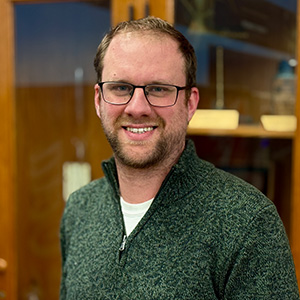
Matthew Eiles has joined the Department of Physics and Astronomy as an assistant professor. He studies atoms in extreme states and the unusual molecules they can form. Using theory and computation, his work aims to better understand how matter behaves at its most fundamental level, while also opening new ways of thinking about interactions that appear across physics.
Eiles comes to Purdue with a strong appreciation for teaching, collaboration and mentorship. Key values that first inspired him to pursue physics and continue to drive his career today. This new chapter brings him back to a campus that played a big role in his academic journey and one he says now feels like home.
Eiles’s research focuses on theoretical atomic and molecular physics, where he uses quantum physics to better understand how matter behaves at the smallest scales. He is particularly interested in systems that push atoms into extreme states, allowing their unusual properties to reveal new ways of thinking about fundamental physical processes. By exploring how these systems interact, his work offers insight into the underlying rules that govern the microscopic world and how seemingly complex behavior can emerge from simple principles.
His work has been published in leading peer-reviewed journals, including Physical Review Letters, and often involves close collaboration with experimental physicists. These partnerships allow theoretical ideas to be tested and refined, strengthening the connection between theory and observation.
While his appointment is research-focused, Eiles places high value on the classroom experience. He is especially motivated by helping students work through difficult ideas and discover connections across topics.
Eiles earned his bachelor’s degrees in physics and math from Hope College in Holland, Michigan, before completing his PhD at Purdue. He then spent seven years at the Max Planck Institute for Complex Physics in Dresden, Germany, where he worked as a postdoctoral fellow and later became a research group leader in 2021.
As he settles into his role at Purdue, Eiles looks forward to building relationships with students and colleagues alike. Whether in the classroom or through mentorship, his goal is to help others see physics not as an obstacle, but as an invitation to think deeply, ask questions and enjoy the process of discovery.
Read Matthew's full write-up: Matthew Eiles joins Purdue Physics and Astronomy faculty
Qing Xia, Spring 2026
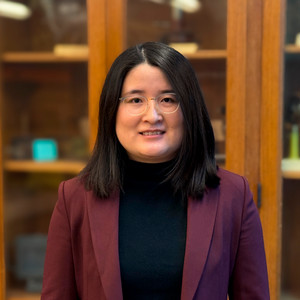 Qing “Shilo” Xia has spent her career chasing something no one has ever seen directly but that shapes the universe on the largest scales imaginable.
Dark matter, an invisible form of matter that makes up about 85% of all matter in the universe, does not emit or reflect light. Astronomers know it exists because of what it does to galaxies, bending their motions and holding them together. What dark matter is made of, however, remains one of the most profound open questions in modern physics.
Xia, an assistant professor of physics and astronomy at Purdue University, has joined the faculty, determined to help answer that question. Her research focuses on developing and using some of the most sensitive detectors ever built to search for rare signals of dark matter interacting with ordinary matter.
Xia is part of the international LUX-ZEPLIN, or LZ, collaboration, which operates the world’s most sensitive detector for one of the leading dark matter candidates. The experiment uses a detector filled with about 10 metric tons of liquid xenon, buried deep underground to shield it from cosmic radiation and other sources of interference. The goal is to observe the incredibly rare event of a dark matter particle colliding with a xenon atom.
After completing her undergraduate studies in China, Xia moved to the United States in 2014 to pursue a Ph.D. in physics at Yale University, where she focused on particle physics. She earned her doctorate in 2020 and then joined Lawrence Berkeley National Laboratory as a postdoctoral researcher, working there until the end of 2025. She arrived at Purdue less than a month ago and is already settling into the rhythm of a college town.
At Purdue, Xia is building a research group focused on dark matter direct detection and the development of new technologies to explore regions of dark matter parameter space that remain largely uncharted. While the LZ experiment targets dark matter, it is also sensitive to neutrinos, another class of elusive particles.
Her publication record reflects this blend of experimental innovation and fundamental physics. She is an author on “Dark Matter Search Results from 4.2 Tonne-Years of Exposure of the LUX-ZEPLIN (LZ) Experiment,” published in Physical Review Letters, as well as papers on the design and performance of LZ calibration systems and on future dark matter searches using crystalline xenon.
Read Shilo's full write-up: Qing “Shilo” Xia joins Purdue Physics and Astronomy faculty