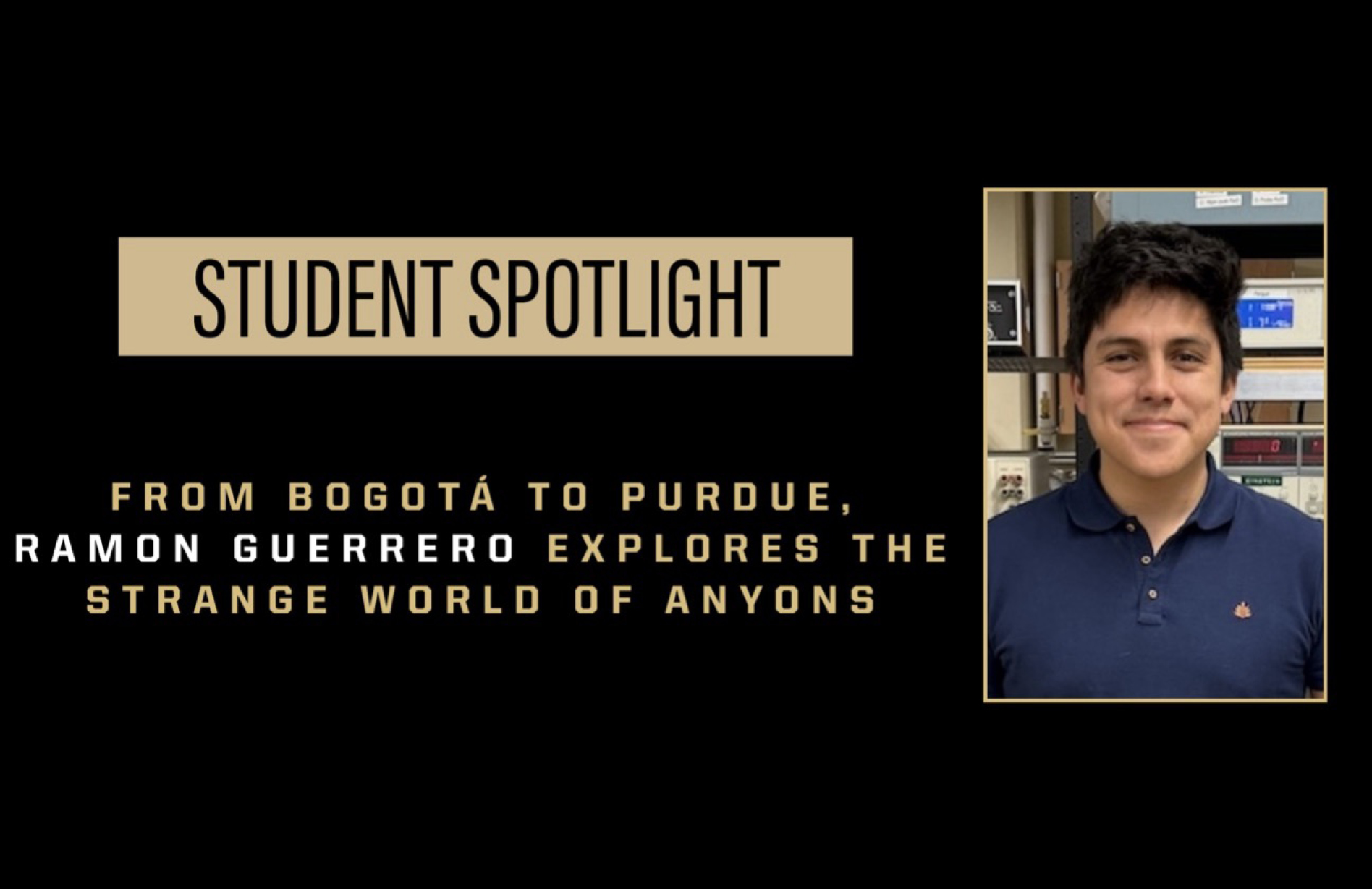
Student Spotlight: Ramon Guerrero
From Bogotá to Purdue, Ramon Guerrero explores the strange world of anyons
Story by David Siple
For Ramon Guerrero, physics was never just another subject in school. It was a way to understand the world at its deepest level. Now a PhD candidate in Purdue University's Department of Physics and Astronomy, Guerrero is studying some of the strangest behavior in quantum science, probing how electrons behave under extreme conditions and helping push forward research tied to the future of quantum technologies.
Guerrero studies electrons confined to two dimensions and exposed to very high magnetic fields and ultra-low temperatures. Under those conditions, the particles begin to interact in unusual ways, giving rise to quasiparticles called anyons. Unlike the particles most people learn about in introductory science classes, anyons do not behave like bosons or fermions. They can carry a fractional charge and show exotic tunneling behavior, making them one of the most intriguing subjects in modern condensed matter physics.
Guerrero explained it this way: "I study electrons in two dimensions subject to high magnetic fields and very low temperatures. Under these conditions, they interact with each other to form anyons, quasiparticles that carry fractional charge (a fraction of the electron charge), fractional statistics (they are neither a boson nor a fermion) and exotic tunneling properties."
That research has already helped place Guerrero on important publications in the field. He is a first author on the 2025 Nature Physics paper "Universal anyon tunnelling in a chiral Luttinger liquid," which reported measurements that fully characterize the topological order of the primary Laughlin state at filling factor 1/3. Purdue also highlighted the work as a major experimental advance in topological quantum matter, noting that Guerrero and fellow graduate student Adithya Suresh performed the experiments and analyzed the data.
His Purdue story began before graduate school. Guerrero first came to campus as an undergraduate through the UREP-C program, which brings promising students from Colombia to Purdue for research experiences. That early opportunity left a lasting impression. "I chose Purdue for grad school after I did a research stance here during my undergrad with the UREP-C program," he said. "I loved the campus and all the opportunities that Purdue has to offer for curious minds."
Before arriving at Purdue, Guerrero earned his undergraduate degree in physics from Universidad Nacional de Colombia, the country's largest public university. He is originally from Bogota, Colombia, a city of roughly 8 million people.
West Lafayette was a change of pace, but one that turned out to be a good fit. "I always tell my family that Purdue is the perfect place to do a PhD," Guerrero said. "It is not too big so that focusing on research is easy, but at the same time it is big enough to have a healthy social life." He also said Purdue quickly became home because of its welcoming international community.
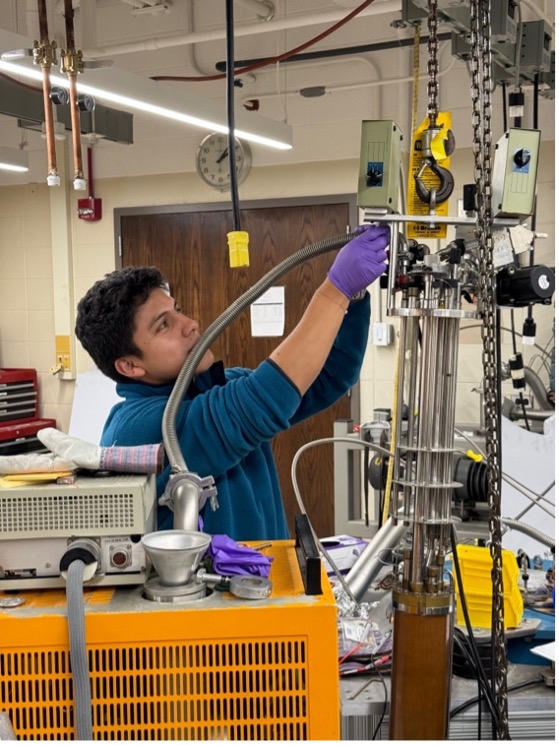
Ramon Guerrero working in the physics lab. (Photo provided by/Ramon Guerrero)
At Purdue, Guerrero works with Michael Manfra, Purdue's Bill and Dee O'Brien Distinguished Professor of Physics and Astronomy. Manfra's group studies quantum matter in semiconductor systems, and the lab gives students a rare chance to work across the full research process, from materials and device design to fabrication and measurement.
Guerrero said that the environment is one of the things that makes the experience so special. "Professor Manfra is a leading expert in mesoscopic physics and the fractional quantum Hall effect," he said. "He has built a quantum transport lab where every step of the process is under our control." Guerrero described the setup as "almost unique in the world," adding that doing research there is "a privilege and a challenge." Guerrero joined the team in 2023 and focuses on quasiparticle interferometry in the fractional quantum Hall regime.
His interest in physics reaches back to childhood, but one course changed everything. "I wanted to be a scientist since I was a kid," Guerrero said. "I picked physics without knowing exactly what I was getting into. It was not until taking quantum mechanics that I decided that I wanted to do physics for the rest of my life." For Guerrero, the field's appeal is not just in its technical depth, but in what it says about human curiosity. Quantum mechanics, he said, reflects "the inventiveness and curiosity of our species."
That sense of purpose carries into his goals after Purdue. Guerrero plans to pursue a career in the quantum computing industry, an area where governments, companies and universities are all racing to build new kinds of computing systems that operate under fundamentally different rules than classical machines. For someone already working on the strange, fractional world of anyons, it feels like a natural next step. "It is very exciting being able to contribute to this collective effort," he said.
He is quick to point to the people who helped him reach this point. Guerrero said his family has been "extremely supportive" of his decision to study physics and has always been there through the harder parts of the journey. He also expressed gratitude to Purdue itself for the chance to grow as a scientist. "I am immensely grateful for getting the opportunity to do my PhD here," he said. "The kid I was 20 years ago would have never imagined that I would be doing top notch science in one of the best quantum transport labs in the world."
For Guerrero, that journey from Colombia to Purdue has been life-changing. It has taken him from a childhood dream of becoming a scientist to the front edge of quantum research. And as he looks ahead, he hopes the same kind of opportunity remains open for others. "I hope Purdue keeps betting on talented people from different backgrounds," he said. It is the kind of hope that fits both his own story and the kind of scientific future he is helping build.