Merel van 't Hoff and Abigail Polin
From a Student’s View: Two Purdue Scientists on Curiosity, Challenge and Community
Story by Emily Maeer
As a Purdue sophomore contributing to this year’s issue of Physics Interactions, I wanted to write this story because it gave me the chance to learn more about two women making important contributions to physics and astronomy. As someone still finding my own path, I was drawn to their work, their experiences and the way they have built careers in fields that continue to shape how we understand the universe. Telling their story felt like an opportunity not only to highlight their research but also to reflect on why representation and curiosity matter to students like me.
I recently had the privilege of interviewing two new faculty members in Purdue's Department of Physics and Astronomy: Merel van 't Hoff and Abigail Polin. While they come from different countries, have studied at distinct universities, and conduct research in separate areas, their experiences in the physics field share striking similarities.
Merel van 't Hoff, who is originally from the Netherlands, has been drawn to science from a very young age. "I actually did not know what I wanted to do after high school, which I think a lot of people can relate to," she said. "I liked most sciences and language, but I figured that I would end up in science."
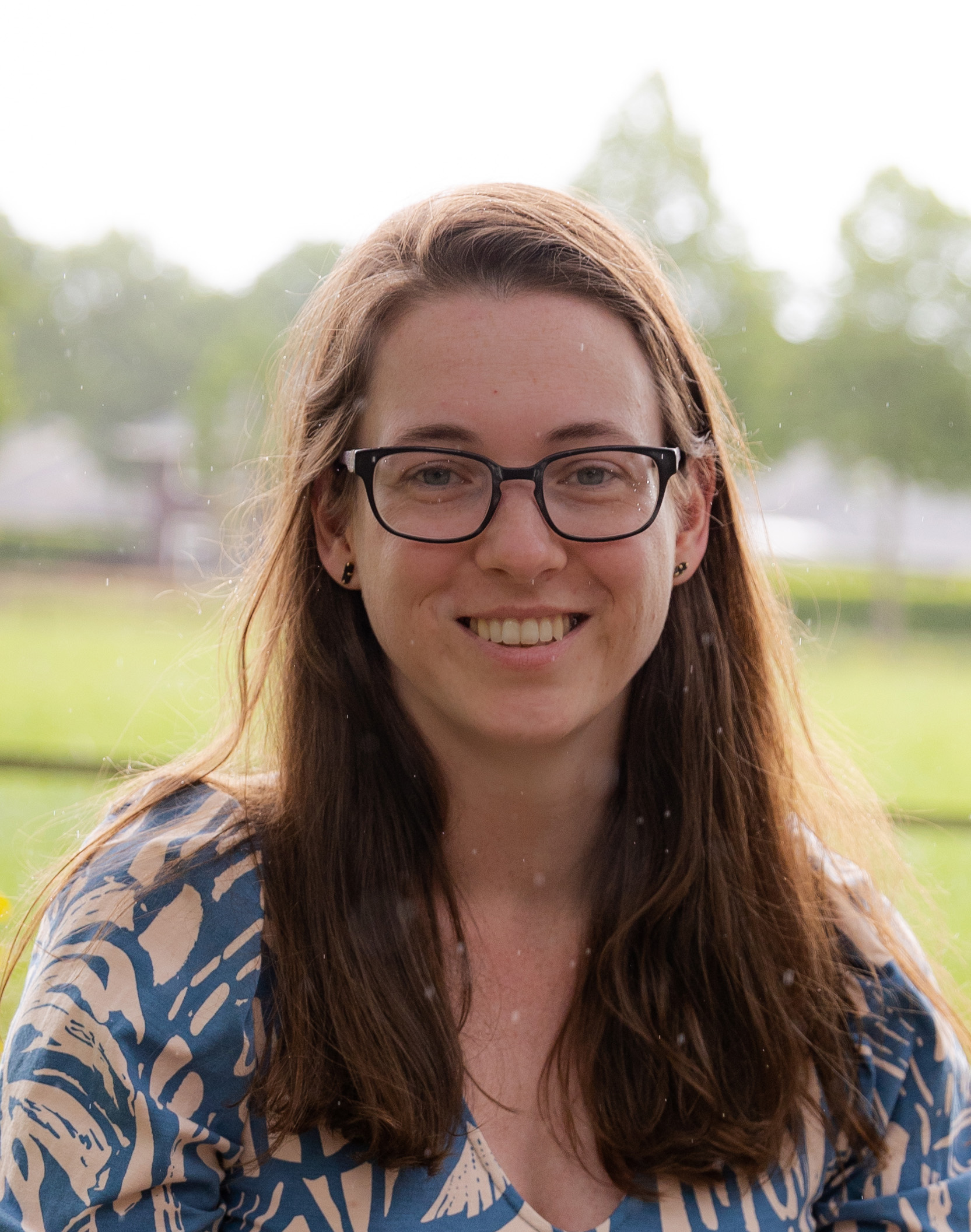
After completing her Ph.D. in astronomy and astrophysics at Leiden University, she began looking at opportunities outside of Europe. "One of my advisers was from the U.S., and I started to realize that a lot of the prestigious postdoc fellowships were in the U.S." This realization led van 't Hoff to the University of Michigan, where she worked as a postdoctoral researcher.
Today, van 't Hoff researches planetary motions and the processes that shape planetary systems from a physical and chemical perspective. Put simply, she studies the material surrounding young stars and how it evolves into planets. Van 't Hoff is especially excited about future telescope advancements. "With the upcoming telescopes that we have, we will be able to zoom in on the formation of planets that are like Earth," she explained. "This allows us to understand how common an Earth-like planet may actually be."
At Purdue, she teaches ASTR 364: Stars and Galaxies, a course where students learn about the structure and evolution of stars and planets alongside the large-scale structure of the universe. Outside of research and teaching, van 't Hoff relaxes by making jewelry with her husband, walking outdoors and taking photographs of nature. "I can adjust really quickly to a place," she said with a laugh. She admitted that one of the only things she misses from the Netherlands is the deep-fried snacks.
Abigail Polin was born in Pennsylvania and also knew from a young age that she wanted to pursue science. After completing her undergraduate studies at NYU, she went on to earn her Ph.D. at UC Berkeley in 2020. "I had the mindset going into college that I wanted to study something that I couldn't learn without help," she said. "It was really easy to see that I could not learn physics without a degree," she added with a laugh.
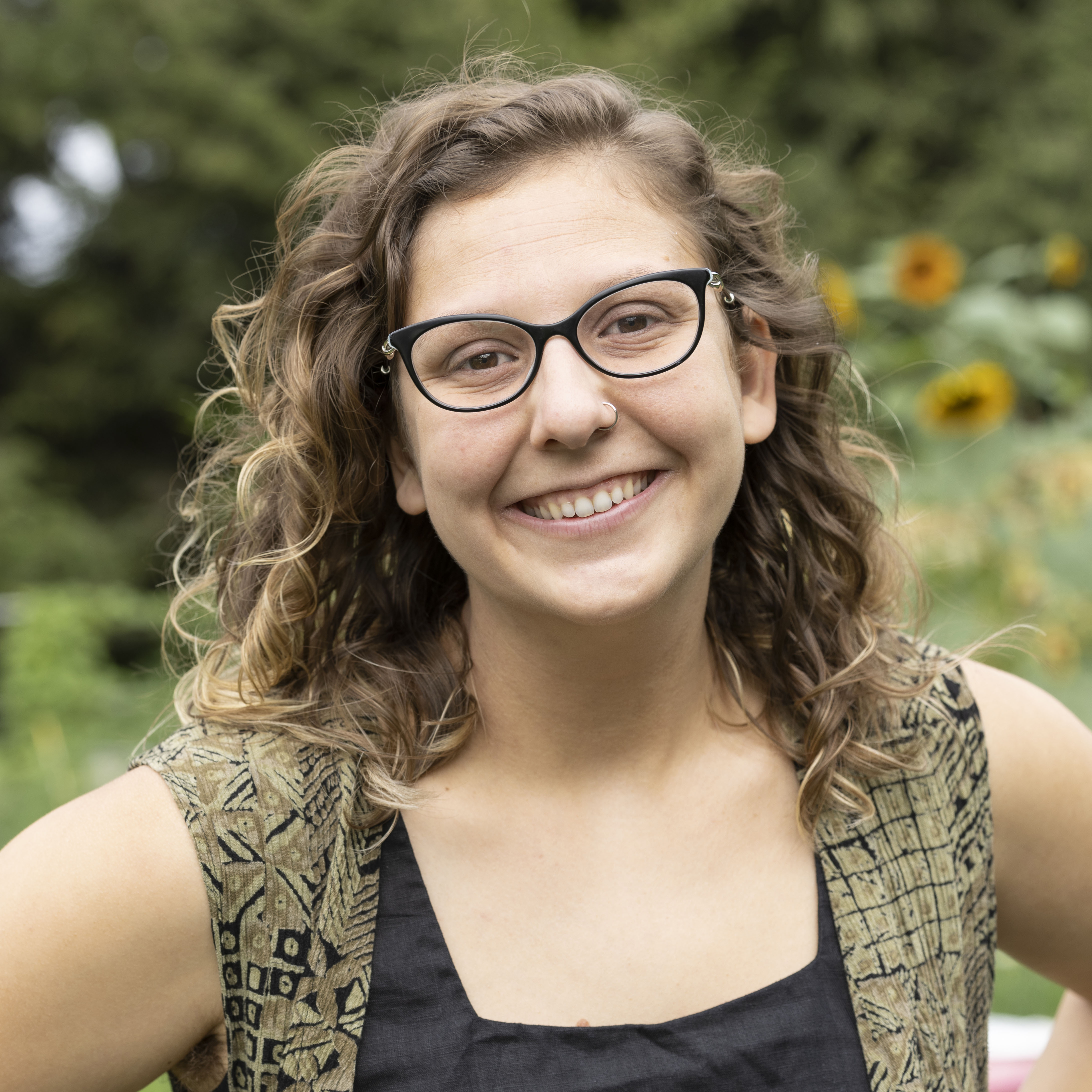
Polin now specializes in transient theory, which she described as "anything that goes boom in the night." Her research bridges the gap between theory and observation in the study of stellar deaths. "There are a variety of ways that stars can die, one of those being supernovae." Using computer simulations alongside observational data from instruments like the Magellan telescopes in Chile, she studies how stars explode and evolve over time.
Looking ahead, she is particularly excited about the potential of large-scale surveys: "With LSST, we are going to get a 10-year faint baseline of every pre-supernova eruption. It's going to be huge in our understanding of the death throes of stars." At Purdue, Polin teaches observational astronomy and stellar evolution. Outside of work, she recharges with creative outlets such as stained glass, watercolor painting and reading.
Despite their success, both women have faced challenges as women in STEM careers. When asked about her experience being a woman in a traditionally male-dominated field, Polin said, "It's hard. It means that you'll have experiences where you're the only woman in the room and that shouldn't matter, but it can." She recalled moments from her undergraduate years when she received unsolicited directions to the psychology side of the physics building. She laughed and said, "My male peers never were told, 'Hey, the psychology department is that way,' just so you know." She also noted the lack of representation throughout her education: "In my entire academic career, I think I've only been taught by one woman professor."
Van 't Hoff reflected on how early experiences can shape a person's sense of belonging in a certain field. "At a young age, it is easy to adopt what you see," she said. "If people that you trust tell you that something isn't for you, and they tell you that often enough, that's what you believe." Van 't Hoff also pointed to subtle messaging as a key influence: "If they're always giving you dolls to play with, then how can you ever find out that building Legos is something that you like doing a lot more?"
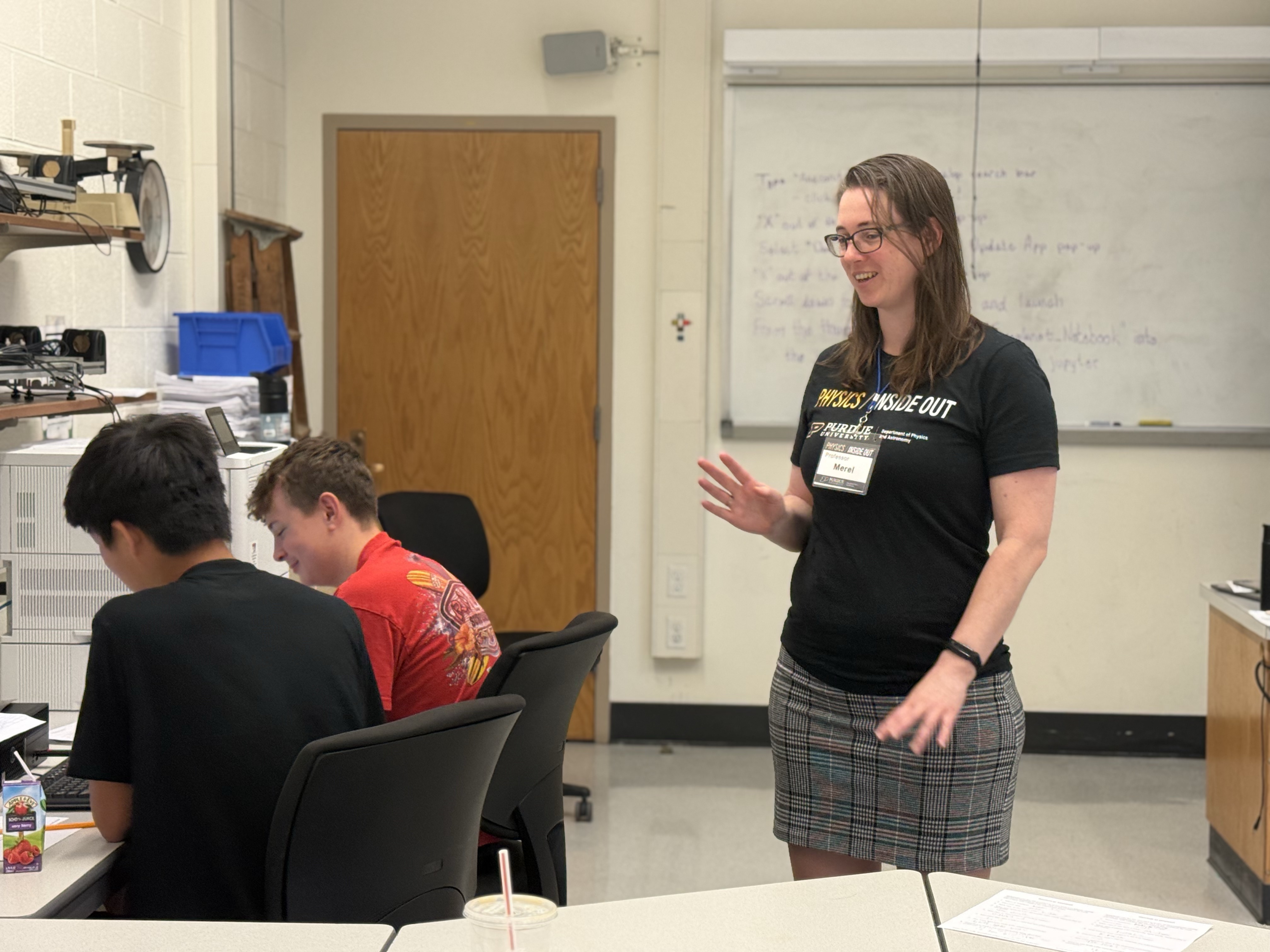
Merel van 't Hoff helping 7th and 8th graders during Physics and Astronomy's Physics Inside Out. (Photo by/David Siple)
Both professors emphasized that the gender gap in STEM is not about ability, but exposure and encouragement. "We see successful women in all kinds of fields, so I don't believe that there's an intrinsic reason as to why there aren't as many women as men," van 't Hoff explained. Instead, she pointed to the influence of representation and early intervention from family and peers.
Polin echoed this sentiment with a personal story from childhood: she recalled telling her mother that it felt like there was “an age where girls don’t do science anymore,” after being signed up for a summer science camp where she was the only girl. Looking back, she credits her mom's encouragement as essential to her development. "You know, it starts early that society doesn't expect you to do this. Kids can be cruel, and they parrot what they hear." When asked why fewer women pursue STEM fields, Polin said: "If you walk into a room and people are angry that you're there, you're not likely to stay."
When asked about their experiences at Purdue, both spoke highly of their department. "It's a great environment. Our students are absolutely phenomenal," Polin said. Van 't Hoff noted that she felt welcomed from her first visit. She described Purdue's community as close-knit and inspiring. She especially enjoys engaging with students, noting that activities like journal club are among her favorite parts of academic life.
When work becomes challenging, both said their students' enthusiasm keeps them motivated. Polin said, "Students get intimidated to come talk to us, but we're physics nerds too. We've just been physics nerds for a little longer."