Faculty Spotlight:
A pen, paper and big questions: Purdue physicist Qi Zhou studies the quantum world
Story by David Siple
Not every physicist needs a giant lab to study the universe's intriguing questions. For Purdue professor Qi Zhou, the work often starts much more simply: a pen, a few sheets of paper, a computer and, according to his website, "a cup of tea or coffee."
Zhou, a professor of physics and astronomy at Purdue University, is a theorist. Rather than building instruments or running large experiments, he develops the ideas that help explain how quantum matter behaves under extreme conditions. His research focuses on atomic, molecular and optical physics, with interests that include synthetic gauge fields for ultracold atoms, strongly interacting bosons and fermions, quantum nonequilibrium dynamics, and the connection between few-body and many-body physics.
His work is rooted in fundamental science, but it also connects to fast-growing areas such as quantum simulation and quantum information science. Those are fields researchers hope will deepen our understanding of nature while also opening the door to future technologies.
That work has brought Zhou recognition at Purdue and beyond. In 2024, he was named a University Faculty Scholar, an honor that recognizes faculty members who are on an accelerated path for academic distinction. In 2025, he was elected a fellow of the American Physical Society, a prestigious honor in the field. Purdue noted that APS fellowship is limited each year to no more than one-half of 1% of the society's membership.
At the center of Zhou's research is a basic but difficult question: What happens when matter no longer behaves in ordinary ways?
In the everyday world, it is easy to think of particles as separate things, each acting on its own. But in quantum systems, especially at ultracold temperatures, particles can begin to behave collectively. In those cases, the system can no longer be understood by looking at one particle at a time.
Zhou pointed to the Bose-Einstein condensate as one example. In that state, he explained, bosons cooled to sufficiently low temperatures are described by a single macroscopic wavefunction, leading to many-body behaviors that cannot be understood from individual particles alone. His work has also explored even more unusual possibilities. In some cases, multiple particles first bind together into composite objects, and those bound states then condense. That can lead to unconventional collective behavior, including situations where a state that would usually be seen as insulating can still carry supercurrents under inhomogeneous fields.
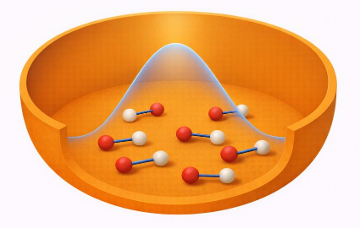
A particle (red sphere) and a hole (white sphere) pair to form a dipole, and these dipoles collectively assemble into a Bose–Einstein condensate. (Figure provided by/Qi Zhou)
For people outside physics, those ideas can sound abstract. For Zhou, though, that is part of the appeal. "The most rewarding aspect is coming to understand something that initially seemed completely unclear," he said. "It may take a long time to work through ideas that are confusing and elusive. Yet when understanding finally arrives, the moment is deeply satisfying and truly joyful, especially when you realize that others in the field have not yet reached the same level of understanding."
His path into physics developed over time. Zhou grew up in Qidong in Hunan province, China, and said his early interest may have started with reading about the debate between heliocentrism and geocentrism, similar to many other kids. But he did not decide all at once to become a physicist.
That interest grew during his undergraduate years at Tsinghua University in Beijing, where he and his classmates shared what he described as a "strong and contagious enthusiasm for physics." They attended seminars, joined research projects and interacted with leading physicists from around the world. Zhou said those experiences deepened their curiosity and encouraged many of them to pursue academic careers.
After earning his bachelor's degree from Tsinghua University, Zhou went on to complete his doctorate at Ohio State University and postdoctoral training at the University of Maryland. Before joining Purdue, he served on the faculty at the Chinese University of Hong Kong.
At Purdue, Zhou said one of the biggest strengths is the people around him. "Colleagues at our university work in diverse areas, with interests that are different yet often overlapping," he said. "We like to exchange ideas and learn from one another."
That kind of environment matters for a theorist whose work crosses multiple areas of physics. Purdue's Department of Physics and Astronomy includes expertise spanning astrophysics, atomic and molecular optics, condensed matter physics, quantum information science and particle physics. For Zhou, that breadth creates space for conversations that can sharpen old questions and spark new ones.
In the classroom, he brings the same careful approach that shapes his research. Zhou said teaching complex material well means breaking it down into pieces students can actually work through. "I think it is important to break complex ideas into smaller, manageable pieces and ensure that each one is accessible to students," he said. "Doing this well requires both patience and experience."
That philosophy also shapes the advice he gives young scientists. Zhou said students sometimes think they understand a concept when their grasp is still only surface level, and that can get in the way of real progress.
"It is essential to be clear about what we truly understand and what we do not," he said. "Sometimes students feel they have grasped a concept when their understanding is only superficial. This false sense of comprehension can become the greatest obstacle to further progress."
He added that without "a clear physical picture articulated in one's own words," it becomes too easy to repeat ideas from others rather than develop original thinking.
Zhou's recent publications reflect the wide range of questions his group is tackling. They include "Curving the Space by Non-Hermiticity," published in Nature Communications in 2022, "Building Krylov Complexity from Circuit Complexity," published in Physical Review Research in 2024, and "Multipolar Condensates and Multipolar Josephson Effects," published in Nature Communications in 2024.
When asked what other profession he might have chosen, he offered a response that was both practical and a little playful. "I have never seriously considered a career outside of physics. My research has been keeping me very busy. In any case, as physicists well know, the arrow of time cannot be reversed, at least not in the foreseeable future."
For Zhou, physics is more than a job. It is a way of asking questions and sitting with them long enough to reach something clearer on the other side. At Purdue, he continues that work through research, teaching and collaboration, one idea at a time.
Related stories
- From Bogotá to Purdue, Ramon Guerrero explores the strange world of anyons
- Manfra appointed Purdue’s chief quantum officer
- Building connection beyond the classroom: PGSA creates community in Purdue Physics and Astronomy
- From a Student’s View: Two Purdue Scientists on Curiosity, Challenge and Community