Engineering fountain in the spring

Quantum Machine Learning Research

Including AI and Quantum Algorithm Development

Overview

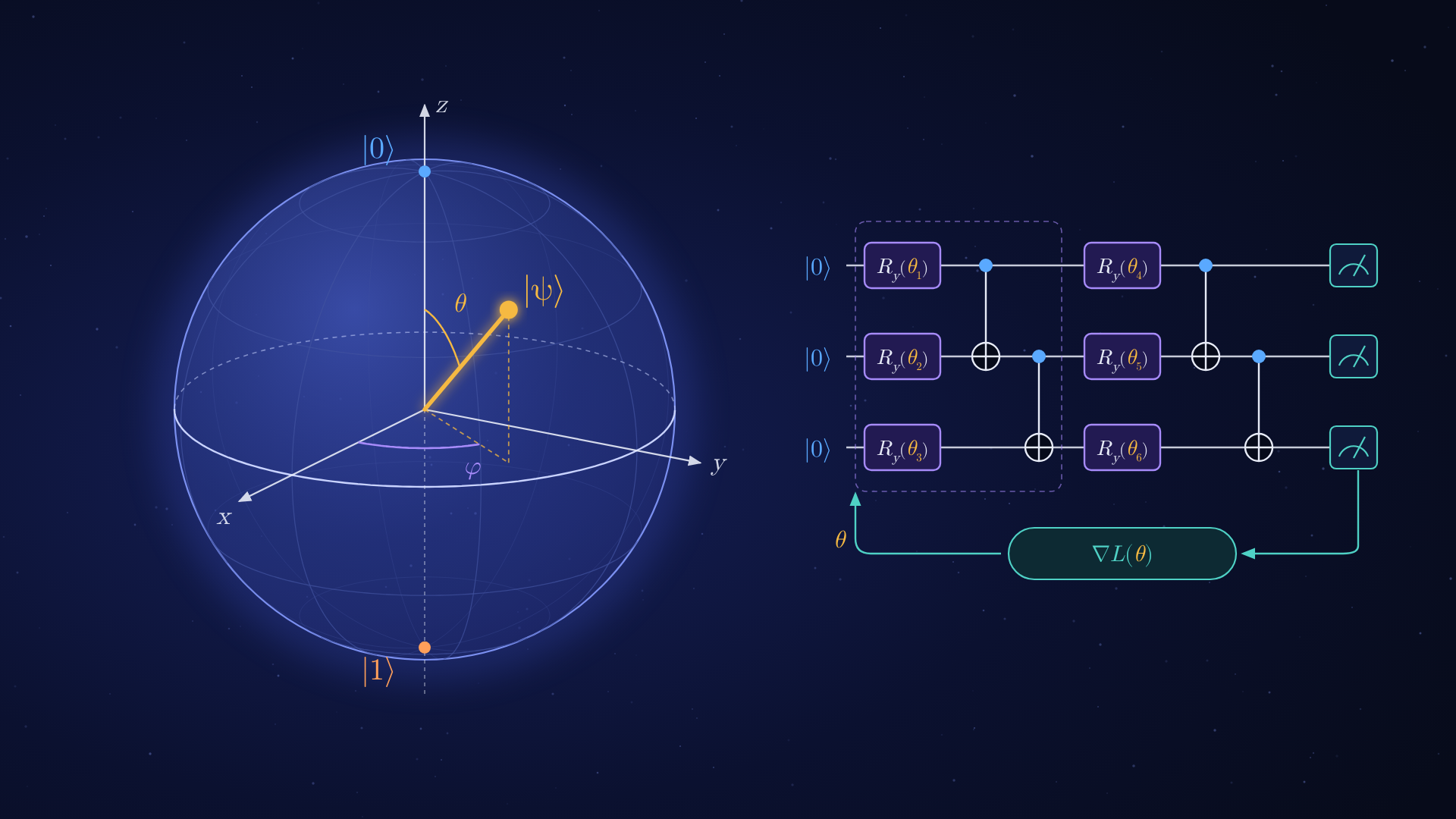
Quantum Machine Learning represents the intersection of quantum information science, machine learning, and scientific computing. The group's activities range from the development of quantum algorithms for optimization and inference to hybrid quantum-classical workflows, quantum-enhanced scientific observables, and workforce development in emerging quantum technologies. A distinguishing feature of this pillar is its strong connection to the other research areas. Quantum algorithms support optimization problems arising in detector design and operations, while quantum-information concepts provide entirely new observables for experimental particle physics.

Automation methods for gamma ray spectroscopy and data analysis

This applied physics research aims to enhance gamma-ray spectroscopy analysis using machine learning. Traditional methods struggle with complex data interpretation due to limited or missing theoretical predictions. By integrating machine learning into "Radware", a widely used spectroscopy analysis program, we aim to accelerate the identification of isotope level schemes and uncover transitions that may have been previously overlooked. The project involves training algorithms with synthetic toy spectral data generated through Monte Carlo techniques, ultimately improving the efficiency and accuracy of nuclear spectroscopy analysis.

Magic

The Jung group is investigating the correlation between quantum magic (AKA non-stabilizerness) and trainability of Parameterized Quantum Circuits (PQCs). Across many circuit families, we have developed a protocol which stratifies the parameter space based on magic and subsequently checks gradient behavior. We aim to understand in what cases magic helps, hurts, or has no effect on trainability of PQCs.

Supply Chain and Inventory Management

The Jung group is leading activities to solve real-world problems such as optimization, data science, and optimizations by employing quantum computing resources. These resources are either quantum annealing system (DWave) or also the Ion-Q & IBM-Q gate-based systems.

Purdue Quantum Computing Landscape

The Purdue Quantum Science & Engineering Institute (PQSEI) provides a stimulating environment to foster the development and ideas of practical and impactful aspects of quantum science. The Jung group is engaged in research and development of quantum algorithms that solve computational challenges arising in times of the High-Luminosity LHC phase. We currently work with a quantum annealing system (D-Wave) and also use Ion-Q, IBM-Q gate-based quantum computer hardware platforms as well.

An overview of quantum computing activities can also be found here: Quantum Informatics. We are members of the Midwest Quantum Collaboratory in the research area of Quantum Algorithms, Quantum machine learning, Data Analytics, and also Quantum sensor development.

Facilities

View the facilities utilized for this research.

Placeholder Image

Purdue University

Facility 1

Lorem ipsum dolor sit amet, consectetur adipiscing elit. Sed viverra molestie justo, non efficitur nunc blandit a. Vestibulum consectetur aliquam nibh, at vulputate lorem faucibus sit amet.

View Facility
Placeholder Image

Purdue University

Facility 2

Lorem ipsum dolor sit amet, consectetur adipiscing elit. Sed viverra molestie justo, non efficitur nunc blandit a. Vestibulum consectetur aliquam nibh, at vulputate lorem faucibus sit amet.

View Facility

Video

Watch Video

Quantum Machine Learning Publications

Enhanced reconstruction of dileptonic top quark-antiquark events using supervised machine learning methods

A.M. Sirunyan, ..., E. Colbert, A.W. Jung, G. NegroP , A.J. Wildridge, Y. Yao et al. (CMS Collaboration), Enhanced reconstruction of dileptonic top quark-antiquark events using supervised machine learning methods, CMS-NOTE-2025-010, 2025