|
Phone:
(765) 496-2464 [office]
(765) 494-5971 [lab]
(630) 309-8187 [cell]
Fax:
(765) 494-0706 [Purdue]
Office:
Phys 378 (office)
Phys 337 (lab)
Purdue Address:
Department of Physics
Purdue University
525 Northwestern Ave.
West Lafayette, IN 47907-2036
|
Research Interests
|
CMS Detector Upgrades
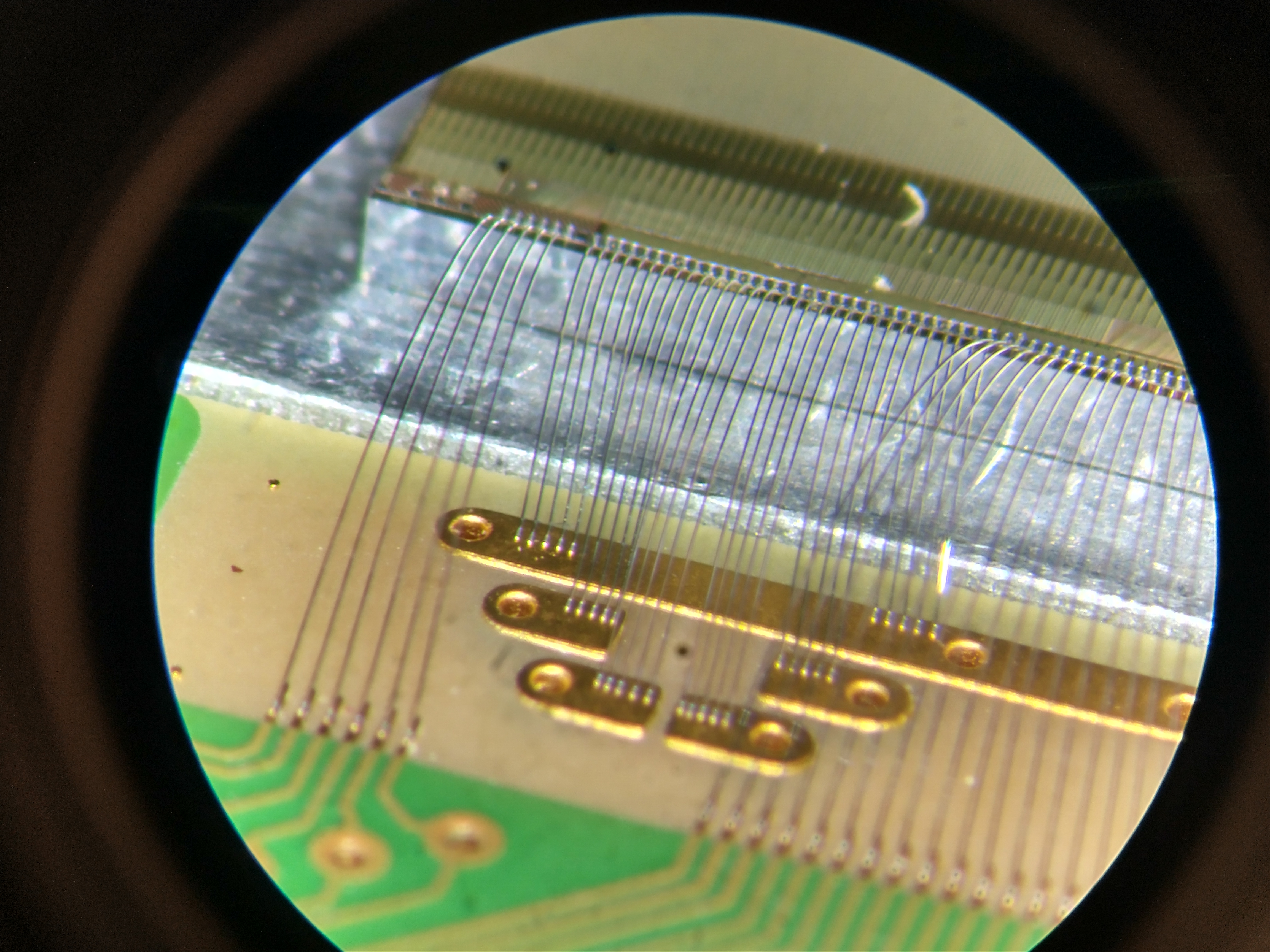
Purdue is leading the US effort to produce approximately 3000 pixel
sensor modules with which to construct parts of the CMS tracking detector
upgrade. We need to build a new inner tracking detector to allow efficient
operation of the CMS experiment when the High-Luminosity LHC accelerator
upgrades are completed. Purdue receives flex circuits and custom ASIC
readout chips bump bonded to rad-hard pixel sensors, and developed a
process for assembling these components using a precision robotic gantry,
custom mechanical fixtures and tooling, and automatic wire bonding.
Purdue completed the assembly of components needed for the Phase-1 CMS tracker
upgrade in 2016, using a similar
robotic assembly
process to build these modules. The Phase-1 Forward Pixel Detector was
assembled at Fermilab and now operates in the CMS detector at CERN.
In collaboration with Fermilab, we have constructed a silicon strip telescope
for use at the
Fermilab Test Beam Facility with
which to characterize rad-hard pixel sensors for future upgrades of the
CMS tracker and other novel sensor technologies.
|
Charged Lepton Flavor Violation with Mu2e
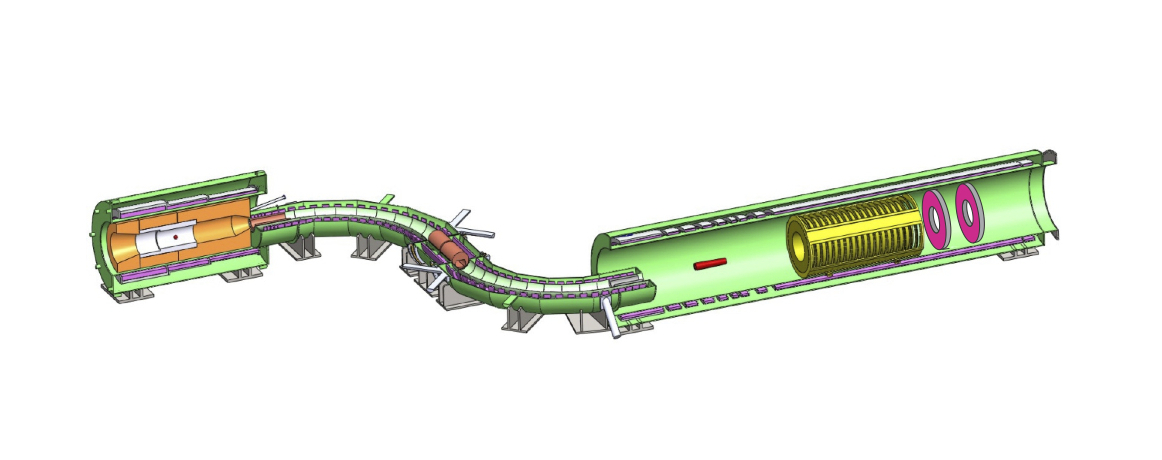
The Mu2e experiment will search for
charged lepton flavor violation by stopping muons on an aluminum target
and searching for μ→e. This rare process is sensitive to possible
new physics at mass scales up to 104 TeV, well beyond those
directly accessible at the LHC. Purdue is collaborating in the construction
of the extinction monitor system, which will measure the time structure of
the proton beam arriving at the muon production target. The detector uses
pixel sensors and readout chips originally developed by the ATLAS experiment,
and is responsible for the design and implementation of the associated data
acquisition system. The DAQ system is implemented in programmable logic
using commercial modules in a MicroTCA form factor.
|
|
Education and Outreach
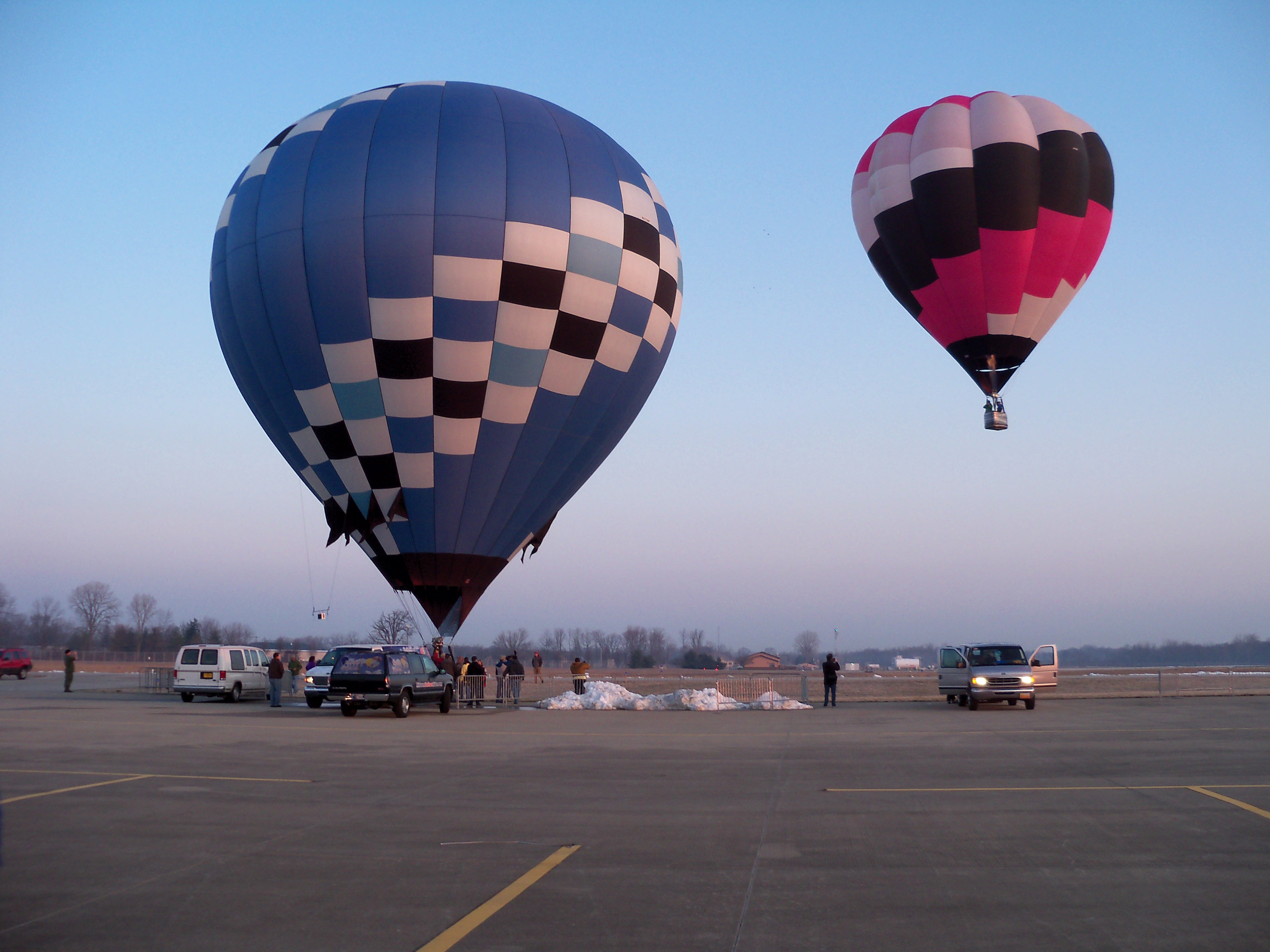
I help organize a QuarkNet summer
workshop for high school teachers as part of the Physics Department's
outreach
program. We provide support for participating teachers throughout the year,
including an annual MasterClass activity for high school students, and local
support for cosmic ray detector experiments in Indiana high schools. The 2016 QuarkNet workshop will be held during the week of June 27th-July 1st.
|
|
Other activities
I organize Purdue's participation as an associate member of the
EU INFIERI project.
| 3rd INFIERI workshop
| January 20-22, 2014 | Madrid, Spain |
| 2nd International School
| July 14-25, 2014 | Paris, France |
| 4th INFIERI workshop
| December 10-12, 2014 | NIKHEF Amsterdam |
| 5th INFIERI workshop
| April 27-29, 2015 | CERN, Geneva |
| 3rd International School
| September 14-25, 2015 | University of Hamburg |
| 6th INFIERI workshop
| October 27-29, 2015 | INFN Pisa, Italy |
| 7th INFIERI workshop
| April 12-15, 2016 | Lisboa, Portugal |
| 8th INFIERI workshop
| October 17-21, 2016 | Fermilab |
I have also worked with the OPAL
experiment at CERN, and the
SLD detector
at SLAC.
Courses
Physics 27200 - Fall 2025 - Electric and Magnetic Interactions
Physics 53600 - Spring 2025 - Electronic Techniques for Research
Physics 46000 - Fall 2024 - Honors Quantum Mechancis I
Physics 53600 - Spring 2024 - Electronic Techniques for Research
Physics 46000 - Fall 2024 - Honors Quantum Mechancis I
Physics 46000 - Fall 2023 - Honors Quantum Mechancis I
Physics 56500 - Spring 2023 - Introduction to Particle Physics II
Physics 33000 - Fall 2022 - Intermediate Electricity and Magnetism
Physics 33000 - Fall 2021 - Intermediate Electricity and Magnetism
Physics 56500 - Spring 2021 - Introduction to Particle Physics II
Physics 33000 - Fall 2020 - Intermediate Electricity and Magnetism
Physics 53600 - Spring 2020 - Electronic Techniques for Research
Physics 56400
- Fall, 2019 - Introduction to Elementary Particle Physics I
Physics 56500
- Spring, 2019 - Introduction to Elementary Particle Physics II
Physics 56400
- Fall, 2018 - Introduction to Elementary Particle Physics I
Physics 56500
- Spring, 2018 - Introduction to Elementary Particle Physics II
Physics 56400
- Fall, 2017 - Introduction to Elementary Particle Physics I
Physics 22000
- Fall, 2016 - General Physics
Physics 42200
- Spring, 2016 - Waves and Oscillations
Physics 21900
- Fall, 2015 - General Physics
Physics 42200
- Spring, 2015 - Waves and Oscillations
Physics 24100
- Fall, 2014 - Electricity and Optics
Physics 42200
- Spring, 2014 - Waves and Oscillations
Physics 24100
- Fall, 2013 - Electricity and Optics
Physics 42200
- Spring, 2013 - Waves and Oscillations
Physics 29000
- Spring, 2013 - Service Learning: Quarknet Outreach
Physics 24100
- Fall, 2012 - Electricity and Optics
Physics 56500
- Spring, 2012 - Introduction to Particle Physics II
Physics 56500
- Spring, 2011 - Introduction to Particle Physics II
Physics 56500
- Spring, 2010 - Introduction to Particle Physics II
Physics 536
- Spring, 2009 - Electronic Techniques for Research
Physics 536
- Spring, 2008 - Electronic Techniques for Research
Physics 536
- Fall, 2007 - Introduction to Elementary Particle Physics
Physics 536 - Spring, 2007 - Electronic Techniques for Research
Physics 310 - Fall, 2006 - Intermediate Mechanics
Physics 218
- Spring, 2006 - General Physics
Physics 564
- Fall, 2005 - Introduction to Elementary Particle Physics
Physics 218
- Spring, 2005 - General Physics
Physics 310
- Fall, 2004 - Intermediate Mechanics
Physics 564
- Fall, 2003 - Introduction to Elementary Particle Physics
Last updated Mon Mar 7 08:15:15 EST 2015
mjones@physics.purdue.edu