ELECTRONIC STRUCTURE AND MAGNETISM OF MOLECULAR AND BIOMOLECULAR
NANOSTRUCTURES
Our research applies methods of computational quantum
mechanics to elucidate the electronic structure and magnetic properties of
molecular and biomolecular nanostructures. We are also interested in
understanding the electronic structure and functional mechanisms of
biomolecules, such as proteins and DNA, to propose new bio-inspired
nanodevices.
Recent
experiments suggest that electronic spin can be used to control and manipulate
the electrical conductivity and other properties of potential molecular-based
electronic devices. Our aim is to understand, from first-principle
electronic structure calculations,
how spin degrees of freedom can be used in conjunction with molecular systems to
design useful molecular spintronic devices.
Molecular Magnets
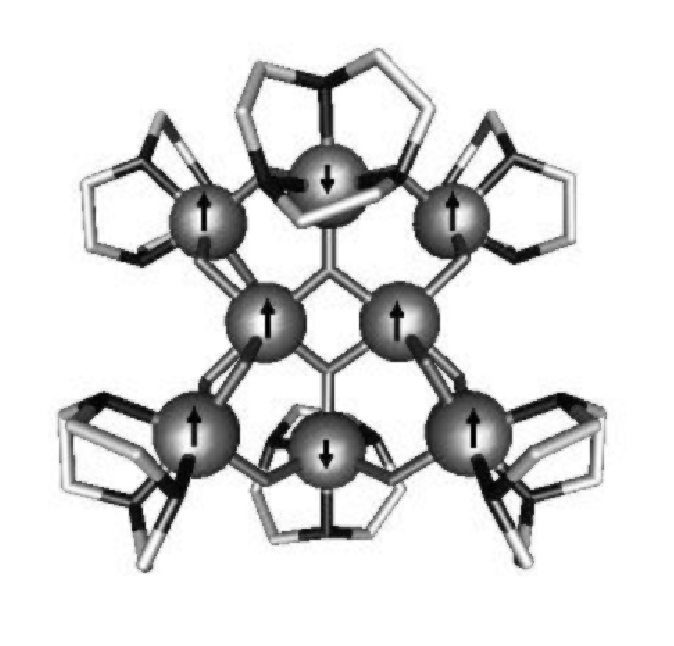 Iron core of the molecular magnet Fe8. The spheres represent the
iron ions and their arrows illustrate one of several possible ferrimagnetic
orderings which can lead to the observed S = 10 molecular ground state.
Iron core of the molecular magnet Fe8. The spheres represent the
iron ions and their arrows illustrate one of several possible ferrimagnetic
orderings which can lead to the observed S = 10 molecular ground state.
Several transition metal-containing molecular nanostructures of intermediate
nuclearity have been synthesized.
These structures contain on the order of 10 metal ions and
have novel physical and magnetic properties which are favored by their
mesoscopic dimensions. Displaying characteristics which are borderline
between those of simple paramagnets and those of bulk magnetic materials,
these transition metal-containing molecular nanostructures have attracted
considerable interest from physicists, chemists and material scientists.
The theoretical investigation of "molecular
magnets" is of interest not only due to their novel properties, which
are borderline between quantum and classical phenomena, but
also due to their potential technological applications which range from
quantum computing to memory storage devices. In fact, the magnetic bistability
found in several molecular magnets can potentially permit storing data
at an extremely high density by localizing each bit of information in a
single molecule. Prominent examples are the ferrimagnetic nanostructures
known as Fe8 and Mn12 which exhibit quantun tunneling of their sublattice
magnetizations (macroscopic quantum tunneling) and magnetic hysteresis not given
by long-range-order interactions but having a purely molecular origin.
Athough much experimental
and theoretical effort has been devoted to understanding
spin dynamics
and tunneling rates in molecular magnets, little
attention has been given to the first principle calculation of their electronic
structures and to the computational prediction of
their magnetic properties such as magnetic anisotropies.
Our efforts are devoted to understanding the detailed electronic configurations
which ultimately give rise to the observed magnetic properties of molecular
magnets. Such understanding can significantly contribute to the work of
synthetic material scientists who try to engineer molecular magnets for
potential technological applications.
Computational Electronic Structure
of DNA

(a) The double-helix structure of DNA consists of two linear strands
with four bases guanine (G), cytosine (C), adenine (A) and thymine (T). The
A bases on one strand pair up with the complementary T bases on the other
strand, while G pairs up with C.
(b) Electron-transfer-rate experiments have been carried out on DNA
molecules that have donor and acceptor groups added at each end. In
electronic-transport experiments, the DNA molecules are sandwiched between two
metal electrodes. [Source: C. Dekker and M. Ratner,
physicsweb.org, 2001]
DNA has a crucial role in biological systems as a carrier of
genetic information. More recently, however, some experiments suggest that
DNA can also be seen as an efficient "molecular wire" which offers
virtually no resistance to electronic conductivity. We are interested in
elucidating, by means of computational methods of electronic structure, the
possible pathways for electron transfer which give rise to the conduction
properties of DNA.
Computational Electronic Structure
of Nanotubes
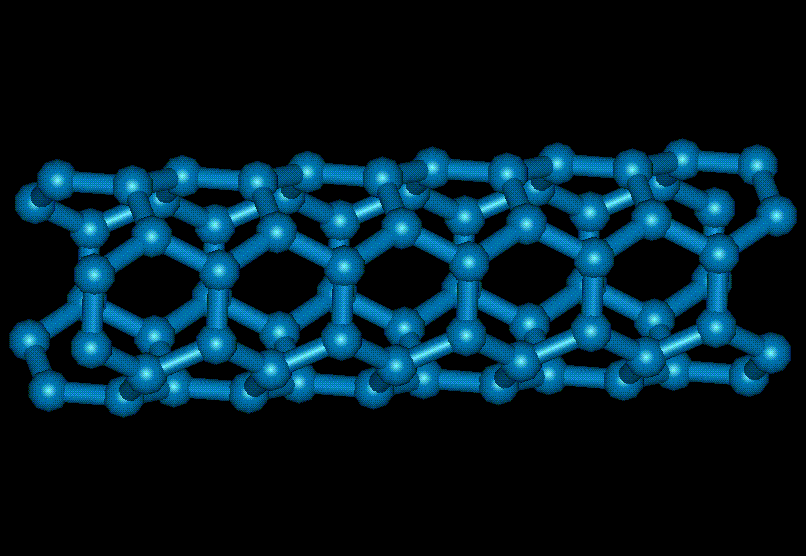 Single-Walled
Carbon Nanotube of (3,3) Chirality.
Single-Walled
Carbon Nanotube of (3,3) Chirality.
Single walled nanotubes (SWCNs) are carbon-based nanostructures with
remarkable electronic properties. The small diameter of SWCNs gives their
physical properties a quasi one-dimensional character. That is SWCNs
can be regarded as one-dimensional quantum wires. SWCNs are thought to
be potentially useful in the design of nanoscale electronicdevices and,
due to their mechanical properties, for developing strong polymer-based
materials. We are studying the electronic structure of nanotube models
to establish some correlations between their geometric structures,
density of states (DOS), and characteristics of their valence and conduction
bands. We are particularly interested in studying possible magnetic
properties, such as intrinsic spin polarization, which is believed to occur
in some heterostructured (doped) nanotubes. Such heterostructures
may serve as "spin-polarizers" during electron transport.
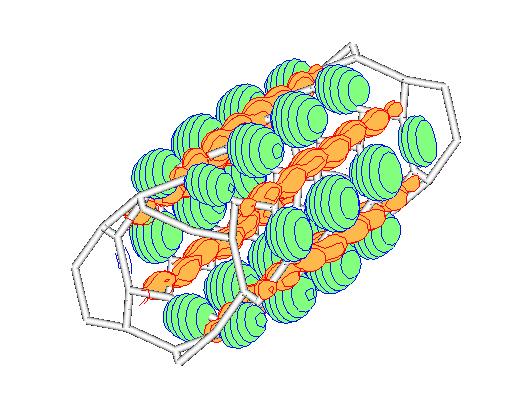
Delocalized Electron Density.
The figure shows a delocalized one-electron valence state that we have obtained
from density functional theory (DFT) calculations on the (3,3) nanotube shown
above. The one-electron density spans the entire nanostructure indicating that
the molecular geometry allows, by itself, intrinsic delocalization
whereby some valence electrons are completely delocalized along the axis
of the nanotube.

 The
National Science Foundation (NSF) has granted a CAREER award to Jorge Rodríguez,
Assistant Professor of Physics at Purdue. This award intends to foster Prof.
Rodriguez's theoretical and computational research on biomolecular and
mesoscopic physics and, in particular, on quantum models of the electronic
structure and biological function of magnetically ordered metalloproteins. This
award also intends to contribute to Prof. Rodriguez's various educational
efforts. According to NSF, the CAREER is its "most prestigious award for
new faculty members. The CAREER program recognizes and supports the early
career-development activities of those teacher-scholars who are most likely to
become the academic leaders of the 21st century." The award carries with it
funding for five consecutive years.
The
National Science Foundation (NSF) has granted a CAREER award to Jorge Rodríguez,
Assistant Professor of Physics at Purdue. This award intends to foster Prof.
Rodriguez's theoretical and computational research on biomolecular and
mesoscopic physics and, in particular, on quantum models of the electronic
structure and biological function of magnetically ordered metalloproteins. This
award also intends to contribute to Prof. Rodriguez's various educational
efforts. According to NSF, the CAREER is its "most prestigious award for
new faculty members. The CAREER program recognizes and supports the early
career-development activities of those teacher-scholars who are most likely to
become the academic leaders of the 21st century." The award carries with it
funding for five consecutive years.