Andrew S. Hirsch
NOTE: E-mail addresses end with @purdue.edu
S.B., Physics 1972 Massachusetts Institute of Technology
Ph.D., Physics 1977 Massachusetts Institute of Technology
- Experimental exploration of the equation of state of state of nuclear matter
- Physics Education Research projects
- Making Sense of Global Warming and Climate Change: Model of Student Learning via Collaborative Research
- Teaching and Learning about Climate Change: A Framework for Educators, coeditor, to be published by Routledge
- Understanding aspects of the performance in introductory mechanics of first year engineering majors
- High energy nuclear physics projects
- Nonlinear Dynamics and Chaotic Phenomena
- High Energy Nuclear Physics
- Science and Society
- Introductory Mechanics and Electricity & Magnetism
- Charles Allen
- Tyler Browning
- Alex Cardenas
- Philip Cole
- Robert R. Davies
- James B. Elliott
- James E. Finn
- David Garand
- Mark L. Gilkes
- J. Andrew Hauger
- Tim Herston
- Mohamed Mahi
- Matt Marziale
- Roger W. Minich
- Cristina Moody
- T. Craig Sangster
- Penny Warren
A first generation experiment at the Relativistic Heavy Ion Collider (RHIC). Gold beams of 100 GeV/nucleon each will collide, providing conditions sufficient for the production of the quark-gluon phase of hadronic matter. The Purdue High Energy Nuclear Physics group has played a major role in the interpretation of the relativistic heavy ion data in terms of the Color String Percolation Model.
EOS Collaboration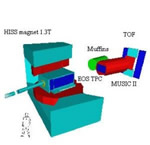 A reverse kinematics experiment in which Gold, Lanthanum, and Krypton 1 A GeV projectiles bombarded a Carbon target. This experiment features a seamless series of detectors capable of providing complete charge reconstruction of each collision. Results to date are consistent with a continuous phase transition occurring over a narrow range of excitation energy deposited in the projectile.
A search conducted at the BNL Alternating Gradient Synchrotron (AGS) for long-lived (>50 ns) strange quark matter. Strange quark matter (SQM), matter comprised of roughly equal numbers of up, down, and strange quarks, may be the ultimate ground state of nuclear matter. Even if SQM is not absolutely stable, it may be stable against strong decay, decaying via the weak interaction. If this is the case, central collisions between two heavy ions may provide the necessary conditions to create a "strangelet." The E864 spectrometer has redundant tracking in both space and time, and a spaghetti calorimeter that provides a "late-energy" trigger, allowing us to enhance the sample of events that are likely to contain strangelets.
E895A continuation the EOS Collaboration Bevalac flow studies extended to higher energies.
E442An inclusive proton-nucleus experiment conducted at the Internal Target Area at Fermilab in 1977. Using a supersonic gas jet of hydrogen mixed with varying inert gases, Xenon, Krypton, Argon, we studied the systematics of the kinetic energy spectra of fragments as a function of mass, charge, and production angle. The experimental evidence suggested that intermediate mass fragments of charge > 3 originated from a common system, i.e. a simultaneous disassembly.
E591An inclusive proton-nucleus experiment, also conducted at the Internal Target Area at Fermilab in 1981, featuring high statistics and low energy thresholds for dectection of heavy nuclear fragments. The capability of detecting low energy multiply charged reaction products such as carbon, oxygen, etc. was crucial to deterimining the total yield of each fragment type. The main experimental result was the observation of the power-law yield in the fragment mass distribution. The power-law characterizing the inclusive mass yield distribution had an exponent of -2.6, within the range expected for a system undergoing a continuous, or second order, phase transition. The fragment isotopic yield was well-described by adapting the Fisher droplet formula for nuclear physics. The Fisher droplet formula is a highly successful model of liquid-gas phase transitions in the neighborhood of the critical point. We estimated of the temperature of the system to be 5 MeV. Incident beam energies varied from 30-350 GeV. No energy dependence in fragment production was observed in this, the limiting fragmentation regime.
E778An inclusive gas jet experiment conducted at the Brookhaven National Laboratory (BNL). Alternating Gradient Synchrotron (AGS) in 1986. Fragment production in xenon was studied as a function of incident proton energy over the range 1-20 GeV. As much as a ten-fold increase in fragment production was observed over this energy range. Evidence for binary breakup at low incident energies was observed. The energy dependence of the Fisher droplet model quantities was determined permitting the approach to the critical point to be explored.
E735A proton-antiproton collider experiment conducted at the Fermilab Tevatron in 1987. This was one of the first examinations of very high multiplicity events created in pbar-p collisions at center-of-mass energy 1.8 TeV. By triggering on high multiplicity events and sampling particle spectra for pions, antiprotons, kaons, lambdas..., we were able to study the energy density dependence of the transverse momentum spectra and yields. A Hanbury-Brown and Twiss analysis of the pions permitted us to study the energy density dependence of the source size.
Selected Publications- Deconfinement and Clustering of Color Sources in Nuclear Collisions, M. A. Braun, J. Dias de Deus, A. S. Hirsch, C. Pajares, R. P. Scharenberg, B. K. Srivastava, Physics Reports, 599, 1-50, 2015.
- Gyroscopic Motion: Show Me the Forces!, Harvey Kaplan and Andrew Hirsch, Physics Teacher, 52, 30 (2014).
- Conceptualizing climate change in the context of a climate system: implications for climate and environmental education, Daniel P. Shepardson, Dev Niyogi, Anita Roychoudhury and Andrew Hirsch, Environmental Education Research Vol. 18, No. 3, 323-352 (2012).
- When the Atmosphere Warms It Rains and Ice Melts: Seventh Grade Students’ Conceptions of a Climate Change, Daniel P. Shepardson, Dev Niyogi, Anita Roychoudhury and Andrew Hirsch, Environmental Education Research, DOI:10.1080/13504622.2013.803037
- Percolation of color sources and the equation of state of QGP in central Au-au collisions at √ sNN = 200 GeV, R. P. Scharenberg, B. K. Srivastava, A. S. Hirsch, Eur. Phys. J. C (2011) 71: 1510
- Statistical signatures of critical behavior in small systems, J. B. Elliott, et al., (EOS Collaboration), Phys. Rev. C 62 064603-1-33 (2000).
- An investigation of standard thermodynamic quantities as determined via models of nuclear multifragmentation, J. B. Elliott and A. S. Hirsch, Phys. Rev. C 61, 054605-1-17 (2000).
- Search for neutral strange quark matter in high energy heavy ion collisions, T.A. Armstrong et al. (E864 Collaboration), Phys. Rev. C 59, R1829-R1833 (1999).
- Comparison of the 1A GeV 197Au+C interaction with first-stage transport codes, B.K. Srivastava et al (EOS Collaboration), Phys. Rev. C 60, 064606-1-7 (1999).
- Search for Charged Strange Quark Matter Produced in 11.5A GeV/c Au + Pb Collisions. T.A. Armstrong et al. (E864 Collaboration), Phys. Rev. Lett. 79, 3612-3616 (1997).
- J. B. Elliott, et al., Individual fragment yields and determination of the critical exponent sigma, Physics Letters B381, 35, 1996.
- J. A. Hauger, et al., Dynamics of the Multifragmentation of 1A GeV Gold on Carbon, Physical Review Letters 77, 235, 1996.
- M.L. Gilkes, et al., Determination of Critical Exponents from the Multifragmentation of Gold Nuclei, Phys. Rev. Lett. 73, 1590-1593, 1994.
- M.L. Gilkes, J. B. Elliott, J.A. Hauger, A.S. Hirsch, E. Hjort, R.P. Scharenberg, M.L. Tincknell, P.G. Warren, et al., Extraction of Critical Exponents from Very Small Percolation Lattices, Phys. Rev. C 49, 3185-3191, 1994.
More info on publications can be found at High Energy Nuclear Physics' website.