Stephen M. Durbin
NOTE: E-mail addresses end with @purdue.edu

Link to Durbin's Google Scholar homepage.
B.A. Physics 1976 University of Chicago
M.S. Physics 1977 University of Illinois, Urbana
Ph.D. Physics 1983 University of Illinois, Urbana
Research Interests
- Ultrafast x-ray dynamics in semiconductors
- X-ray physics at synchrotrons
- X-ray free electron laser
Ultrafast x-ray dynamics in semiconductors
While x-ray science has been unsurpassed in uncovering the detailed atomic structure of materials, today’s sources are so powerful that an x-ray pulse can actually change the electronic and structural properties of a material on ultrafast time scales. We have shown how an intense x-ray synchrotron pulse absorbed by the semiconductor GaAs can drive it into an optically transparent state for laser light that would otherwise be absorbed (Durbin, S.M., et al., X-ray pump optical probe cross-correlation study of GaAs. Nature Photonics, 2012. 6(2): p. 111-114). More recent studies have successfully used x-rays to excite such a high density plasma of electron-hole pairs in GaAs that stimulated emission of band gap radiation is seen, an x-ray excited version of a semiconductor laser diode. Other investigations have uncovered unique interactions between both laser and x-ray pulses of high intensity, resulting in optical amplification, stimulated emission, energy storage in metastable defects, and isochoric heating approaching warm dense matter.
The Advanced Photon Source x-ray synchrotron source at Argonne Nation Laboratory provides the phenomenal x-ray science capabilities that enable much of this research program. Fortunately, Purdue University is only a two-hour drive away from one of the world's premier science facilities, in a nearby Chicago suburb. Recent research has utilized the combination of intense x-ray pulses with a synchronized laser pulse, often tuned to the band gap of GaAs or other semiconductors. While others have long excited samples with a laser pulse and followed with a diagnostic x-ray pulse to sense subtle structural changes, to highlight one example, we have reversed this paradigm by pumping with an x-ray pulse, and probing subtle electronic perturbations with a carefully tuned laser pulse. We frequently utilize undulator beamlines in Sector 7 and Sector 14, which both have lasers synchronized with focused x-ray beams that are ideal for these x-ray pump/laser probe studies.
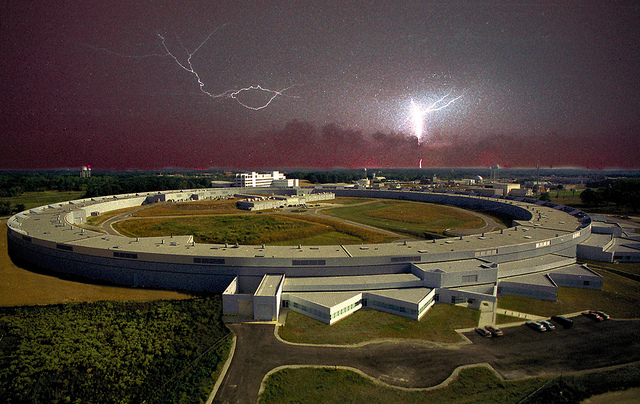
The Advanced Photon Source
X-ray free electron laserX-ray free electron lasers (XFELs) are already revolutionizing the capabilities for exploring matter at the frontiers of ultrafast, ultrasmall, and extreme energy densities. It will shape the future of x-ray physics, in the same way the synchrotron facilities have shaped the present. My research group has participated in an experiment at the Linear Coherent Light Source (LCLS) at Stanford/SLAC, in a collaboration with the lead PI, Professor Gerry Seidler at the University of Washington. Similar to our recent synchrotron studies, we are exploring how these femtosecond high intensity pulses of x-rays can excite simple materials at the nanoscale, including two-color x-ray pump x-ray probe studies. We hope to take advantage of the remarkable XFEL capabilities with greater regularity in the near future.
Teaching Interests
PHYS 233 Physics for Life Sciences
Starting in Fall 2014, Professor Durbin again initiated an entirely new curriculum for one of Purdue Physics largest constituents, this time for life science majors. (See below for the new engineering physics curriculum in PHYS 172/272.) PHYS 233/234 “Physics for Life Sciences” is the first introductory physics course at Purdue that was designed from the ground up to meet the unique requirements for the life sciences, as opposed to the traditional approach of teaching a watered-down version of engineering physics. PHYS 233 and its companion PHYS 234 are based on courses developed at the University of Maryland with the support of HHMI through the NEXUS collaboration (which includes Purdue). Working with Professor Ken Ritchie, this new sequence is now taught to several hundred life science majors a year, and it continues to grow in popularity.

PHYS 172: Matter & Interactions.
The traditional “Halliday & Resnick” introductory format for engineering physics that had been in use for over half a century at Purdue was finally set aside about ten years ago for a new approach that treats matter as being made up of atoms, for example, and other “modern” concepts that helped bring this critically important teaching responsibility into the 21st century. Professor Durbin spearheaded the switch to the “Matter and Interactions” curriculum that has been successfully taught to thousands of student every year since 2006. Instead of teaching the same physics that could have been taught to the grandparents of today’s students, the PHYS 172/272 sequence incorporates modern concepts of atoms, relativity, quantized states, and thermodynamics and includes programming skills that allow students to graphically simulate important physical systems.
Professional Affiliations
- American Physical Society
- National Synchrotron Light Source II, Inelastic Scattering Proposal Review Panel (chair).
- Linear Coherent Light Source, Methods & Instrumentation Review Panel (member).
Selected Publications
- Durbin, S.M., Comment on "Ultrafast terahertz-field-driven ionic response in ferroelectric BaTiO3". Physical Review B 2018, 97(22).
- Durbin, S.M.; Landcastle, A.; DiChiara, A.; Wen, H.; Walko, D.; Adams, B., Optical birefringence imaging of x-ray excited lithium tantalate. APL Photonics 2017, 2(8), 086102.
- Durbin, S.M.; Nagula, T.: DiChiara, A.D., X-ray and optical pulse interactions in GaAs. Journal of Applied Physics 2017, 122 (24).
- Durbin, S.M.; Liu, S.C.; Dufresne, E.M.; Li, Y.L.;Wen, H.D., Time delay measurement in the frequency domain. J Synchrotron Radiat 2015, 22, 1293-1296.
- Durbin, S.M.; Mahmood, A.; Caffee, M.; Savikhin, S.; Dufresne, E.M.; Wen, H.D.; Li, Y.L., Optoelectronic measurement of x-ray synchrotron pulses: A proof of concept demonstration. Applied Physics Letters 2013, 102 (5).
- Durbin, S.M.; Clevenger, T.; Graber, T.; Henning, R., X-ray pump optical probe cross-correlation study of GaAs. Nat Photonics 2012, 6(2), 111-114.
- Durbin, S.M.; Mahmood, A., Picosecond X-ray Sensor. 2012 Ieee Sensors Proceedings, 2012, 2216-2218.
- Durbin, S.M.; Colella, R., X-Ray Optics Diamond Brillance. Nature Physics 2010, 6(3), 163-164.
- Scheidt, W.R.; Durbin, S.M.; Sage, J.T., Nuclear Resonance Vibrational Spectroscopy - NRVS. Smallest Biomolecules: Diatomics and Their Interactions with Heme Proteins 2008, 124-146.
- Khang, D.; Kim, S.Y.; Liu-Snyder, P.; Palmore, G.T.R.; Durbin, S.M.; Webster, T.J., Enhanced fibronectin adsorption on carbon nanotube/poly(carbonate) urethane: Independent role of surface nano-roughness and associated surface energy. Biomaterials 2007, 28(32), 4756-4768.
- Durbin, S.M.; Jach, T.; Kim, S.; Gopalan, V., Natural focusing of x-rays from ferroelectric lithium niobate wafers. Applied Physics Letters 2007, 91(14).
- Zhang, C.F.; Durbin, S.M., Hydration-induced far-infrared absorption increase in myoglobin. Journal of Physical Chemistry B 2006, 110(46), 23607-23613.
- Adams, K.L.; Tsoi, S.; Yan, J.S.; Durbin, S.M.; Ramdas, A.K.; Cramer, W.A.; Sturhahn, W.; Alp, E.E.; Schulz, C., Fe vibrational Spectroscopy of myoglobin and cytochrome f. Journal of Physical Chemistry B 2006, 110(1), 530-536.
- Rai, B.K.; Prohofsky, E.W.; Durbin, S.M., Single-atom test of all-atom empirical potentials: Fe in myoglobin. Journal of Physical Chemistry B 2005, 109(40), 18983-18987.
- Bird, C.T.; Calvin, J.L.; Davies, M.H.; Fetrow, B.M.; Herman, S.M.; Hill, R.J.; Holman, K.W.; LaBelle, J.J.; Smiley, C.L.; Wegner, J.M.; Dedrick, E.; Durbin, S.M., Miscibility of Au and Cu in superconducting YBa2(Cu1-xAux)307-delta for 0 < x < 0.15. Physica C 1999, 324(3-4), 133-136.
- Durbin, S.M., Classical theory of magnetic x-ray scattering. Physical Review B 1998, 57(13), 7595-7605.
- Chung, J.S.; Durbin, S.M., Dynamical Diffraction in Quasi-Crystals. Physical Review B 1995, 51(21), 14976-14979.
PDFs on this page are part of the Department of Physics and Astronomy Web Archive. They are no longer maintained and may not meet web accessibility standards. To request them in an accessible format, contact the department at dsiple@purdue.edu.