Purdue NanoTechnology Initiative (NTI)
The objective of the Purdue Nanotechnology Initiative is to demonstrate novel techniques for the design and fabrication of nanoelectronic devices by the chemical manipulation of nanometer (10-9 meters) sized clusters and molecular wires. These efforts are made possible by the combined efforts of an interdisciplinary team of researchers from Chemistry, Chemical Engineering, Electrical Engineering and Physics who were brought together under an ARO/URI (1992-97).
Metallic nanoclusters and molecular wires have
been studied for some time as two active but distinct fields of research.
We have recently been able to combine the expertise from these two fields
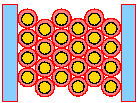
to fabricate a Linked Cluster Network (LCN) : a two-dimensional superlattice
consisting of nanometer-sized gold clusters electronically linked by pi-conjugated
organic molecules (right). 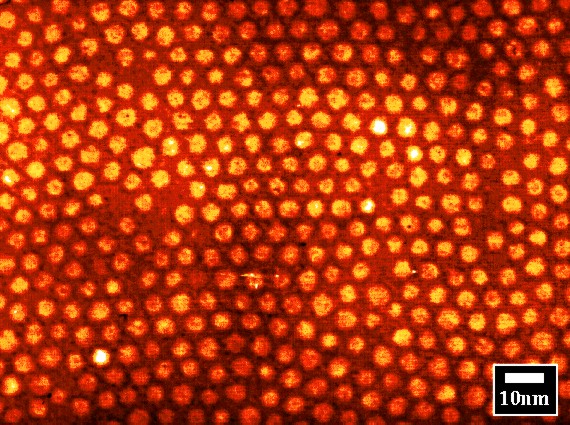 The
procedure is to first form a monolayer of gold nanocrystals of uniform
size which are kept from coalescing by encapsulating each gold cluster
in an insulating layer of dodecanethiol ((CH3)12-SH).
Next we use pi-conjugated molecules, with functional groups that bond strongly
to gold at both ends, to displace the single-ended dodecanethiols. Uniform
LCN's of up to 1µm x 1µm in area have been fabricated using
gold clusters and dithiol linking molecules. Their current-voltage characteristics
have been measured at different temperatures and shown to exhibit single-electron
charging effects even at room temperature. These measurements provide estimates
for the resistance of individual molecular wires that correlate well with
their theoretical model [1-3].
The
procedure is to first form a monolayer of gold nanocrystals of uniform
size which are kept from coalescing by encapsulating each gold cluster
in an insulating layer of dodecanethiol ((CH3)12-SH).
Next we use pi-conjugated molecules, with functional groups that bond strongly
to gold at both ends, to displace the single-ended dodecanethiols. Uniform
LCN's of up to 1µm x 1µm in area have been fabricated using
gold clusters and dithiol linking molecules. Their current-voltage characteristics
have been measured at different temperatures and shown to exhibit single-electron
charging effects even at room temperature. These measurements provide estimates
for the resistance of individual molecular wires that correlate well with
their theoretical model [1-3].
Our work at Purdue has shown that organic linking molecules can provide tight mechanical and electronic binding leading to stable and reproducible cluster networks that can carry large current densities (~ 106 A / cm2). This demonstration opens up numerous possibilities. While the LCN's studied to date involve gold clusters and a limited set of conjugated linking molecules, the synthesis, characterization, and modeling techniques that have been developed can be extended to LCN's with different cluster materials and linking molecules leading to many different applications in nanotechnology. For example, if the molecular wires can be doped, then the resulting low resistance LCN's could be used to implement molecular electronic devices or to form self-assembled interconnects for conventional electronic devices or to make ultra-sensitive chemical sensors. Alternatively, LCN's made with magnetic clusters could be useful for information storage while LCN's made with special organic molecules could have strong non-linear optical properties useful for optical limiters.
The above accomplishments have placed the Purdue group in a unique position to exploit the properties of electronically-linked cluster networks in applications of military and civilian interest. These include devices and materials which employ nanoscale elements to realize (1) local interconnects for integrated circuits with minimum feature sizes of less than 0.1 micron, (2) electronic devices with extremely high densities of computational or memory cells, (3) chemical sensors with high sensitivity and selectivity, and cluster-engineered materials with enhanced (4) optical and (5) magnetic properties. The research program will include characterization and modeling of nanoscale elements and LCN's for various applications and the development of synthesis techniques which could potentially allow low-cost fabrication.
To promote work in this area, the nanotechnology initiative will seek and obtain industrial participation; serve as a focal point for the development of nanotechnology and molecular self-assembly efforts in the mid-western states and Indiana in particular; broaden the nanotechnology effort at Purdue to include other faculty members; and develop new courses within the university that emphasize the multi-disciplinary nature of the science and engineering required for a successful career in the rapidly emerging new field of nanotechnology. Participating students will receive extensive training in many of the critical technologies identified by the U.S. Office of Technical Assessment.
References:
INTRODUCTION . RESEARCH GROUPS . RESEARCH TOPICS . PUBLICATIONS . RELATED GROUPS
21 JAN 99
Elton D. Graugnard