Traditional nuclear physics has been devoted to the study of nuclei which are gently perturbed. Using high energy beams of heavy nuclei (ions), we can create states of nuclear matter that are far removed from the ground state. For example, at sufficiently high densities and temperatures, neutrons and protons should "melt" into their constituent quarks and gluons, forming the so-called quark-gluon plasma (QGP). The density or temperature for this to happen is predicted by Quantum Chromodynamics (the fundamental theory governing the strong interaction) to be about 1 GeV/fm3 (~1012kg/cm3) or 170 MeV (~1012 oK). The QGP state is believed to have existed for the first 10 μsec of the universe after the Big Bang. The QGP may exist in the core of neutron stars. However, the only viable way to recreate the QGP in today's laboratory is to collide heavy nuclei at relativistic energies.
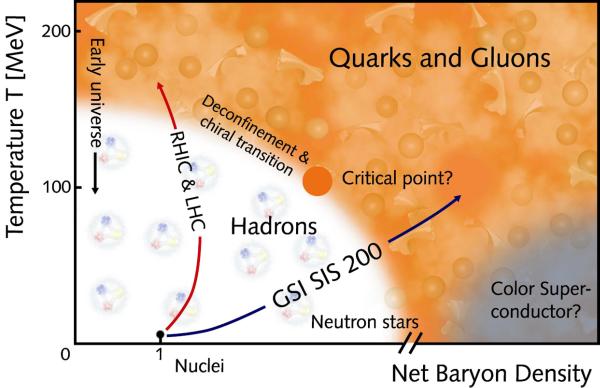
Creating and studying the QGP state will provide fundamental information about Nature. The Purdue High Energy Nuclear Physics (HENP) group is in the forefront of this exciting area of research. We create and study the QGP in experiments conducted at the Relativistic Heavy Ion Collider (RHIC) at the Brookhaven National Laboratory (BNL) and the Large Hadron Collider (LHC) at CERN. Heavy-ion beams are accelerated to nearly (> 99.99% of) the speed of light. A collision of these beams produces thousands of particles. We measure those particles with the STAR (Solenoidal Tracker At RHIC) and CMS (Compact Muon Solenoid at LHC) experiments. From the measurements we investigate the state of matter formed in the collisions between the high energy heavy ion beams.
In contrast to earlier beliefs, the QGP created in relativistic heavy ion collisions is strongly interacting. It behaves like a nearly perfect liquid where its shear viscosity to entropy density ratio is close to the conjectured quantum lower limit of 1/4π. The created QGP can be described by macroscopic thermodynamic quantities and hydrodynamics. The QGP is sufficiently opaque to energetic gluons and light and heavy quarks due to their strong interactions with the QGP, so that high momentum quarks and gluons are strongly attenuated. We are a world leading group in the measurements of collective hydrodynamic flow and jet correlations arising from energetic gluons and light and heavy quarks.
In order to make precision measurements of jet interactions with the QGP, we are participating in the sPHENIX experiment, a new detector planned for the RHIC facility at BNL. It will provide state-of-art capabilities for studies of the strongly interacting quark-gluon plasma using jet and heavy-quark observables.
The field is also planning on a future collider facility, the Electron-Ion Collider (EIC) at BNL to use electron beam to probe the gluon distributions in the proton and nuclei.